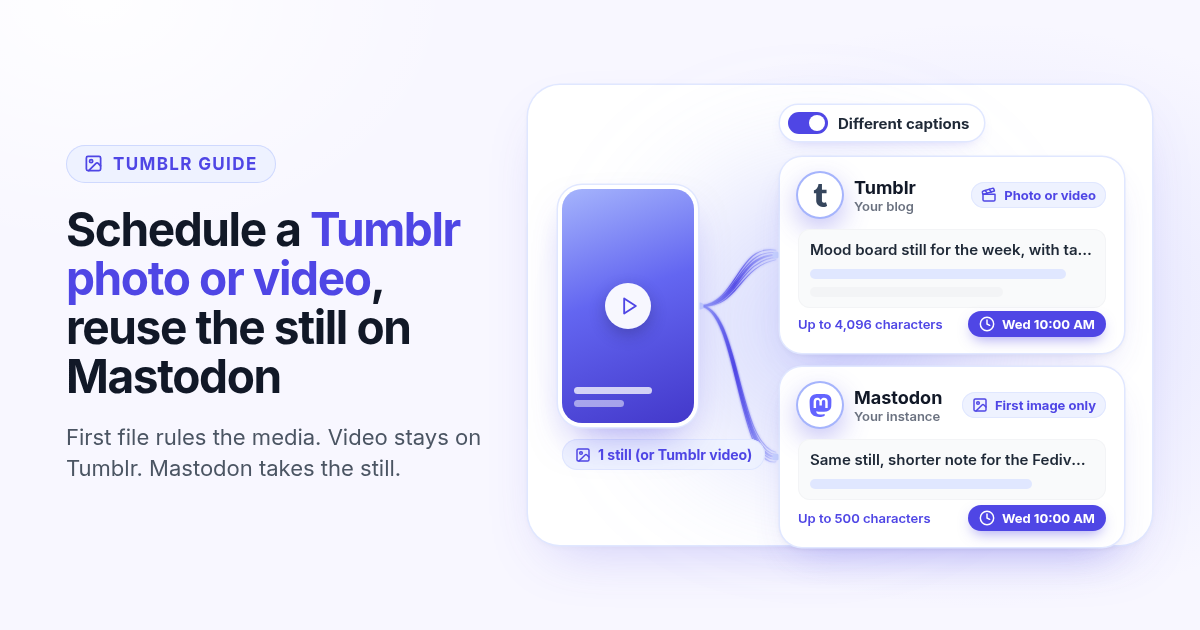
Tumblr still has a queue, and for one blog that is often enough. The gap shows up when the same photo or clip should also land on Mastodon (or Bluesky) while you are offline. Tumblr's queue is Tumblr only. A multi-network scheduler is useful when you want one file, two captions, and one time on the calendar.
This guide shows how to schedule a Tumblr photo or video with Postlaty, and how to reuse the still on Mastodon without promising a video that will never publish there. Connect Tumblr with an Allow popup, connect any Mastodon server with an access token, attach the first media file, write a caption for each network, then pick one time. The Tumblr channel page has the short product version; this article is the weekly routine around the media split.
If you already live in Tumblr's editor, keep that muscle for drafts and reblogs. The scheduler job is narrower: ship the public photo or clip on time, then mirror the still where the Fediverse audience actually reads. That split is boring on purpose. Boring is what stops half-published posts.
Why schedule Tumblr together with Mastodon
Tumblr and Mastodon both reward a clear still and a short note. People who left X often keep a Tumblr blog for longer posts or reblogs, and a Mastodon account for the Fediverse timeline. Writing the idea twice and uploading the file twice is where mornings disappear. A shared queue does not remove judgment about tone. It removes the double login, the double upload, and the sticky note that said "also Mastodon at 9."
Same idea, two homes
A launch note, a mood board still, or a short clip can live on Tumblr and as a Mastodon status when the media rules match.
One calendar
Tumblr’s queue does not see your Mastodon server. A shared week view catches gaps and double posts before they go live.
Video is the trap
Tumblr can take a video block. Mastodon in Postlaty takes the first image and skips video. Plan the still first when both should show media.
Captions are not clones
Tumblr allows a long caption (up to 4,096 characters in the composer). Mastodon sits at 500. Write two versions on purpose.
Roundup posts that list five "best Tumblr schedulers" rarely explain that split. They compare feature grids. Your week fails when Mastodon goes out as text-only because the first file was a clip meant for Tumblr. Get the media rule right before you care which logo wins a comparison table.
If you only post to Tumblr, stay on Tumblr’s queue. Pay for a scheduler when you cross networks, need a week view next to Instagram or LinkedIn, or want an agent to draft the caption through REST or MCP after the accounts are connected.
Founders who treat Tumblr and Mastodon as "the same post twice" usually burn an hour on tiny differences: character limits, whether the still uploaded, which blog or server is connected, and whether a clip belongs on both. A single queue does not erase those differences. It surfaces them in one composer so you decide once per post instead of once per app.
Tumblr's own queue, in short
Tumblr lets you queue posts inside the blog. That is the free baseline, and it is the right tool for a Tumblr-only week. Treat it the same way you treat LinkedIn’s native scheduler or X’s calendar icon: use it until the job outgrows one network.
Queue and schedule live inside Tumblr for the blog you are logged into. One place, one network, no extra bill.
Photo, video, text, quote and the rest of Tumblr’s post types stay in Tumblr’s editor. A third-party tool will not recreate every post type one for one.
The queue is a Tumblr list. It will not show your Mastodon, Bluesky or LinkedIn slots next to it, so cross-network gaps stay invisible.
Keep using that queue when Tumblr is the only destination. Switch when the same file should leave Tumblr and hit another network at a set time, or when you want replies from several networks in one Inbox after the post goes live.
Connect Tumblr and Mastodon
Two connections, two credential shapes. Do this once, then the composer can see both channels every time you open Create.
Tumblr: Allow popup
Open Connect, pick Tumblr, and finish the OAuth Allow flow. The connection is one blog. For a second blog, add another account or reconnect. Details live on the Tumblr page.
Mastodon: server + token
Enter your instance URL and an access token with permission to post. Any Mastodon server works. See the Mastodon page for the short version.
Inbox after publish
Tumblr replies can land in Comments, and mentions in Mentions, when the token allows. There are no Tumblr DMs. Mastodon replies and mentions sync the same way as other Fediverse connections.
Bluesky is a third option if you want the still on AT Protocol too. Connect with a handle and app password, then add it as another channel on the same post. Media rules for Bluesky (up to four images, or video) are covered in the Bluesky and Mastodon cross-post guide. Pixelfed is photo-required if you want a third Fediverse home for the still; it will not take a text-only status.
Photo vs video: what each network actually gets
This is the part most Tumblr scheduler listicles skip. Postlaty sends Tumblr text plus the first image or the first video. Mastodon gets the first image only; a video file is not uploaded there. The publisher path is intentional: Tumblr’s NPF content array can hold a text block and an image or video block from that first file. Mastodon’s media upload runs only when the first file is an image.
Photo first: attach one still as the first file. Tumblr posts an image block. Mastodon uploads that same still. Extra images after the first are not sent to either network in this path.
Video first: Tumblr gets a video block from the first file. Mastodon skips the video, so the Mastodon side goes out as text only unless you attach a still instead.
Want both a clip and a Fediverse still? Schedule the video to Tumblr alone, then a separate post with the still to Mastodon (and Bluesky if you use it). One calendar, two posts, honest media.
Generate the still in Create with Recraft, Flux, or Nanobanana when you do not have a photo yet. Name the models you actually use in the trial so you know which look you like before you queue a week. If you already shoot on a phone, export one clean frame as the Mastodon still and keep the full clip for Tumblr.
Analytics after the fact stay per network: Tumblr posts show through the connected blog; Mastodon posts show through the instance. Do not expect one blended "engagement" number across both. Read each side for a week before you change the posting times.
Schedule the Tumblr and Mastodon pair
Once both accounts are connected, the weekly motion is short. Batch on a computer, then answer early replies from wherever you already check Inbox.
- 1
Open Create and pick both channels
Select the Tumblr blog connection and the Mastodon account. Add Bluesky only if the still should go there too.
- 2
Attach the first media file
Use a photo when both networks should show media. Use a video only when Tumblr is the media destination for this post.
- 3
Turn on Different captions
Write a longer Tumblr caption if you need it. Keep Mastodon inside 500 characters. Drop Tumblr tags that do not belong on Mastodon.
- 4
Pick one time and schedule
Check the week view so the slot is free on both. After it publishes, skim Comments for early replies.
Starter is $29 a month for 10 channels, Pro is $39 for 20, Premium is $49 for 50. Inbox, AI models, agents and templates sit on every plan. Yearly billing gives two months free on the same limits. The 7-day free trial is enough to connect Tumblr, connect Mastodon, and confirm a photo post lands on both sides at the time you picked.
A practical week for a founder who still likes Tumblr: three photo posts to Tumblr and Mastodon on the same times, one Tumblr-only video mid-week, and one quieter day for replies. That pattern respects the media rules without turning the calendar into a spreadsheet.
Agents can create the same scheduled post after the accounts are connected. Use REST or MCP from Cursor, Claude, or ChatGPT to draft the caption and set the time, then review the week view before anything goes live. The human check stays on the media file: photo for the pair, video for Tumblr alone.
Captions that fit each feed
Tumblr culture still likes tags and a longer note under the media. Mastodon prefers a shorter status and fewer hashtag piles. Different captions exists so you do not paste a Tumblr essay into a 500-character box. The Same captions toggle is fine for a one-line announcement. Everything else deserves two boxes.
Tumblr caption
Lead with the hook under the photo or clip. Keep tags useful. You have room (up to 4,096 characters in the composer) but readers still skim on a phone.
Mastodon caption
One clear sentence, optional second line, then stop. Mention the server-local context if it matters. Skip Tumblr-only tags and long link dumps.
Alt and clarity
Make the still readable at phone width. Screenshots need a crop. If the image carries the point, say so in the first line of the caption on both sides.
When you add Bluesky to the same post, trim again. Bluesky’s composer limit is 300 characters. The hook that fits Tumblr will not fit Bluesky unchanged. Three captions for three cultures is normal; one caption for three networks is how posts look pasted.
Limits to know before you queue a week
Honest limits save retries. These are the ones that matter for Tumblr and Mastodon in Postlaty today:
First file only on Tumblr: text plus one image or one video. Carousels of several Tumblr photos are made in Tumblr, not in this composer path.
Mastodon skips video in Postlaty. A Tumblr video post will not automatically become a Mastodon video.
One Tumblr blog per connection. One Mastodon server token per connection. Plan channels the way you plan brands.
No Tumblr DMs in Postlaty. Replies and mentions are the inbox path when the token allows.
Those limits are product facts, not marketing footnotes. Build the week around a still when you cross-post, and keep Tumblr video for Tumblr-only slots. If a workflow depends on Tumblr post types Postlaty does not send (quotes, chat posts, multi-photo sets), keep that work in Tumblr’s editor and only schedule the photo or video posts that fit the composer.
Channel counts matter once you add Instagram, LinkedIn, or a second Tumblr blog. Starter’s 10 channels are enough for a personal blog, one Mastodon server, and the main public networks. Move to Pro or Premium when the mix of blogs and brand accounts crosses that line, not because Tumblr alone needs a higher plan.
The bottom line
Use Tumblr’s queue when Tumblr is the only destination. Use a scheduler when the same photo should also reach Mastodon (or Bluesky) at a set time, with a caption written for each feed. In Postlaty that means: connect the blog, connect the server, attach the first file on purpose, write two captions, schedule once. Put the video on Tumblr alone when Mastodon should not go out as text-only by accident.
Start with one photo post to both networks during the trial. If the still arrives on Tumblr and Mastodon at the time you picked, the rest of the week is the same motion: batch the stills, isolate the clips, answer the first replies from Inbox.
More on nearby networks: Bluesky, Mastodon, Tumblr, and the Bluesky and Mastodon guide.
FAQ
Frequently Asked Questions
Yes. Connect Tumblr with an Allow popup, pick the blog, then schedule text plus the first image or the first video. Extra files after the first one are not sent.
No. Mastodon in Postlaty publishes the first image and skips video. Keep a still as the first file when both networks should show media, or schedule the video for Tumblr alone.
Yes. Each Tumblr connection is one blog. Add another account (or reconnect) for a second blog. Mastodon is one server token per connection.
Replies can show in Comments and mentions in Mentions when the token allows. There are no Tumblr DMs in Postlaty.
Tumblr's queue is Tumblr only. A scheduler puts the same idea on Tumblr and Mastodon (or Bluesky) from one calendar, with a caption written for each network.
Yes. Postlaty has a 7-day free trial. Connect Tumblr and a Mastodon server, schedule a photo post to both, and check that the image arrives on each side.
Blog
More articles
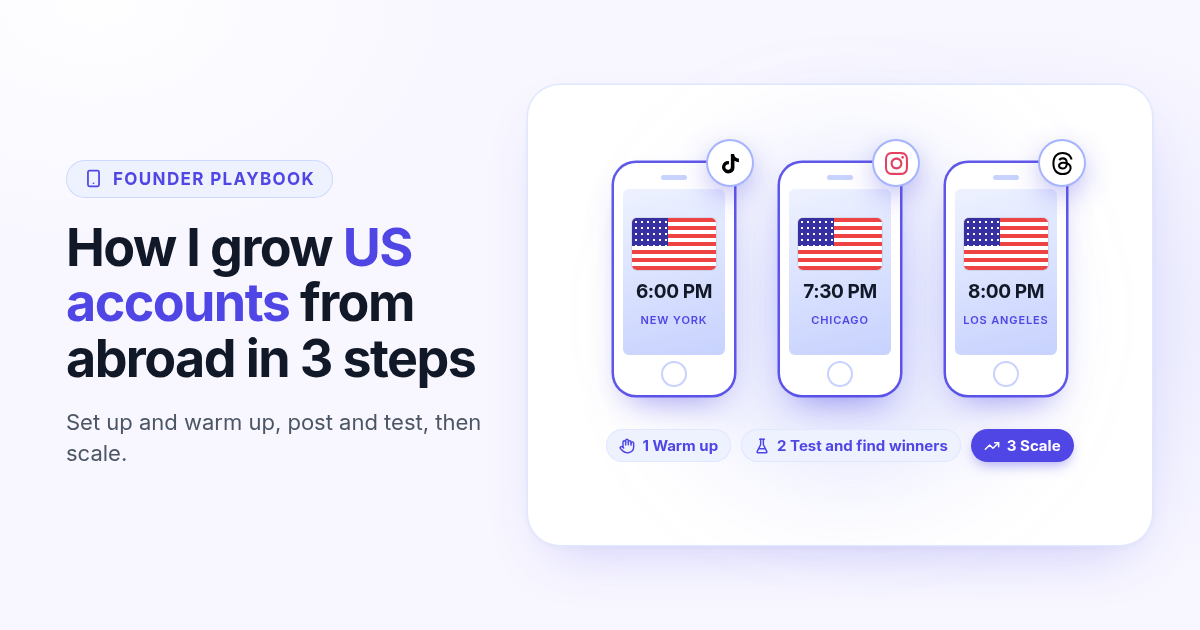
How I grow US TikTok accounts from abroad in 3 steps
I do not live in the US, but I grow accounts for a US audience. My 3 step playbook: set up and warm up a cheap dedicated phone, post and test for 30 days, then scale only the winners.
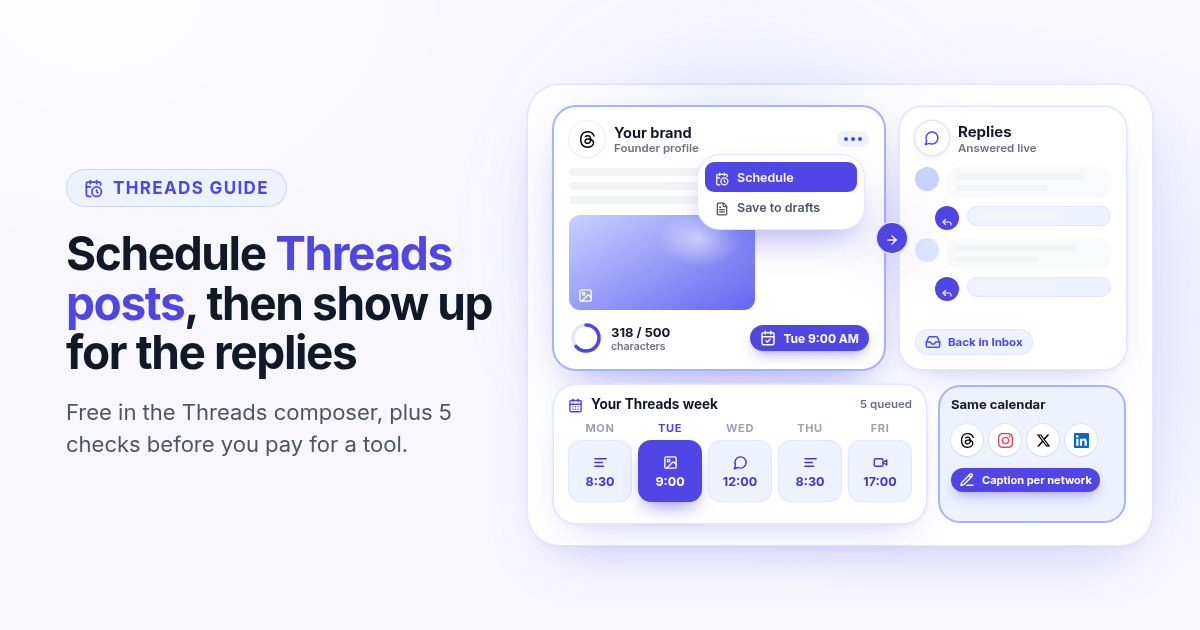
Threads scheduler in 2026: how to schedule Threads posts for free, and when a tool is worth it
Threads has a free scheduler in the composer three dot menu. How to use it step by step, where it stops (one profile, no week view, Threads only), five checks to run on any Threads scheduling tool, and a weekly routine built around replies.
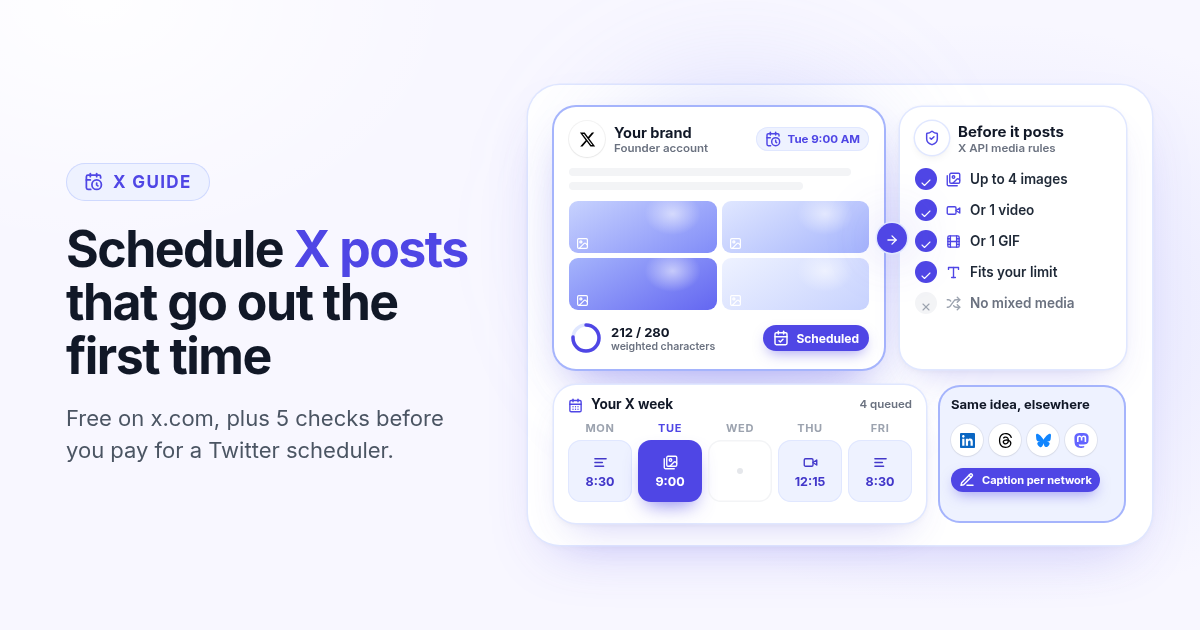
Twitter scheduler in 2026: how to schedule X posts for free, and 5 checks before you pay
X still has a free scheduler: the calendar icon in the x.com composer. How to use it step by step, where it stops (one account, no week view, no long posts on the web), and five checks to run on any paid Twitter scheduler during the trial.
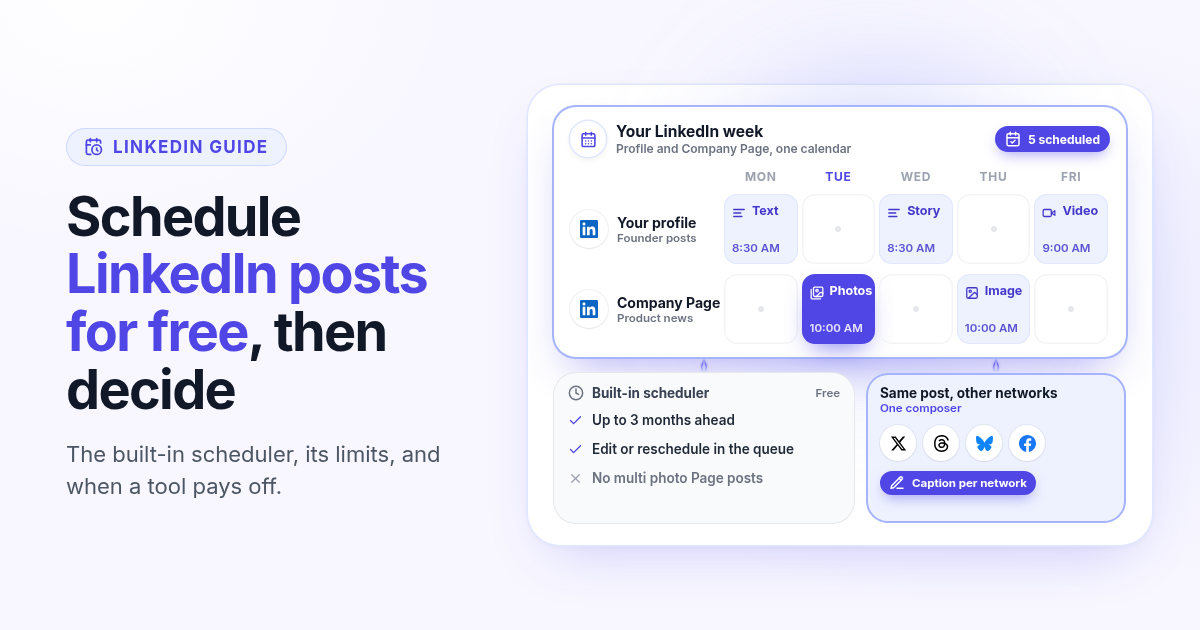
How to schedule LinkedIn posts for free in 2026 (and when a paid tool is worth it)
LinkedIn's own scheduler is free: profile posts from 10 minutes to 3 months ahead, Company Page posts from 1 hour. How to use it step by step, what it cannot schedule, and five signs a paid LinkedIn scheduler is worth it.
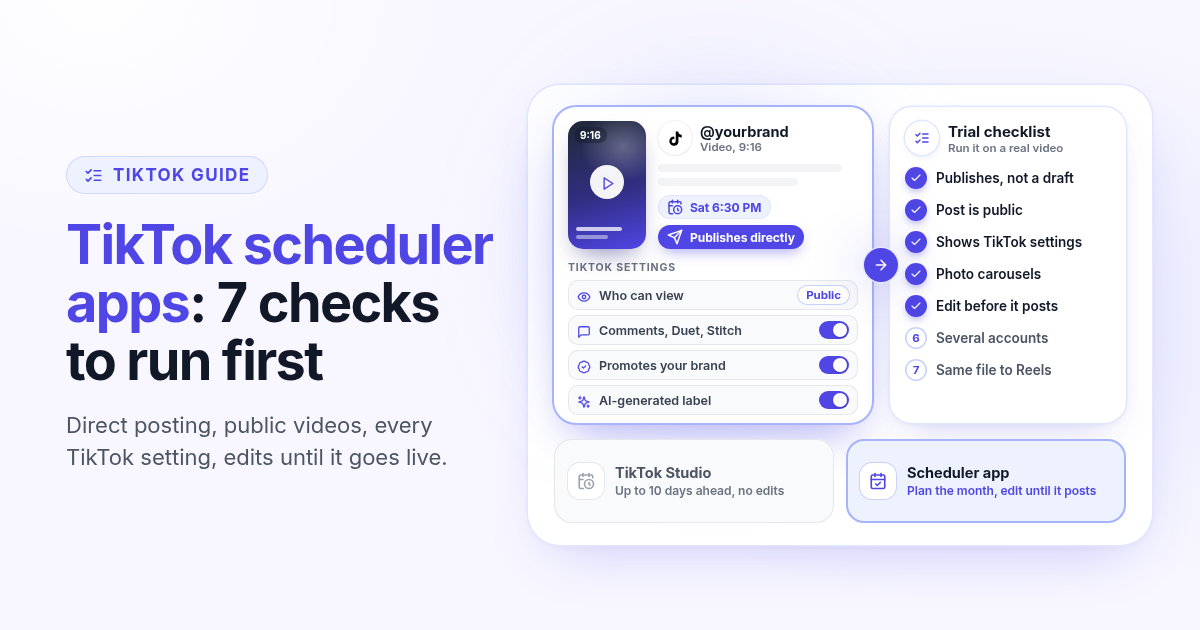
TikTok scheduler apps in 2026: 7 checks before you trust one with your videos
What TikTok Studio already schedules for free, and seven checks to run on any TikTok scheduler app during the trial: direct posting, public visibility, TikTok settings, photo posts, editing, multiple accounts and cross posting.
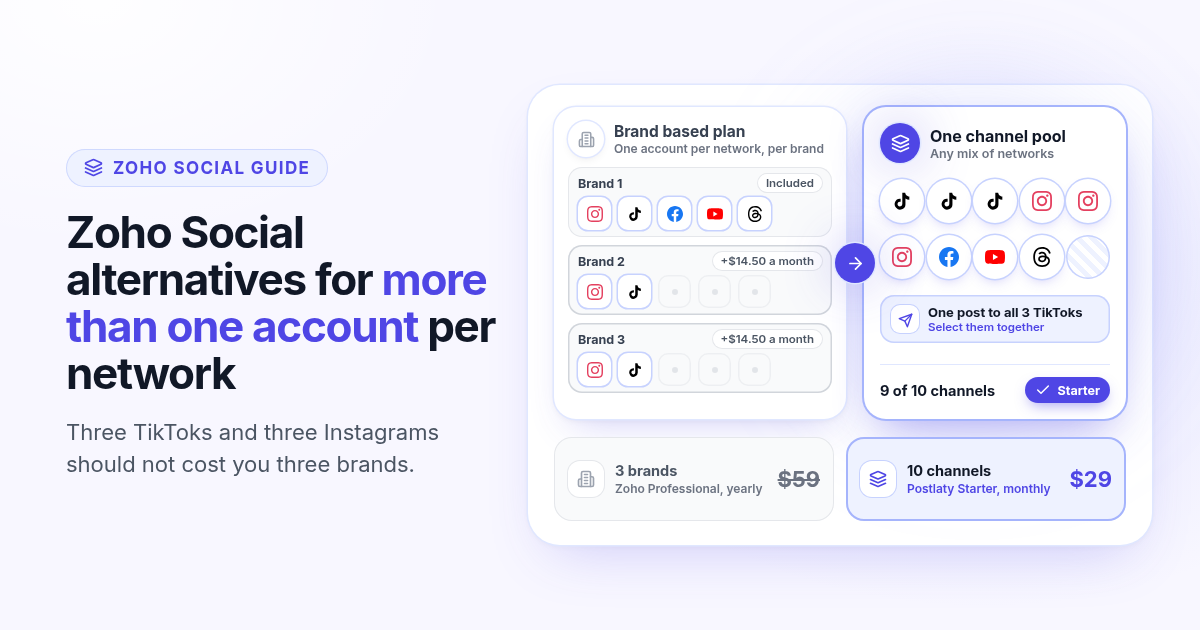
Zoho Social alternatives in 2026: when you run more than one account per network
Zoho Social prices by brand, and a brand holds one account per network. How Zoho Social pricing works in 2026, what three TikToks and three Instagrams really cost, and what to look for in an alternative priced by channels.
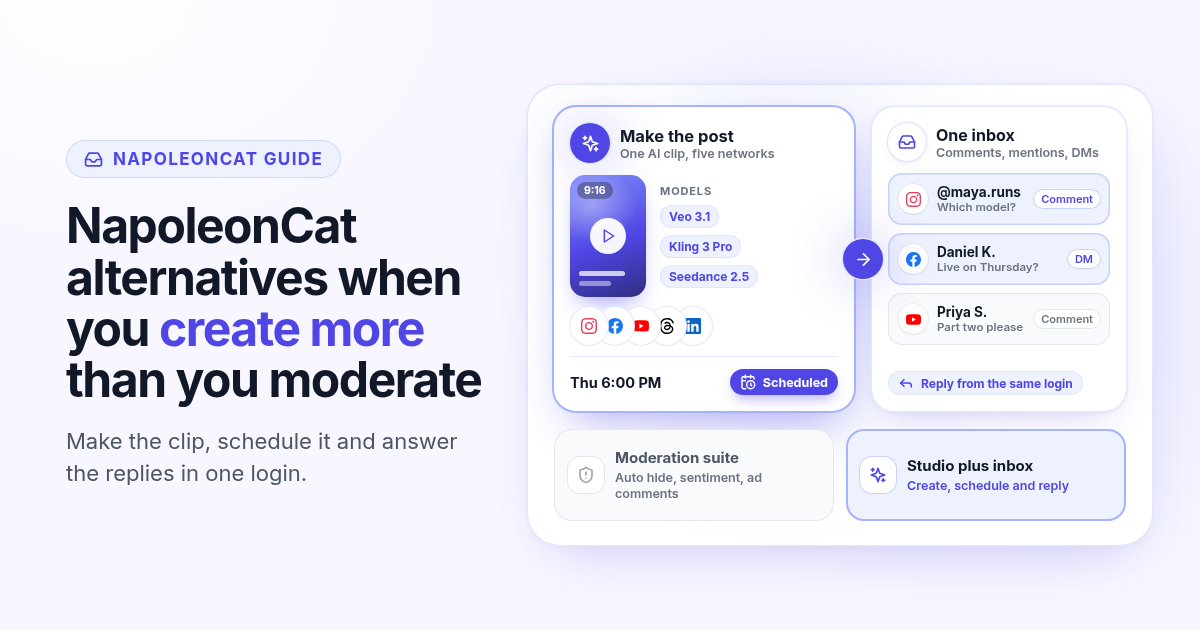
NapoleonCat alternatives in 2026: when you create more than you moderate
NapoleonCat is a strong moderation and inbox suite priced by users and profiles. If you spend more time making posts than moderating comments, here is what its 2026 pricing covers and what to look for in an alternative.
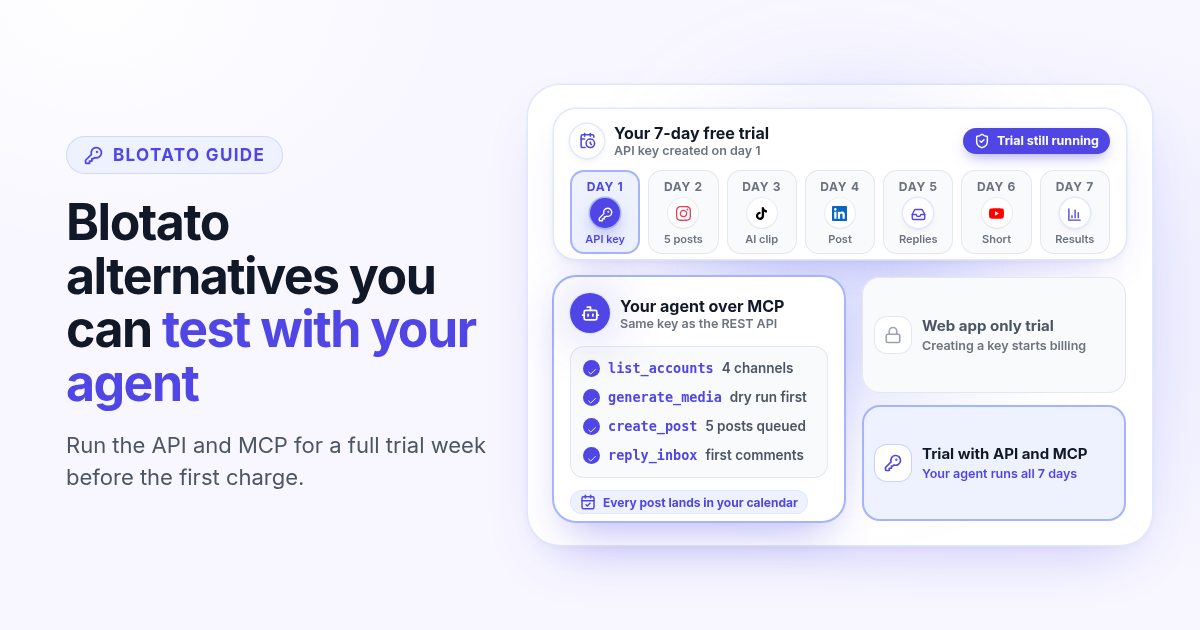
Blotato alternatives in 2026: when you want to test the API before you pay
Blotato starts at $29 a month for 20 accounts, but its free trial leaves out the API and MCP. How Blotato pricing works in 2026, why creating an API key ends the trial, and what to test in an alternative when an agent posts for you.
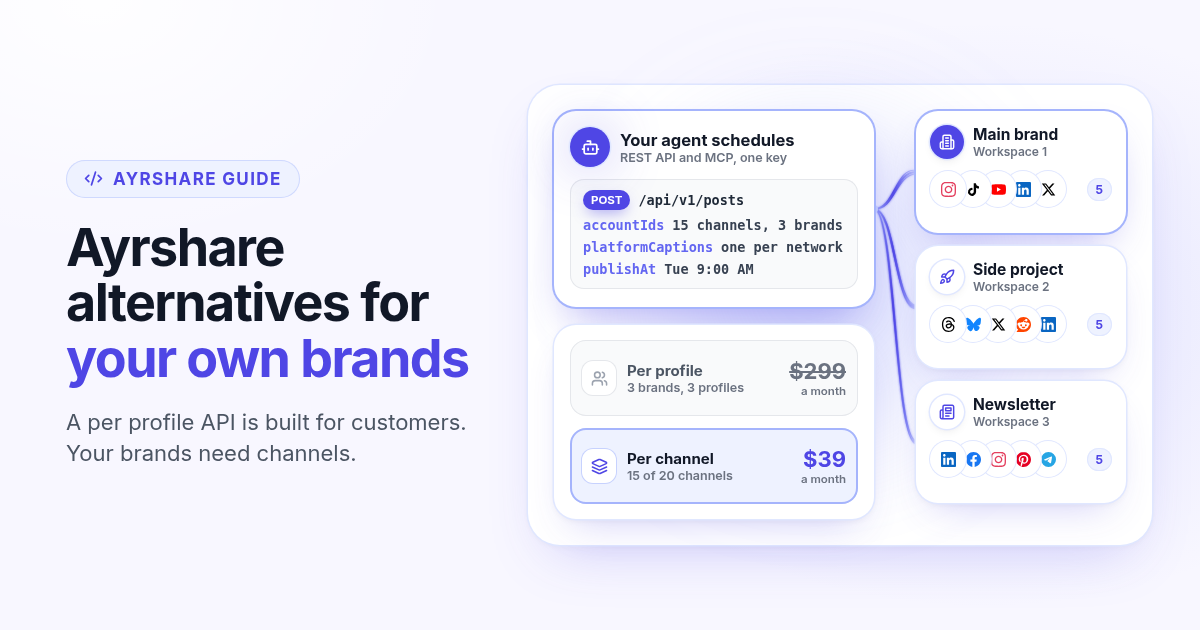
Ayrshare alternatives in 2026: when you post for your own brands, not customers
Ayrshare is a social media API billed per profile, from $149 a month for one. How Ayrshare pricing works in 2026, why profiles and channels lead to very different bills when the brands are yours, and what to test in an alternative with API and MCP on every plan.
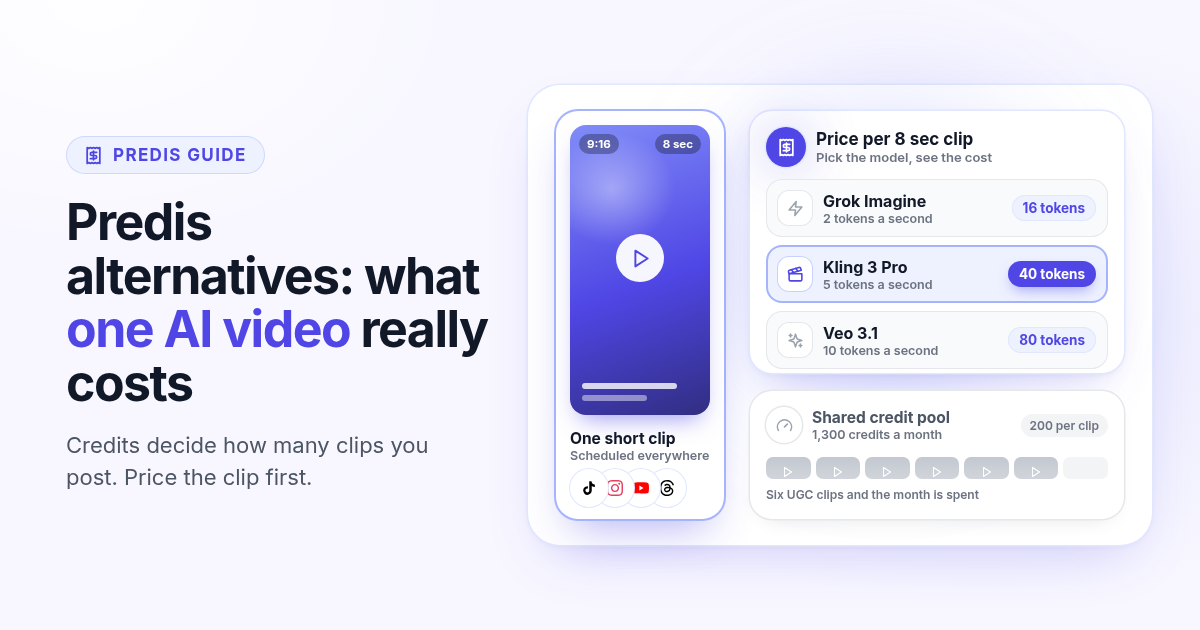
Predis alternatives in 2026: what one AI video really costs you
Predis.ai starts at $19 a month billed yearly, but credits decide how many AI videos you get. How Predis pricing works in 2026, what one clip costs on each plan, and how to price a real week of video in an alternative before you switch.
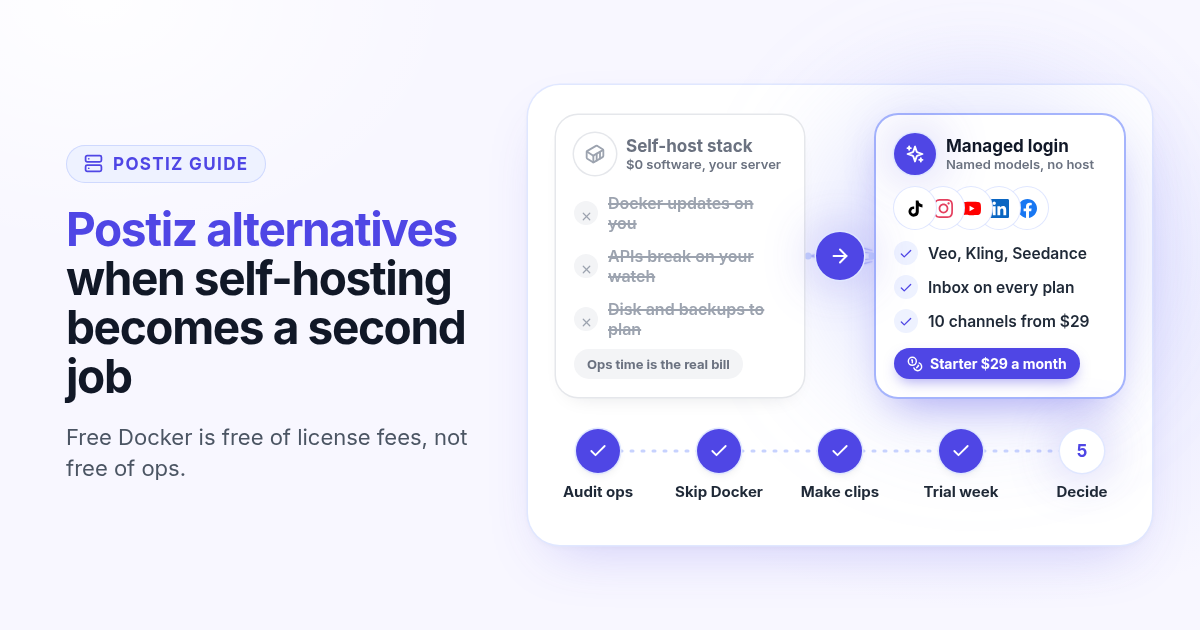
Postiz alternatives in 2026: when self-hosting becomes a second job
Postiz is a strong open-source scheduler with a free Docker install and hosted plans from $29. How Postiz pricing works in 2026, when self-hosting costs more than the bill, and what to test in a managed alternative with named AI video and inbox on the first plan.
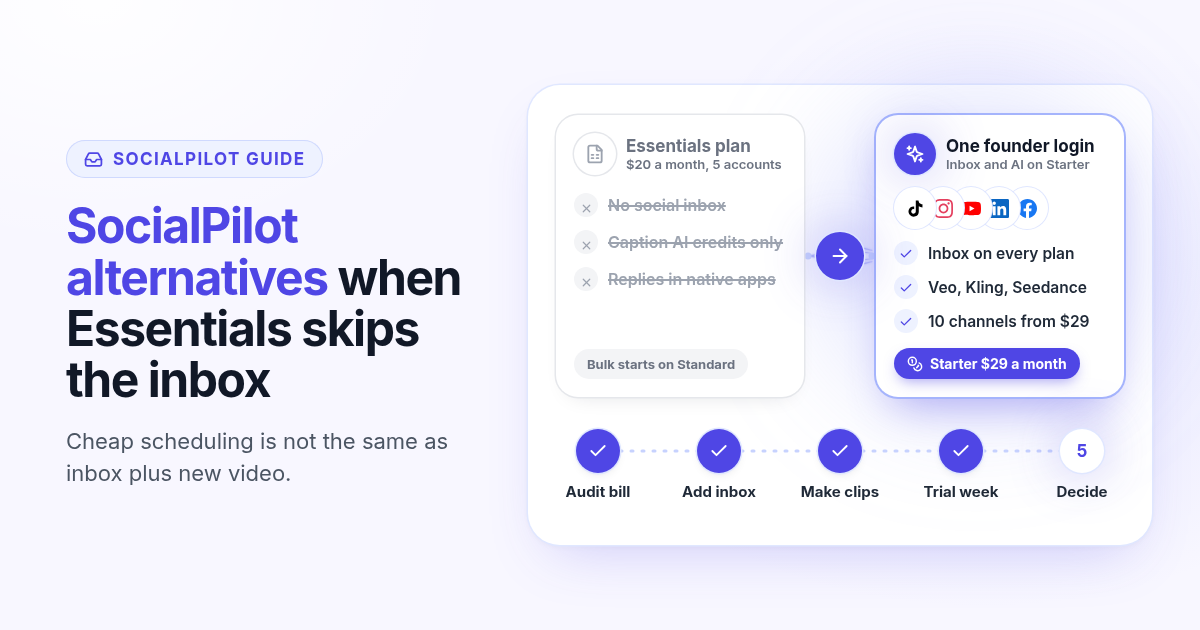
SocialPilot alternatives in 2026: when the cheap plan skips the inbox
SocialPilot Essentials is $20 a month for 5 accounts, but the inbox starts on Standard at $40. How SocialPilot pricing works in 2026, when bulk scheduling is enough, and what to test in an alternative that includes inbox and AI video on the first plan.
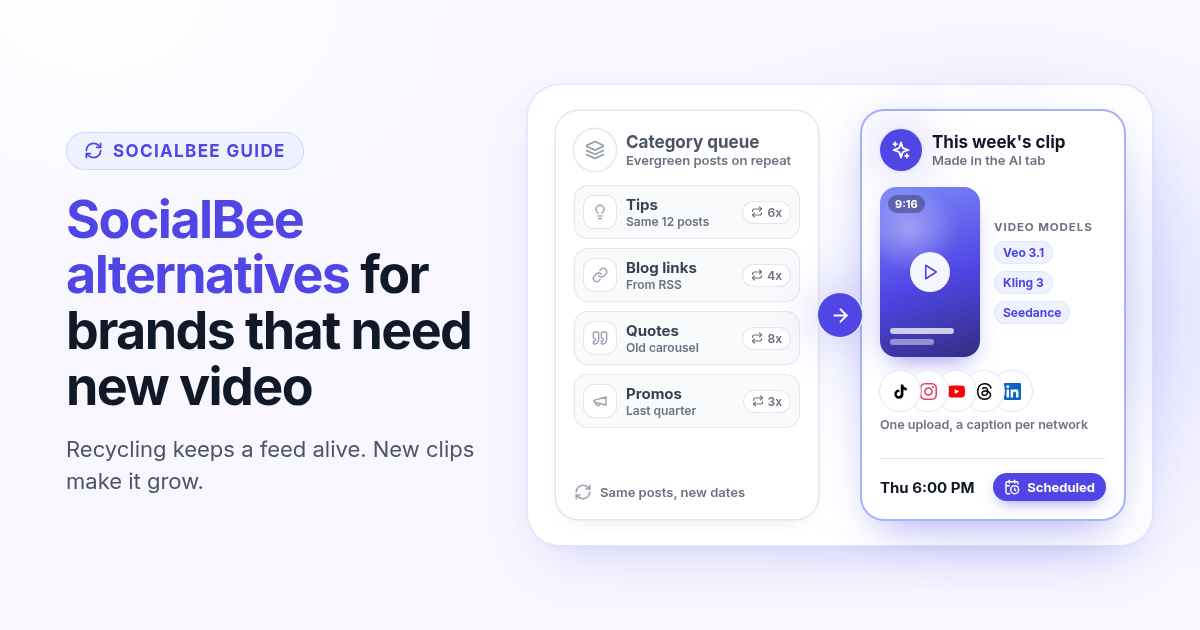
SocialBee alternatives in 2026: when recycled posts stop growing your accounts
SocialBee recycles evergreen posts by category, which keeps a feed active but rarely grows it on TikTok, Reels and Shorts. How SocialBee pricing works in 2026, how to audit your queue, and what to test in an alternative that makes new video.
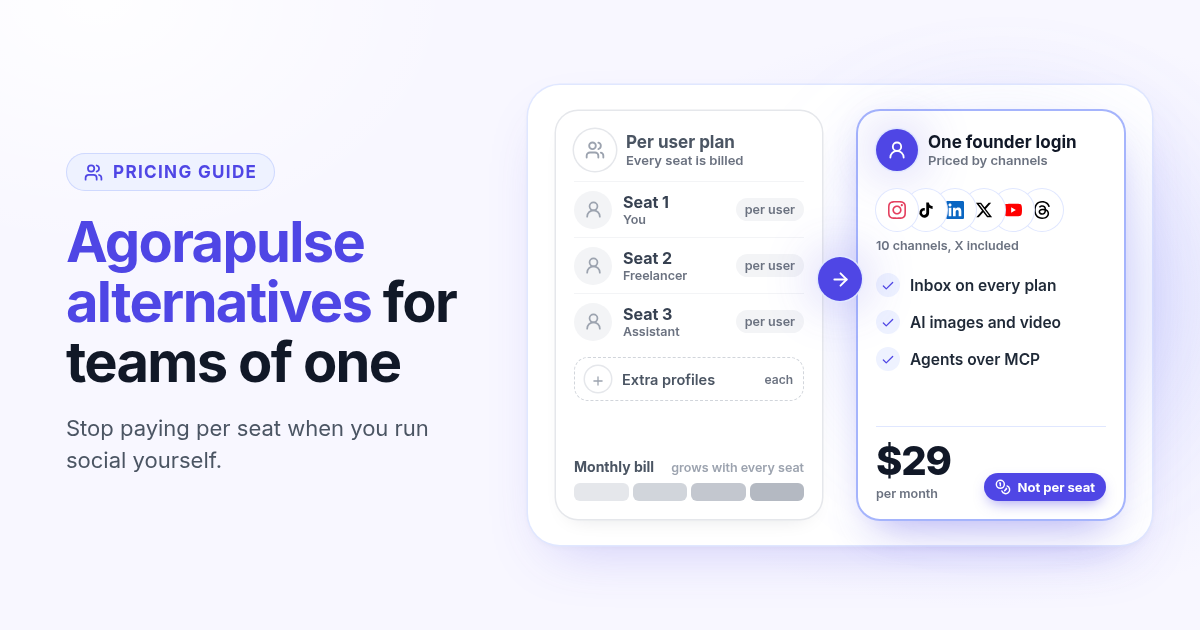
Agorapulse alternatives in 2026: when you pay per seat but post alone
Agorapulse prices every plan per user, which suits social teams more than founders. See how its pricing works in 2026, check which features you really use, and know what to test in any Agorapulse alternative before you switch.
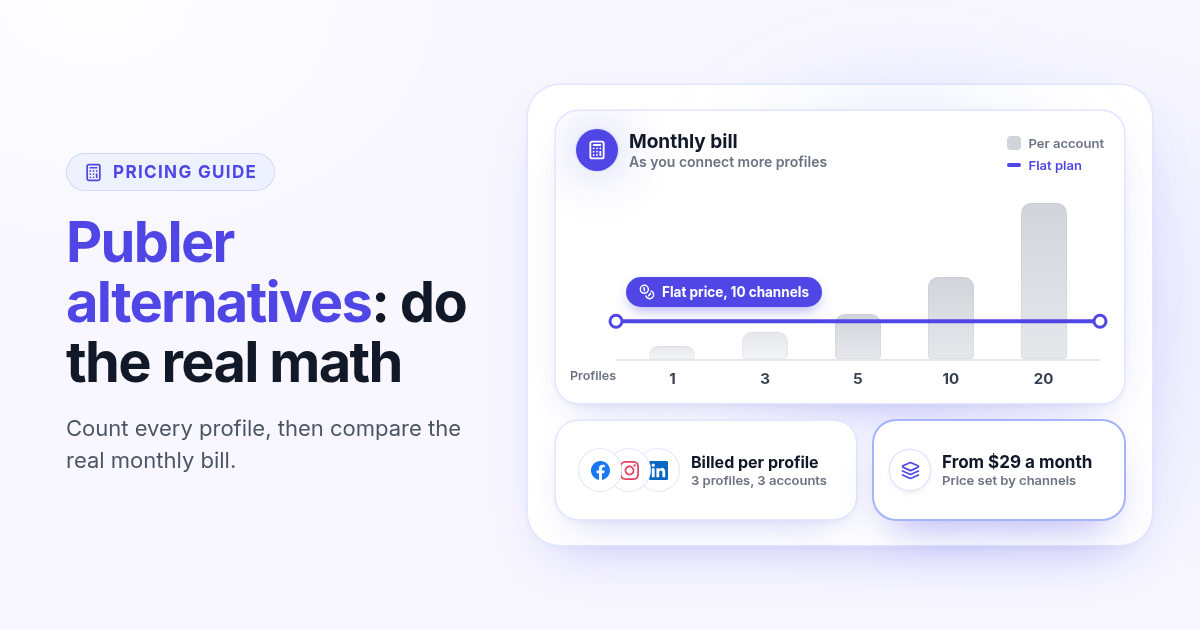
Publer alternatives in 2026: when per account pricing stops paying off
Publer bills per social account, so the price climbs with every Page and profile. Count what you really pay, spot the five signs you have outgrown it, and know what to test in any Publer alternative before you switch.
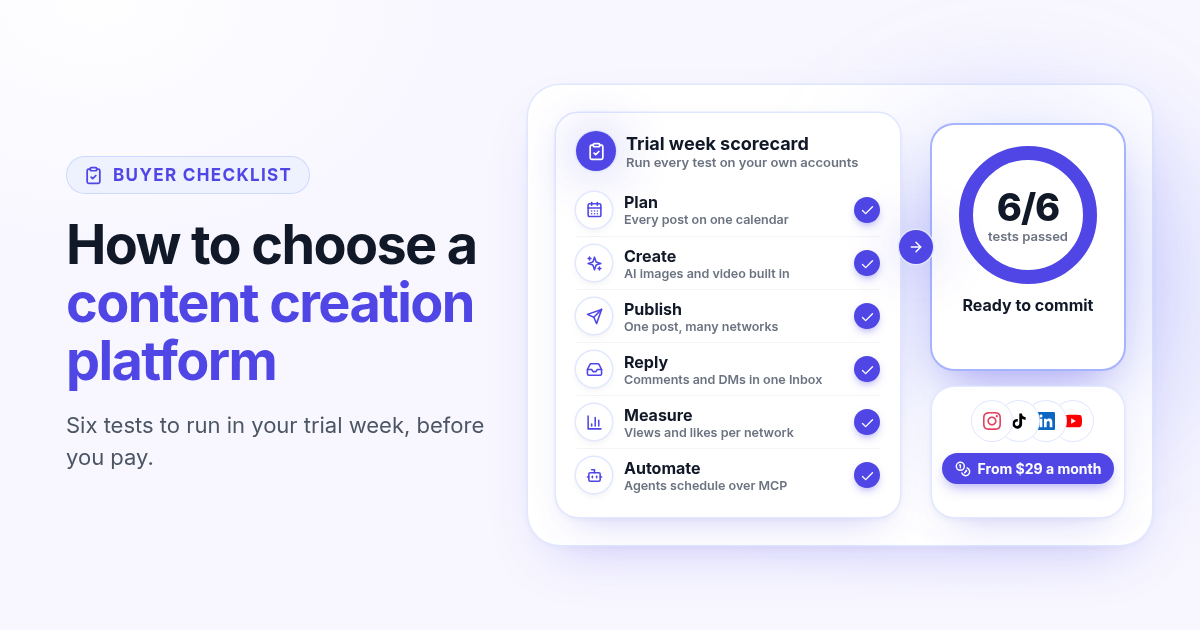
How to choose a content creation platform: 6 tests to run before you pay
A founder checklist for picking a content creation platform: add up the stack you pay for, then use a 7-day trial to test planning, AI images and video, publishing to every network, one Inbox for replies, per network numbers and AI agents.
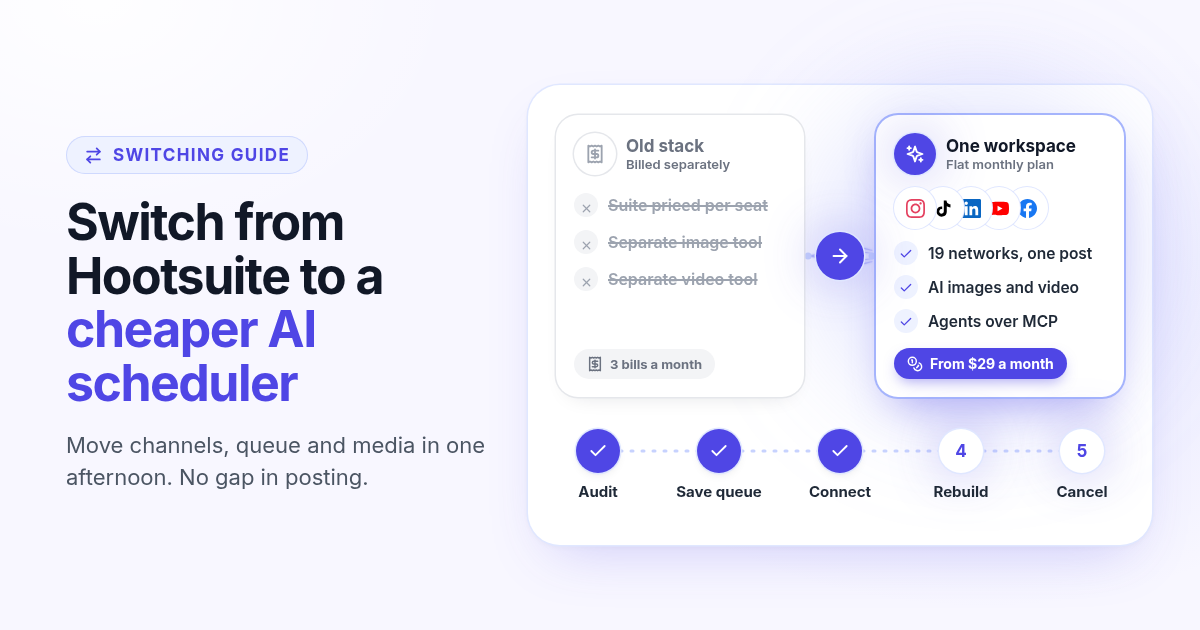
How to switch from Hootsuite to a cheaper AI scheduler in one afternoon
A step by step plan to leave Hootsuite without a gap in posting: audit what you use, save your queue and media, connect your channels, rebuild two weeks of posts, add AI images, video and agents, then cancel before renewal.
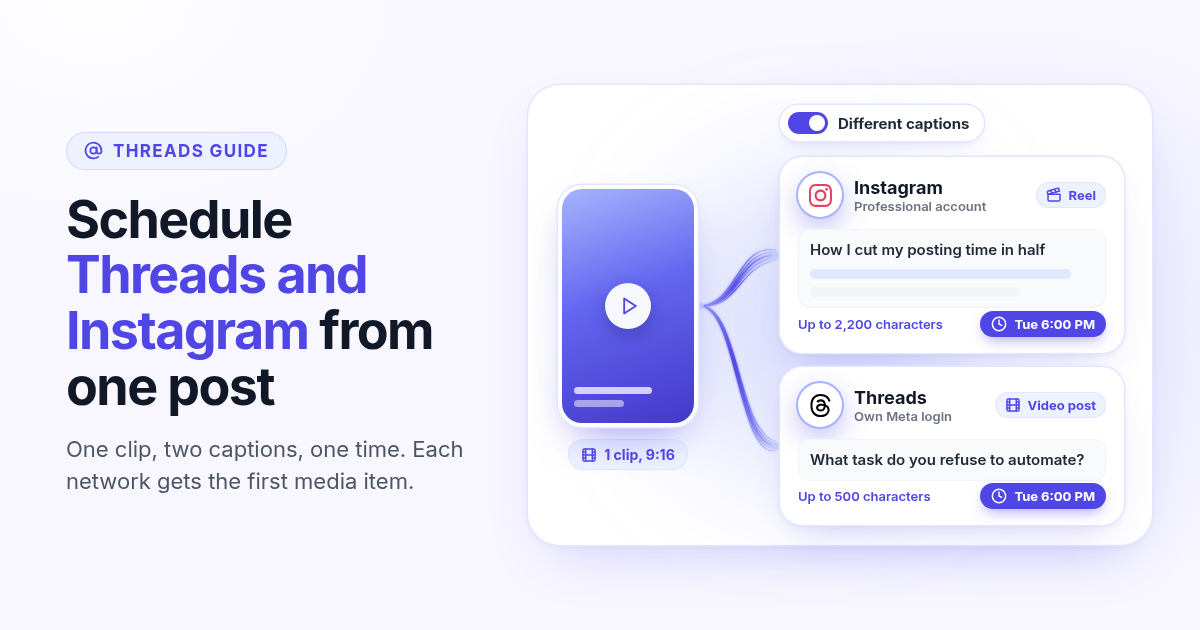
How to schedule Threads and Instagram together from one post
Schedule a Reel or photo to Instagram and Threads at the same time from one post. Connect both Meta accounts, attach one file, write a long Instagram caption and a short Threads caption, and pick one time.
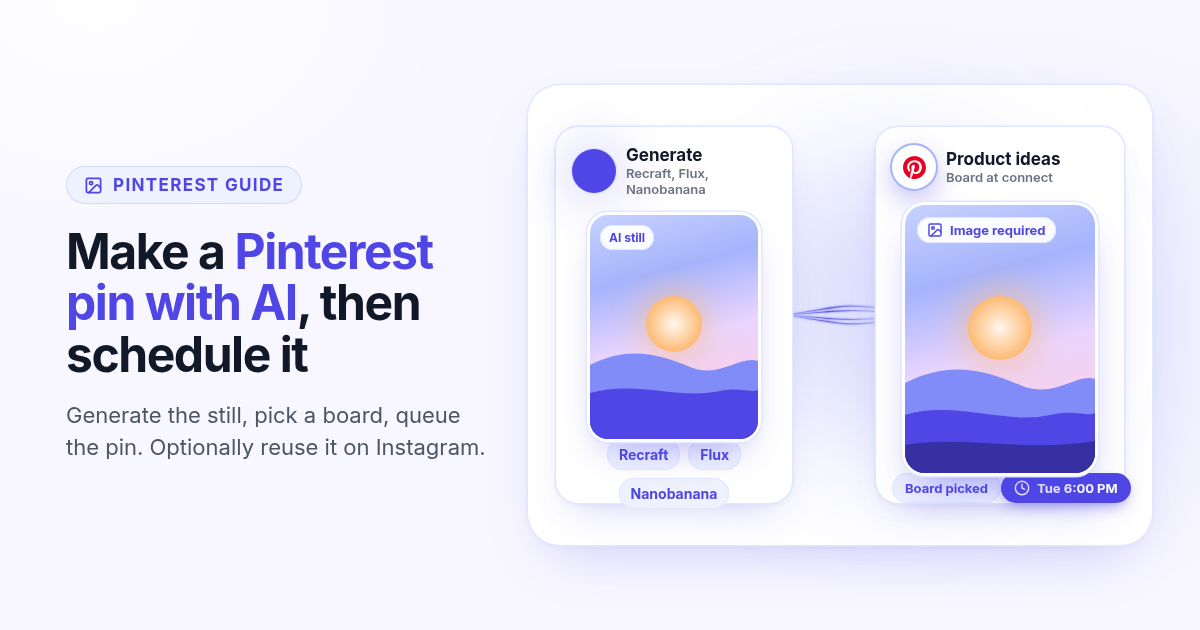
How to make a Pinterest pin with AI and schedule it to a board
Generate a Pinterest pin image with Recraft, Flux, or Nanobanana, pick a Business board at connect, and schedule the pin from Create. Image required. Optionally reuse the still on Instagram.
How to schedule a Dev.to article and the posts that point to it
Schedule a Dev.to article and the short X, LinkedIn, or Bluesky posts that point to it from one queue. Connect with an API key, write the title and body, then ship pointers instead of pasting the markdown.
How to schedule a Discord announcement and the public post together
Schedule a Discord announcement and the matching Instagram and X post from one queue. Add the bot to your server, pick the channel, send text to Discord and the visual to the public networks.
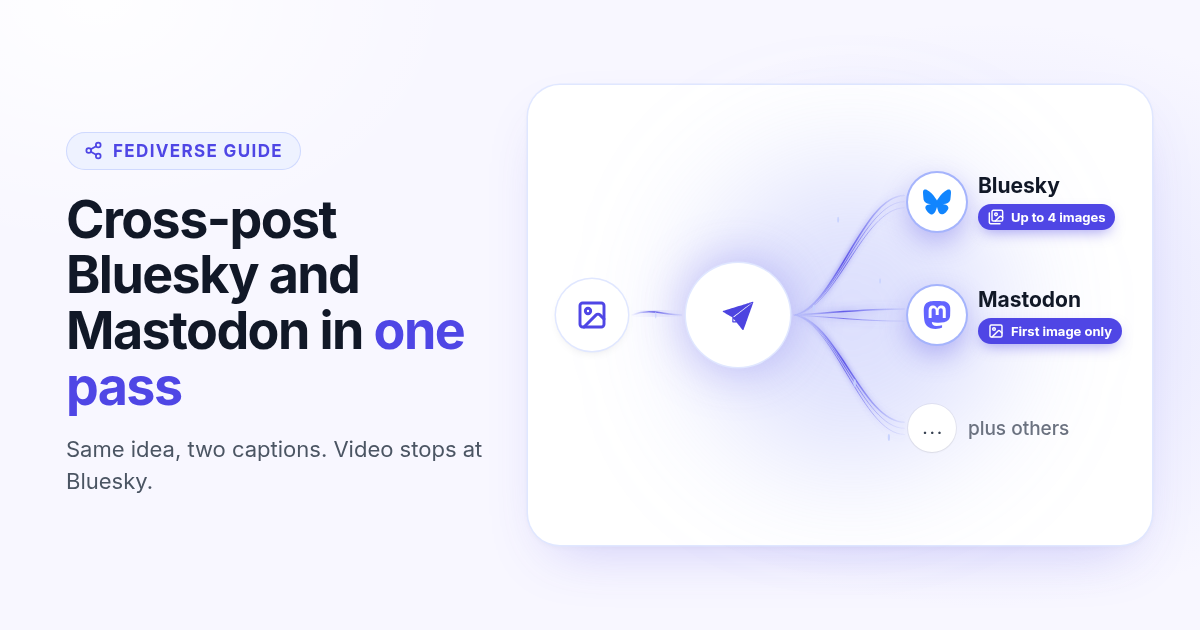
How to cross-post to Bluesky and Mastodon (and where video fails)
Cross-post Bluesky and Mastodon from one composer. Connect with an app password and a server token, share one still, and know why a Bluesky video will not publish as Mastodon video.
How to schedule Telegram channel posts as yourself (not as a bot)
Native Telegram schedule works for one message. Most tools post as a BotFather bot. Here is how to connect with your phone, pick a chat, and schedule posts as yourself with Postlaty.
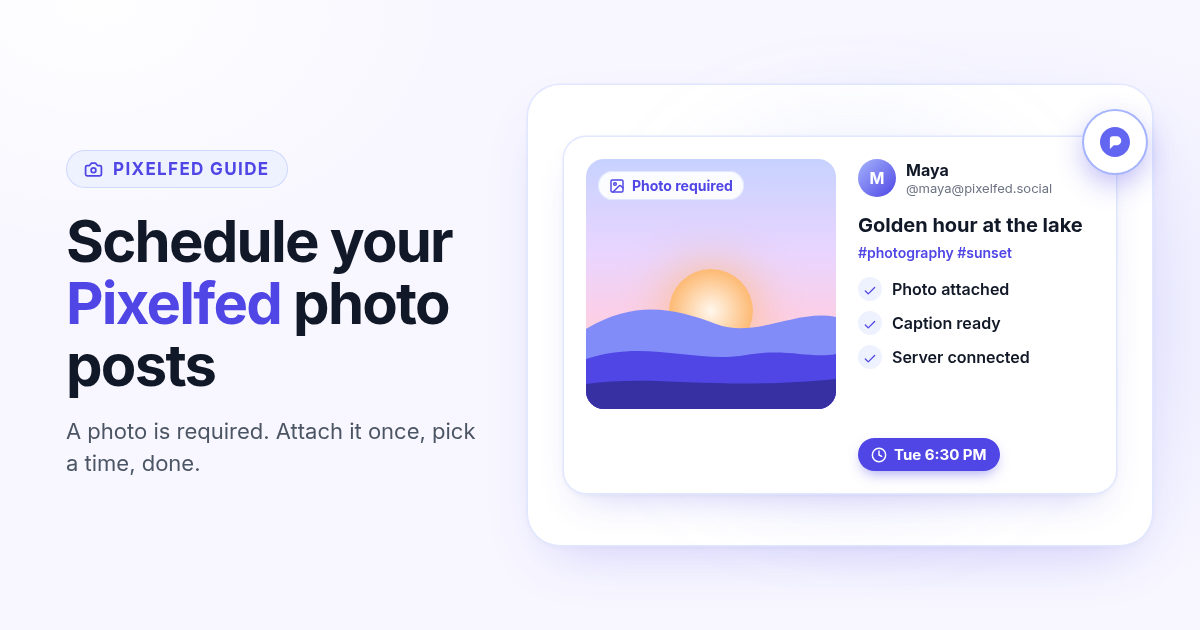
How to schedule Pixelfed posts (a photo is required)
Pixelfed is photo-first and has no real content calendar. Here is how to connect any server with an access token, attach a photo, and schedule posts ahead with Postlaty.
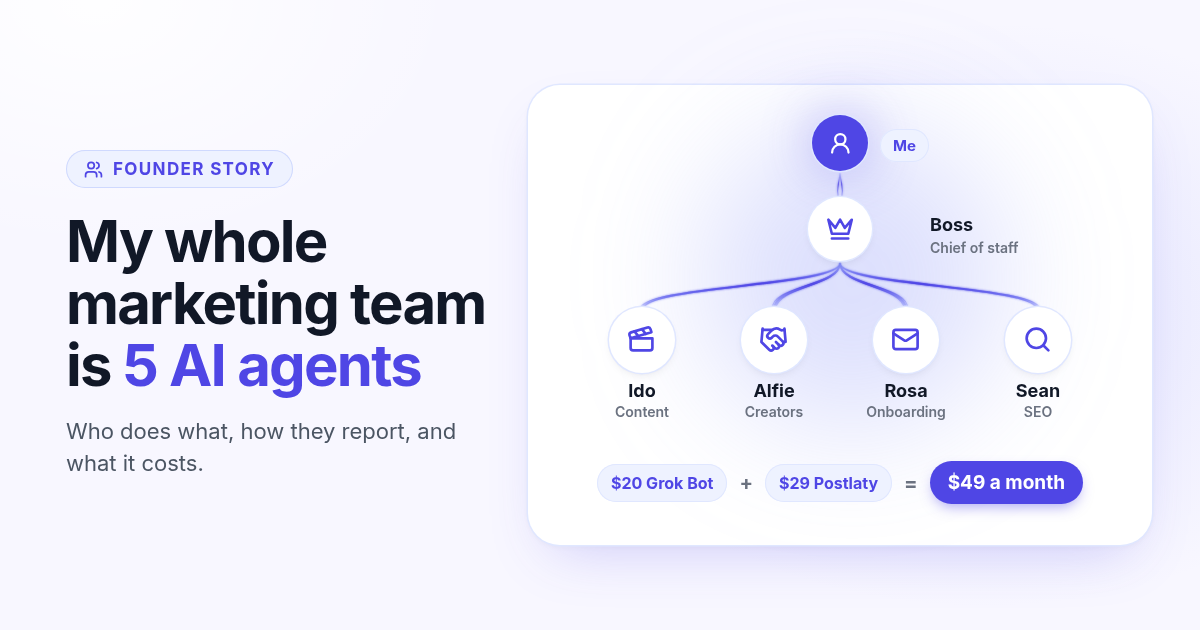
How I run my whole marketing team with AI agents for $49 a month
I am a solo founder. My marketing team is five AI agents that post, reach out, email, and write, then report to me daily. Here is who does what and what it costs.
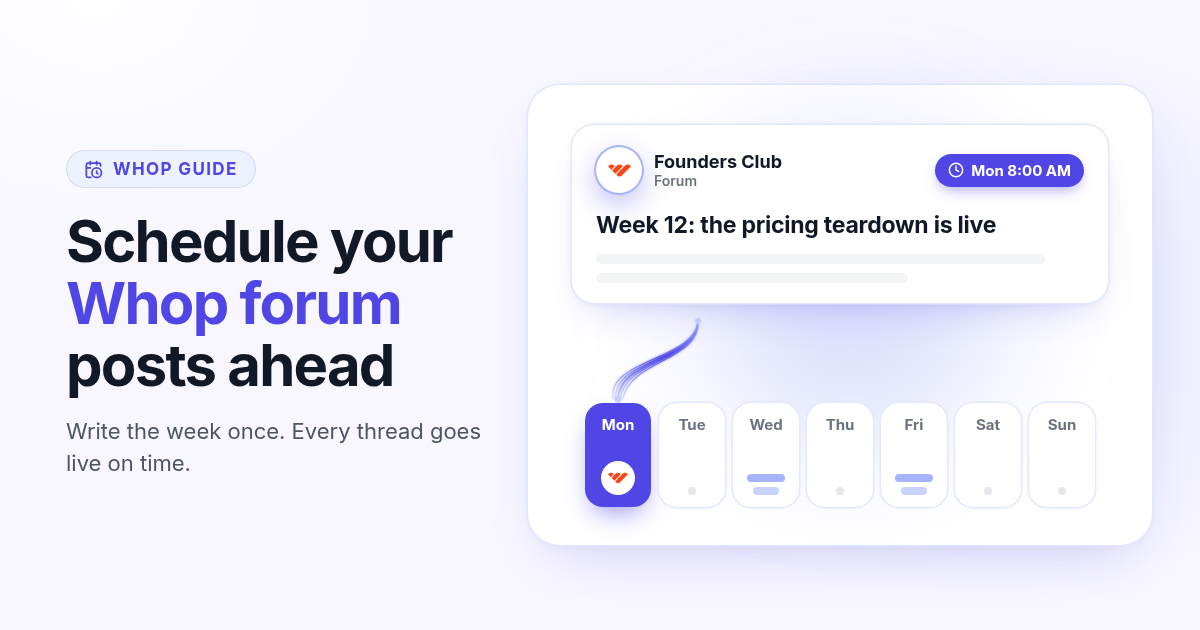
How to schedule Whop posts to your community forum
Whop forums publish when you press Post. Here is how to schedule Whop posts ahead with a company API key, what to write, and how replies reach your inbox.
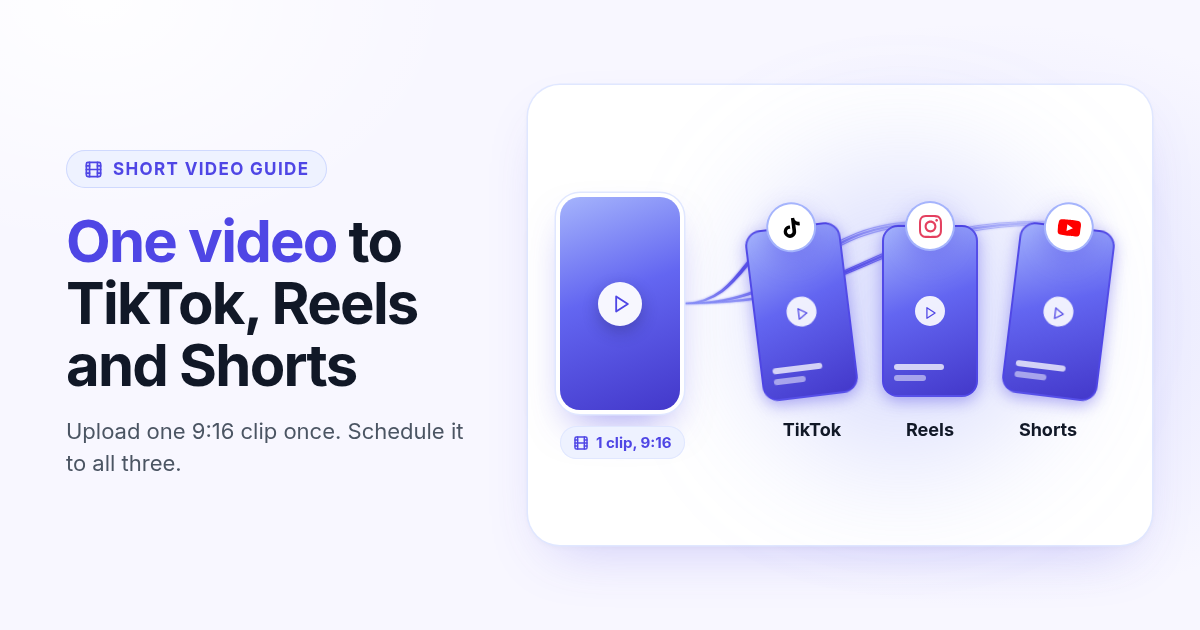
How to post the same short video to TikTok, Instagram Reels, and YouTube Shorts
One 9:16 file can feed TikTok, Reels, and Shorts. This guide covers aspect ratio, captions, covers, and a publish path that does not recrop three times.