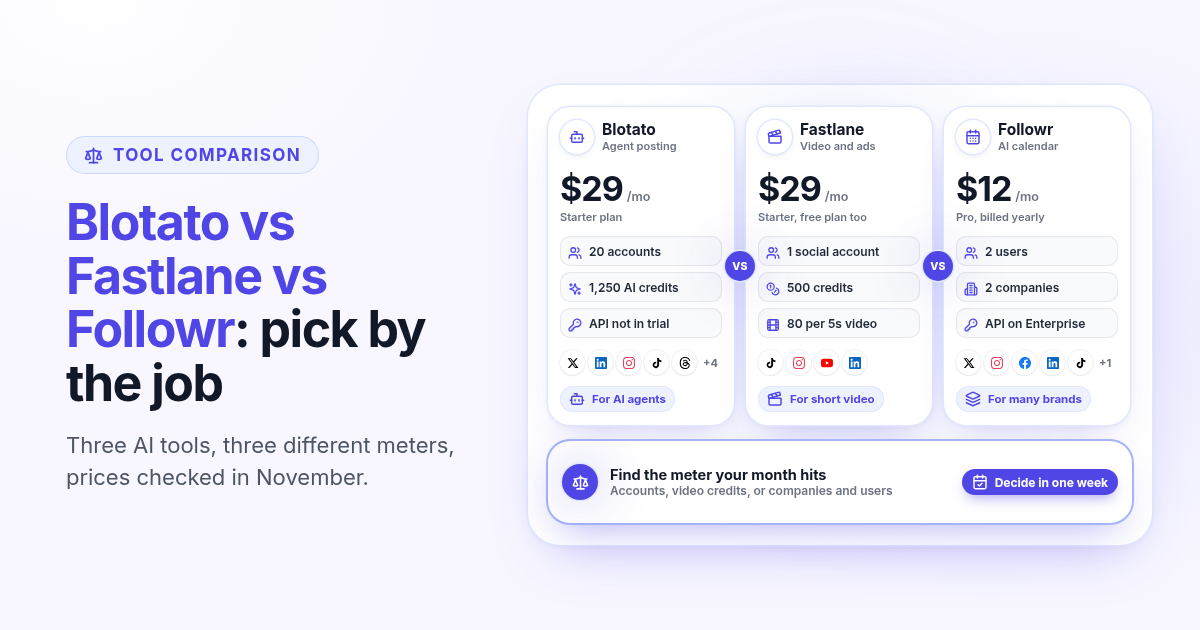
Blotato, Fastlane and Followr all show up when you search for an AI social media tool, and all three start at a price that looks like a rounding error next to an agency. But they are built for three different jobs. Blotato is a posting layer for AI agents. Fastlane is an AI content and ads engine for short video. Followr is an AI writing and scheduling suite for teams and agencies on a budget.
If you pick the one that does not match your job, you pay for credits you never use or miss the one feature you needed. This guide puts the three side by side with the prices on their own pricing pages, checked on 9 November 2026, and shows how to decide in one week.
Blotato vs Fastlane vs Followr: the short answer
Pick by the job you want done, not by the cheapest plan:
Blotato: your agent posts for you
Best when Claude, ChatGPT, n8n or Make already writes your posts and you need one API and MCP server that publishes to 9 networks. Starter is $29 a month for 20 accounts.
Fastlane: AI makes the videos and ads
Best when you want AI UGC clips, slideshows and ad campaigns for TikTok, Reels, Shorts and LinkedIn. There is a free plan, and paid plans start at $29 a month for one social account.
Followr: AI calendar for many brands
Best when you want AI written posts on a calendar for several companies and users at a low yearly price. Pro is $12 a month billed yearly for 2 users and 2 companies.
Pricing side by side in 2026
The entry price is the same $29 for two of them, but what $29 buys is very different:
$29
Blotato Starter: 20 accounts, 1,250 AI credits a month
$29
Fastlane Starter: 1 social account, 500 credits a month
$12
Followr Pro, billed yearly ($144): 2 users, 2 companies
Blotato: Starter $29, Creator $97 (40 accounts, 5,000 AI credits) and Agency $499 (28,000 credits). Every plan has a 7-day free trial, but the trial covers every feature except the API and MCP server, with 60 AI credits.
Fastlane: Free plan, then Starter $29 (500 credits, up to 100 statics or 6 videos), Growth $79 (2,000 credits, 10 social accounts per workspace), Pro $199 and Enterprise $999. A static costs 5 credits and a 5 second video 80. The trial is 7 days with 50 credits.
Followr: Pro $12, Team $25 (10 users, 10 companies), Agency $65 (30) and Enterprise $260 (100), each a monthly rate billed yearly at 35% off the monthly price. API access is listed on Enterprise only, and white labeling is $99 extra below Enterprise.
The real cost is the meter behind the plan. Blotato meters accounts and AI credits, Fastlane meters credits (video eats them fast: 500 credits is about 6 clips), and Followr meters companies and users. Work out which meter your month actually hits before you compare headline prices.
Which networks each one publishes to
Blotato: 9 networks
X, LinkedIn, Facebook, Instagram, TikTok, YouTube, Threads, Bluesky and Pinterest, through one create post call for your agent.
Fastlane: 4 video networks
TikTok, Instagram Reels, YouTube Shorts and LinkedIn, plus ads it launches in your own Ads Manager. No X, Threads or Bluesky.
Followr: 6 networks
Its FAQ lists Twitter, Instagram, Facebook, LinkedIn, TikTok and Medium, with more promised. No YouTube, Threads or Bluesky listed.
This is often the deciding row. If half your audience is on Threads or Bluesky, Fastlane and Followr are out before price even matters. If you only post short video, Fastlane covers the four places that matter for it.
What each free option lets you test
A trial only helps if it covers the part you are buying. Here is the gap to watch on each one:
Blotato: the 7-day trial leaves out the API and MCP server, which is the main reason to buy it. You test the web app, then pay to test your agent. The details are in the Blotato alternatives guide linked below.
Fastlane: the free plan and the trial give you a taste, but 50 trial credits is less than one 5 second video at 80 credits. Plan to judge statics first, or budget for a paid month to judge video.
Followr: the site offers a trial on every plan but does not state its length on the pricing page, so check the signup screen before you count on a full week.
How to decide in one week
Run the same test on whichever tool you start with, so the result is about your workflow, not the demo:
- 1
Day 1: write down your meter
Count the accounts you post to, the networks they are on, the people who log in, and how many videos you need a month. That list tells you which plan you really need on each tool.
- 2
Day 2: connect the real accounts
Not a test account. Connect the founder profile and the brand accounts, so you see the real channel or account count and the real price.
- 3
Day 3: make one week of content
If you are testing Fastlane or an AI studio, generate the clips. If you are testing Blotato, have your agent write and send them. If you are testing Followr, let its AI draft the captions.
- 4
Days 4 to 6: watch what goes out
Open each network after the scheduled time. Check the caption, the media and the account. A tool that saves an hour but misses posts costs you more than it saves.
- 5
Day 7: decide before the charge
Keep the one whose meter you did not hit and whose posts all went out. Cancel the rest before billing starts.
Where Postlaty fits if none of the three is a clean match
I built Postlaty because I wanted the three jobs in one place: make the content with AI, schedule it to every network I use, and let an agent drive it when I am busy. If you found yourself wanting a bit of each tool above, this is what it looks like:
Channels in any mix
Starter is $29 a month for 10 channels, Pro $39 for 20 and Premium $49 for 50, across 18 networks you can connect today, including X, Threads, Bluesky, YouTube, TikTok and Telegram.
AI images and clips included
Each plan comes with monthly tokens (10, 50 or 100) for the AI tab, so you can make a clip or an image and schedule it from the same calendar.
API and MCP during the trial
Every plan includes a REST API and an MCP server, and both work while you are on the 7-day free trial, so you can test your agent before the first charge.
One inbox
Comments and messages from the networks that allow it land in one Inbox next to your calendar.
7-day free trial
The trial starts at checkout with a card and bills after 7 days unless you cancel. Each account gets one trial.
Built for one founder
Postlaty is priced by channels, not by seats or brands, which suits a founder running a personal account and a few brands.
The full plans are on pricing, the API is documented on the API and MCP page, and the Blotato alternative page compares Postlaty and Blotato feature by feature. If agents are the reason you looked at Blotato, here is how I run my whole marketing team with AI agents for $49 a month.
Limitations to know
Postlaty does not launch paid ad campaigns. If running TikTok and Meta ads from AI creative is the job, Fastlane is built for it.
Blotato gives more accounts on its $29 plan (20 versus 10 channels), and Followr is cheaper for teams that need many users.
Reddit is not connectable in Postlaty yet. It is marked as coming soon.
The bottom line
Blotato vs Fastlane vs Followr is less a contest than a sorting question. Choose Blotato if an agent does your posting and you need 9 networks behind one API. Choose Fastlane if short video and ads are the whole plan. Choose Followr if you want AI captions on a calendar for many companies at a low yearly price. If you want content, scheduling and an agent in one tool, test that with a full week on a trial. For the agent side in depth, read Blotato alternatives when you want to test the API before you pay, and for video, see how to make an AI UGC clip and post it to TikTok, Reels, and Shorts.
FAQ
Frequently Asked Questions
Blotato is an API and MCP server that lets an AI agent publish to 9 networks. Fastlane is an AI engine that makes short videos, statics and ads for TikTok, Reels, Shorts and LinkedIn. Followr is an AI writing and scheduling suite priced by users and companies.
Fastlane has a free plan. Paid plans start at $29 a month for 500 credits and one social account, and the 7-day trial comes with 50 credits. A 5 second video costs 80 credits, so video needs a paid plan.
Its pricing page lists paid plans only, from $12 a month billed yearly ($144 a year) for 2 users and 2 companies, with a trial whose length is not stated on that page.
For accounts alone, Blotato gives 20 accounts for $29 a month. Fastlane gives 1 account at $29 and 10 per workspace at $79. Followr counts companies (social sets) instead, 2 on its $12 yearly plan.
Blotato is built for it, with an MCP server and n8n and Make nodes, but its trial leaves out the API and MCP. Followr lists API access on Enterprise only. Postlaty includes a REST API and MCP server on every plan, usable during its 7-day free trial.
Yes. Postlaty has a 7-day free trial that starts at checkout with a card. Billing starts after 7 days unless you cancel.
Blog
More articles
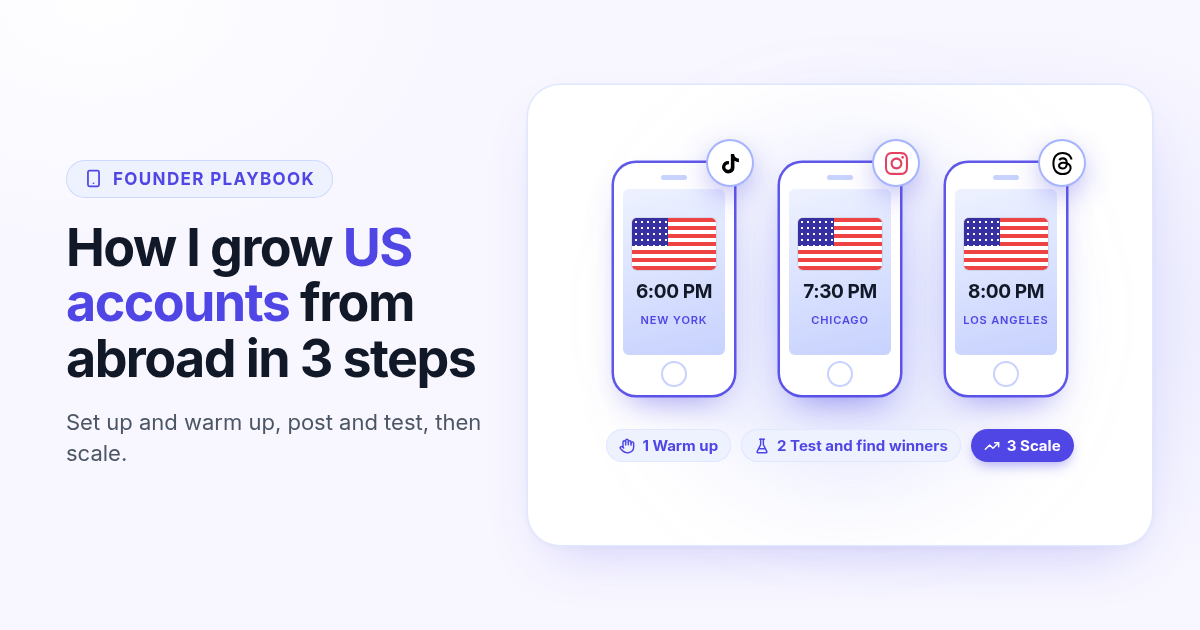
How I grow US TikTok accounts from abroad in 3 steps
I do not live in the US, but I grow accounts for a US audience. My 3 step playbook: set up and warm up a cheap dedicated phone, post and test for 30 days, then scale only the winners.
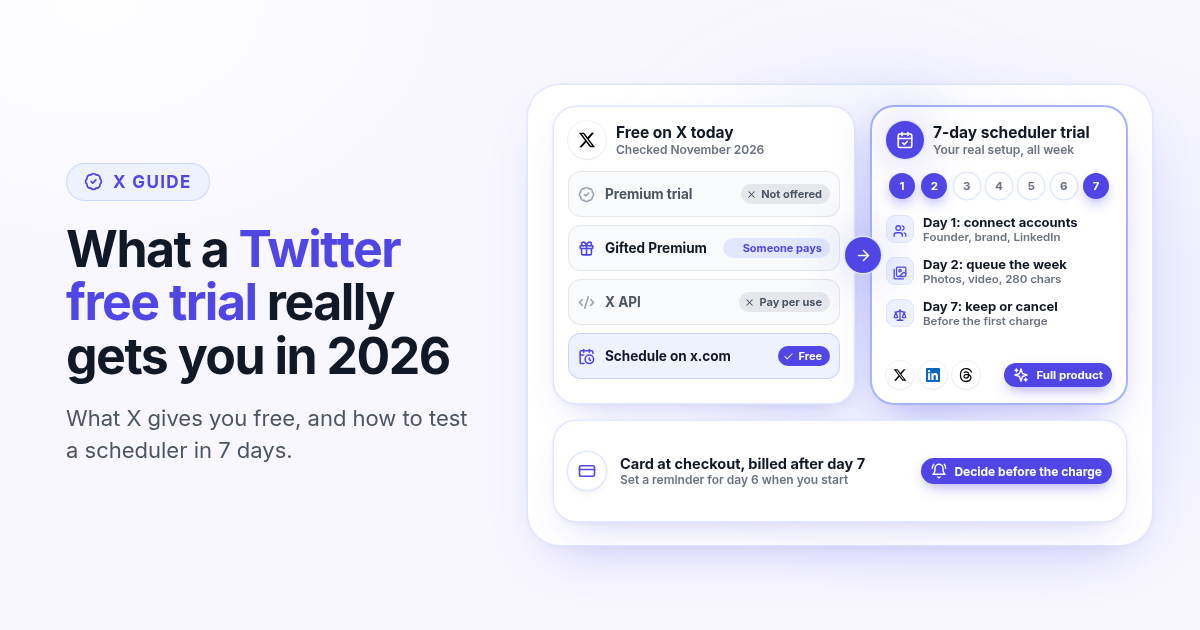
Twitter free trial in 2026: what X gives you for free, and how to test a scheduler in 7 days
X lists no free trial for Premium or The X Subscription, and the X API has no free plan for new developers. Here is what a free X account already does, what the API costs, and how to use a 7-day scheduler trial so you know by day 7 if it is worth paying for.
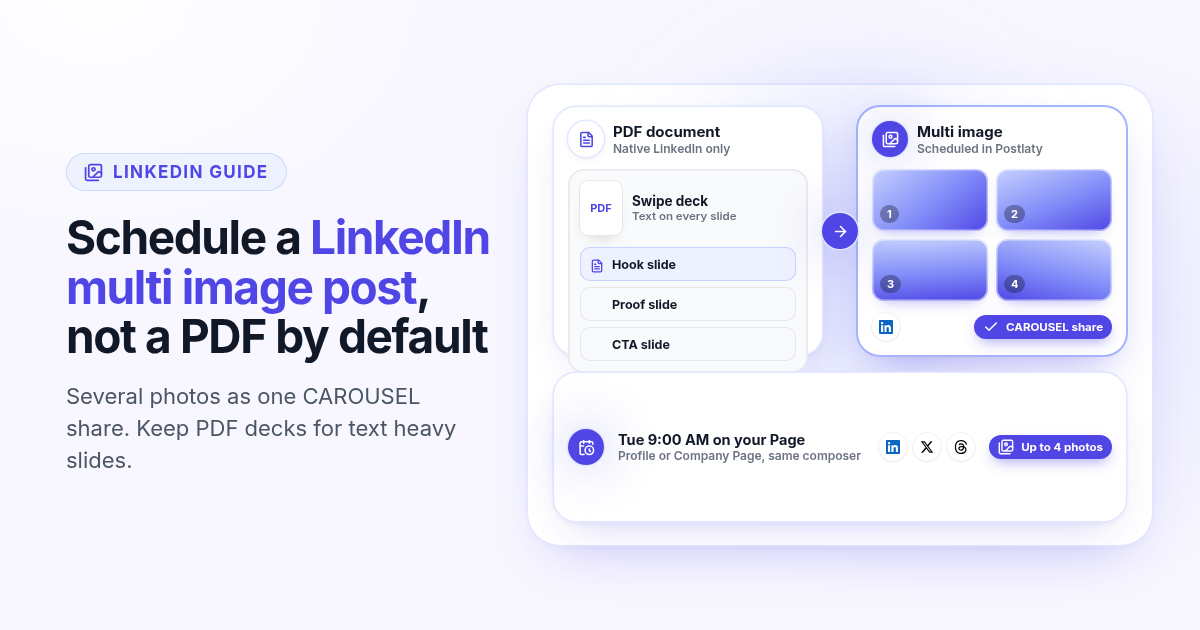
How to schedule a LinkedIn multi image post (and when a PDF carousel is better)
LinkedIn carousels usually mean a PDF. A multi image post is different: several photos as one share, including on a Company Page that cannot schedule multi photo posts natively. Here is how to queue the photo set in Postlaty, and when to stay with a document carousel.
How to make an AI UGC clip and post it to TikTok, Reels, and Shorts
Pick a UGC influencer or template, generate a 9:16 talking clip with Seedance, Kling, Veo, or Grok Imagine, then schedule the same file to TikTok, Instagram Reels, and YouTube Shorts from one Postlaty post.
How to schedule a Tumblr photo or video (and reuse it on Mastodon)
Tumblr takes text plus the first image or video. Mastodon in Postlaty takes the first image and skips video. Connect both, attach one file, write two captions, and schedule the pair so the video stays on Tumblr only.
Threads scheduler in 2026: how to schedule Threads posts for free, and when a tool is worth it
Threads has a free scheduler in the composer three dot menu. How to use it step by step, where it stops (one profile, no week view, Threads only), five checks to run on any Threads scheduling tool, and a weekly routine built around replies.
Twitter scheduler in 2026: how to schedule X posts for free, and 5 checks before you pay
X still has a free scheduler: the calendar icon in the x.com composer. How to use it step by step, where it stops (one account, no week view, no long posts on the web), and five checks to run on any paid Twitter scheduler during the trial.
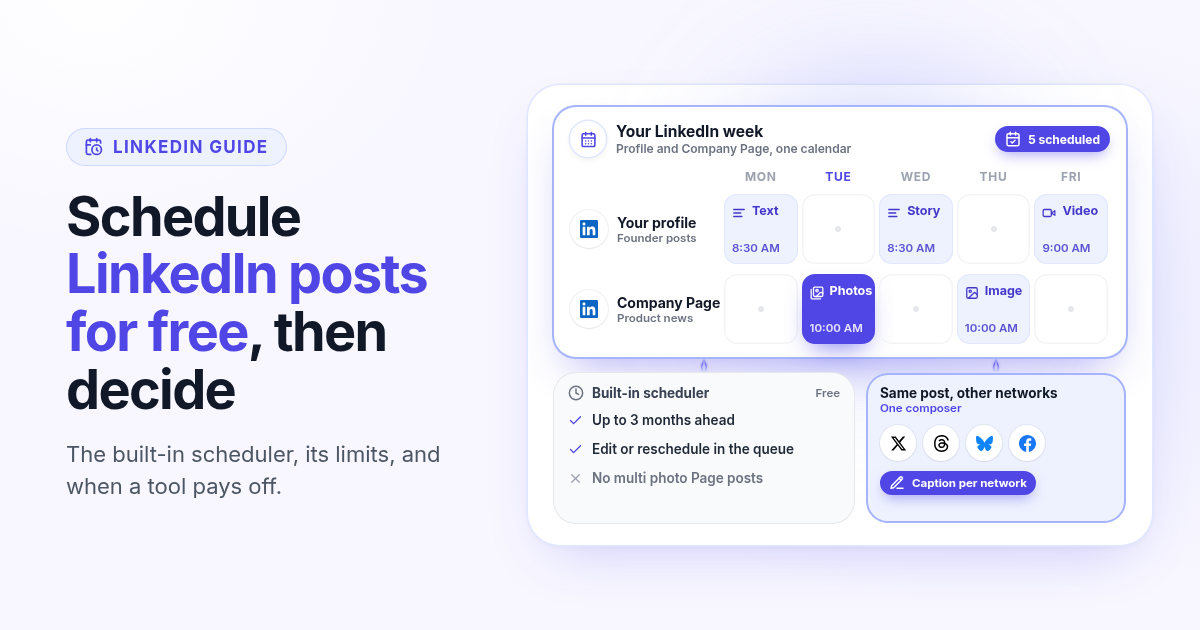
How to schedule LinkedIn posts for free in 2026 (and when a paid tool is worth it)
LinkedIn's own scheduler is free: profile posts from 10 minutes to 3 months ahead, Company Page posts from 1 hour. How to use it step by step, what it cannot schedule, and five signs a paid LinkedIn scheduler is worth it.
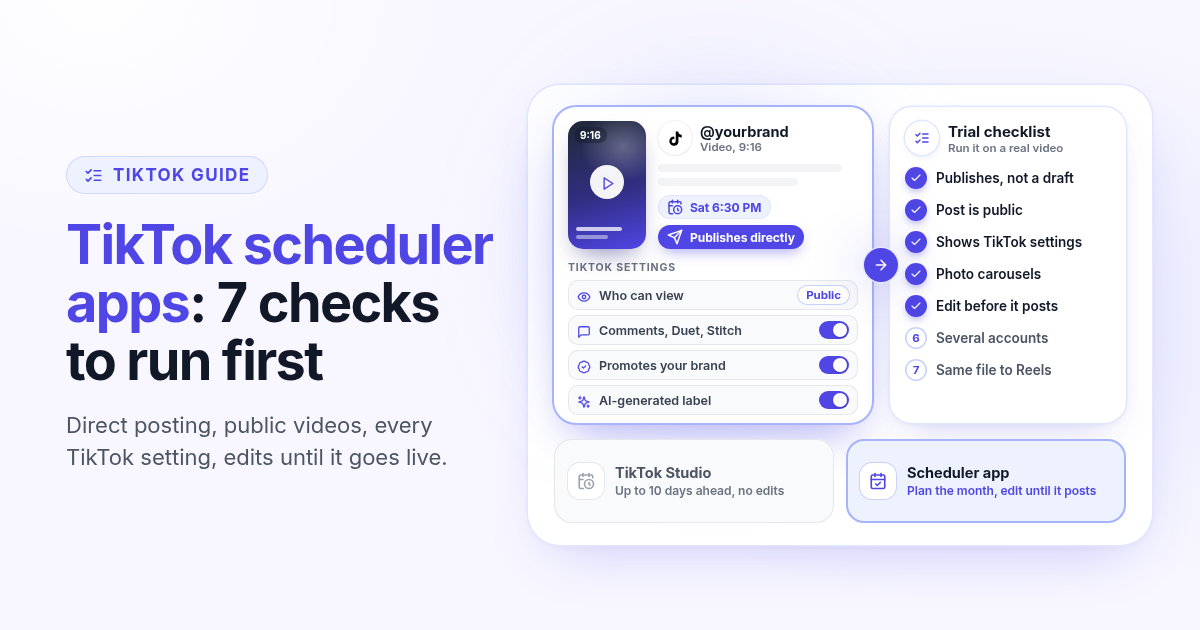
TikTok scheduler apps in 2026: 7 checks before you trust one with your videos
What TikTok Studio already schedules for free, and seven checks to run on any TikTok scheduler app during the trial: direct posting, public visibility, TikTok settings, photo posts, editing, multiple accounts and cross posting.
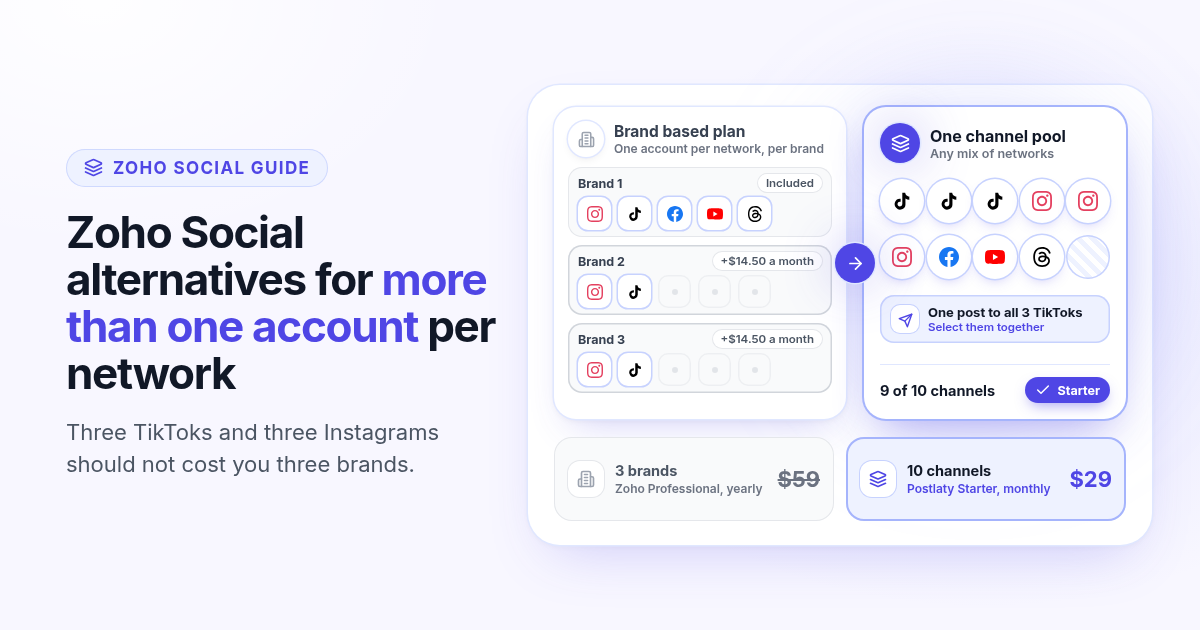
Zoho Social alternatives in 2026: when you run more than one account per network
Zoho Social prices by brand, and a brand holds one account per network. How Zoho Social pricing works in 2026, what three TikToks and three Instagrams really cost, and what to look for in an alternative priced by channels.
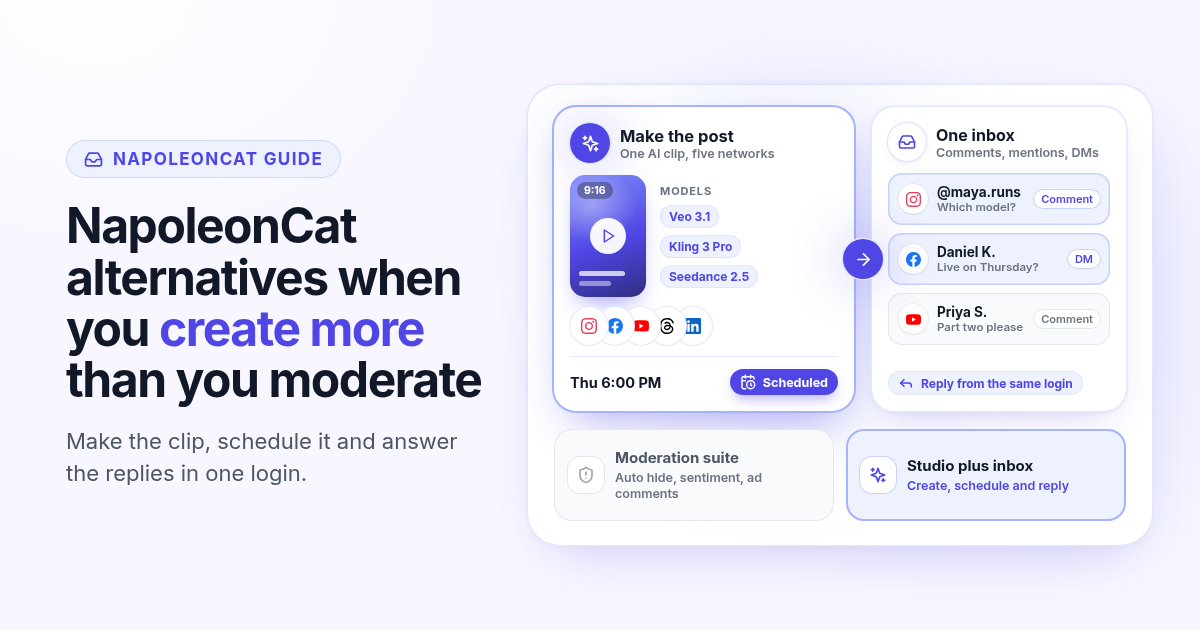
NapoleonCat alternatives in 2026: when you create more than you moderate
NapoleonCat is a strong moderation and inbox suite priced by users and profiles. If you spend more time making posts than moderating comments, here is what its 2026 pricing covers and what to look for in an alternative.
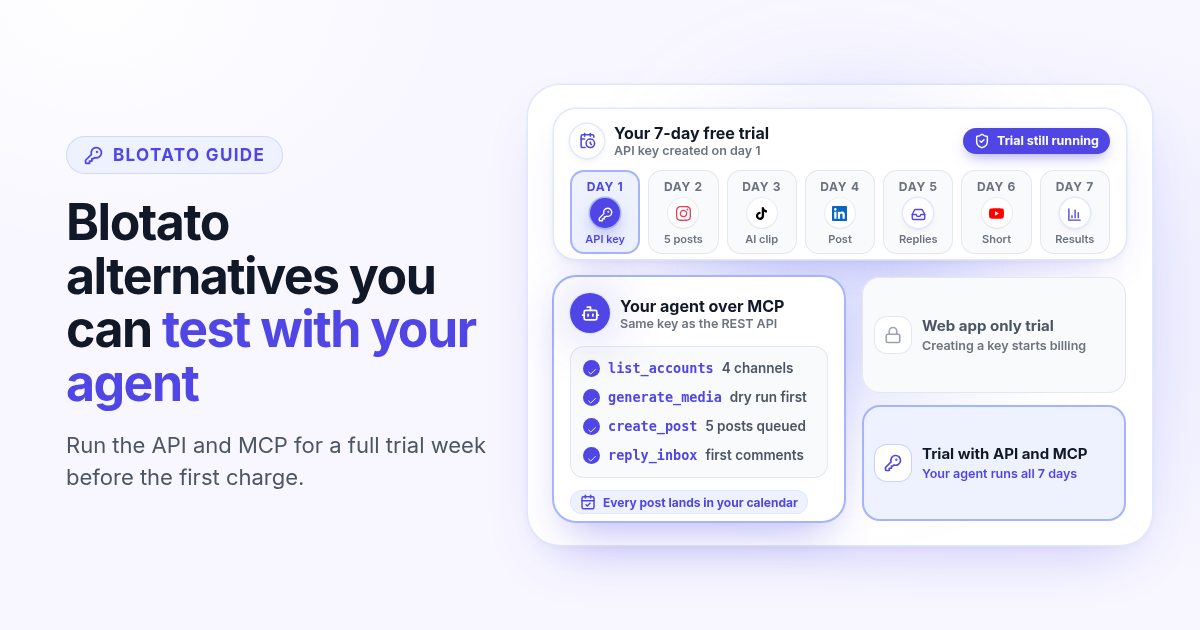
Blotato alternatives in 2026: when you want to test the API before you pay
Blotato starts at $29 a month for 20 accounts, but its free trial leaves out the API and MCP. How Blotato pricing works in 2026, why creating an API key ends the trial, and what to test in an alternative when an agent posts for you.
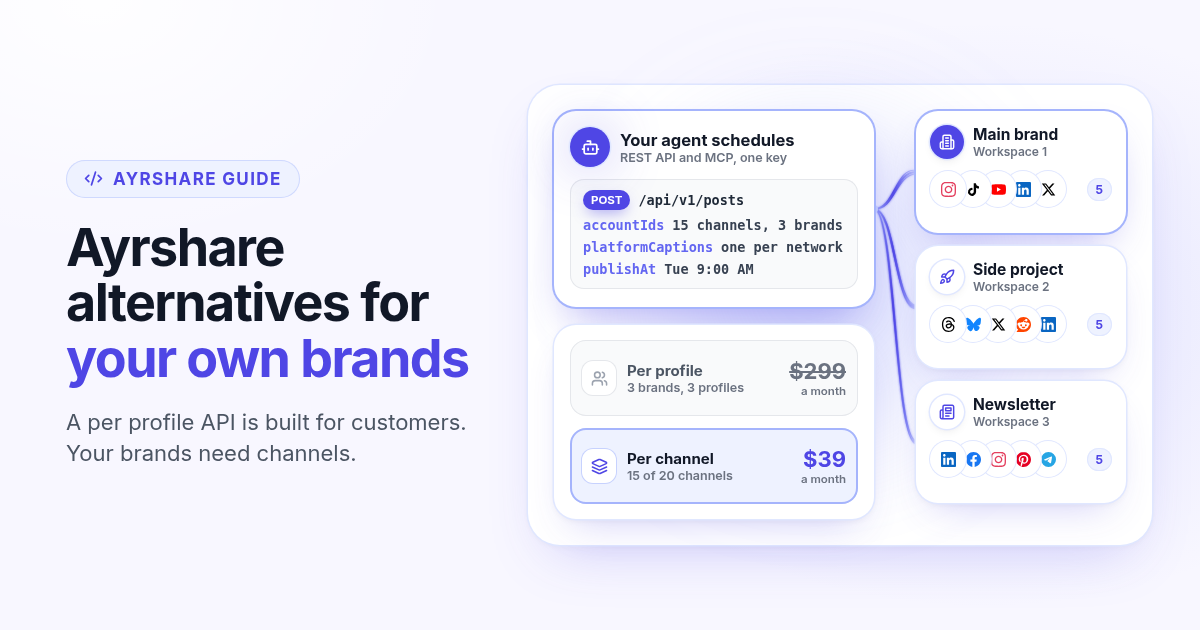
Ayrshare alternatives in 2026: when you post for your own brands, not customers
Ayrshare is a social media API billed per profile, from $149 a month for one. How Ayrshare pricing works in 2026, why profiles and channels lead to very different bills when the brands are yours, and what to test in an alternative with API and MCP on every plan.
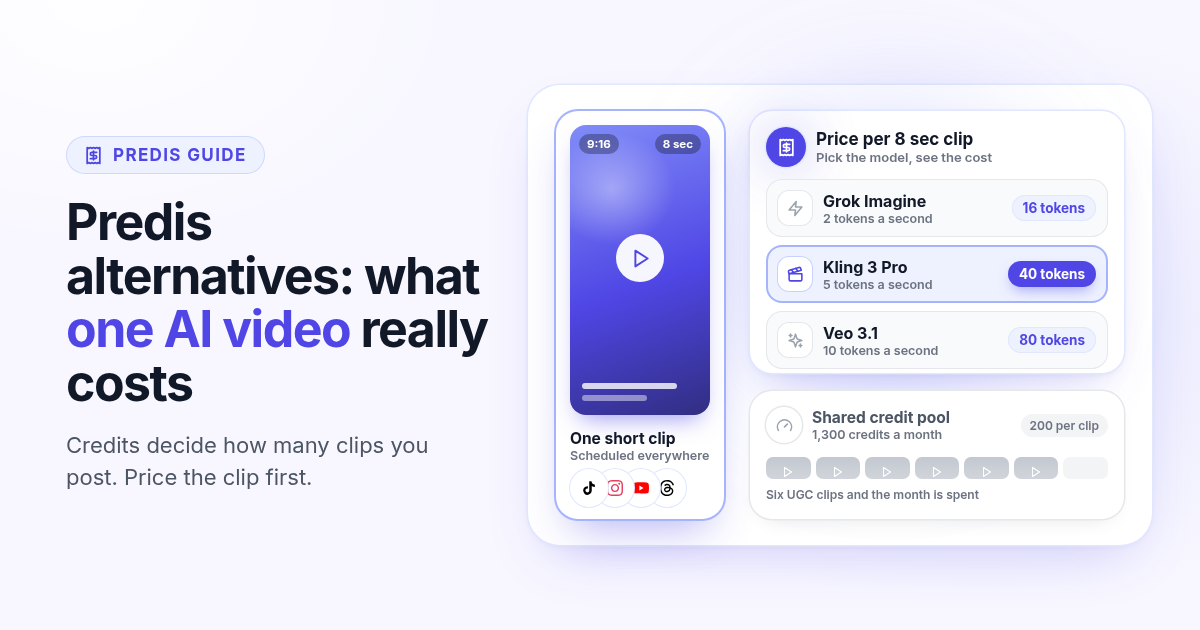
Predis alternatives in 2026: what one AI video really costs you
Predis.ai starts at $19 a month billed yearly, but credits decide how many AI videos you get. How Predis pricing works in 2026, what one clip costs on each plan, and how to price a real week of video in an alternative before you switch.
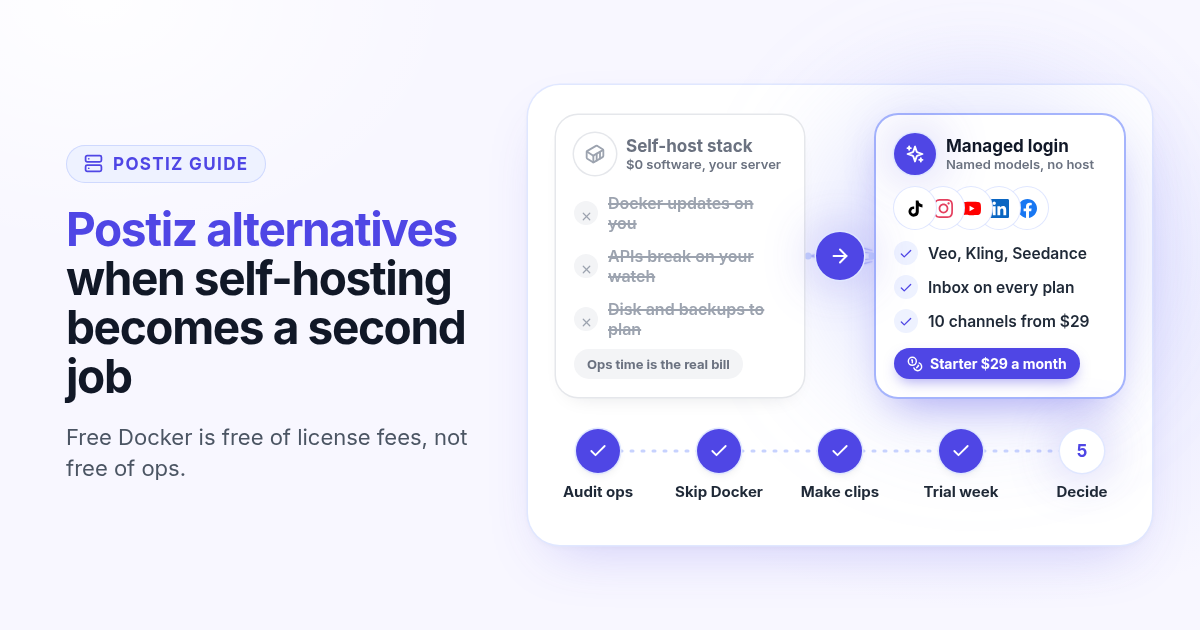
Postiz alternatives in 2026: when self-hosting becomes a second job
Postiz is a strong open-source scheduler with a free Docker install and hosted plans from $29. How Postiz pricing works in 2026, when self-hosting costs more than the bill, and what to test in a managed alternative with named AI video and inbox on the first plan.
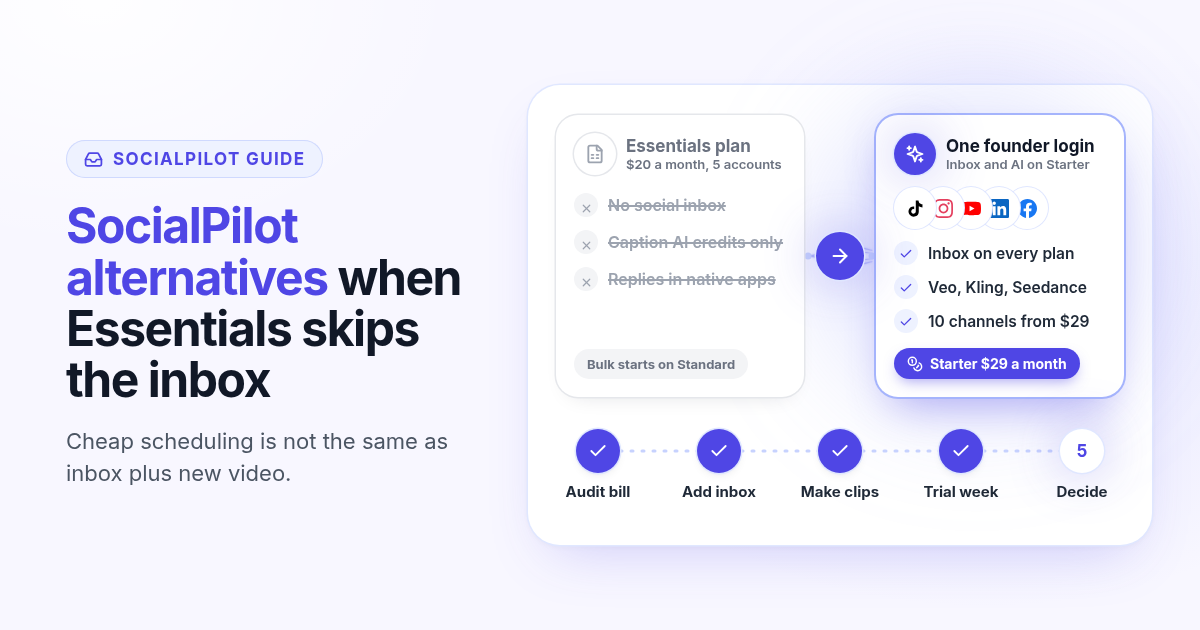
SocialPilot alternatives in 2026: when the cheap plan skips the inbox
SocialPilot Essentials is $20 a month for 5 accounts, but the inbox starts on Standard at $40. How SocialPilot pricing works in 2026, when bulk scheduling is enough, and what to test in an alternative that includes inbox and AI video on the first plan.
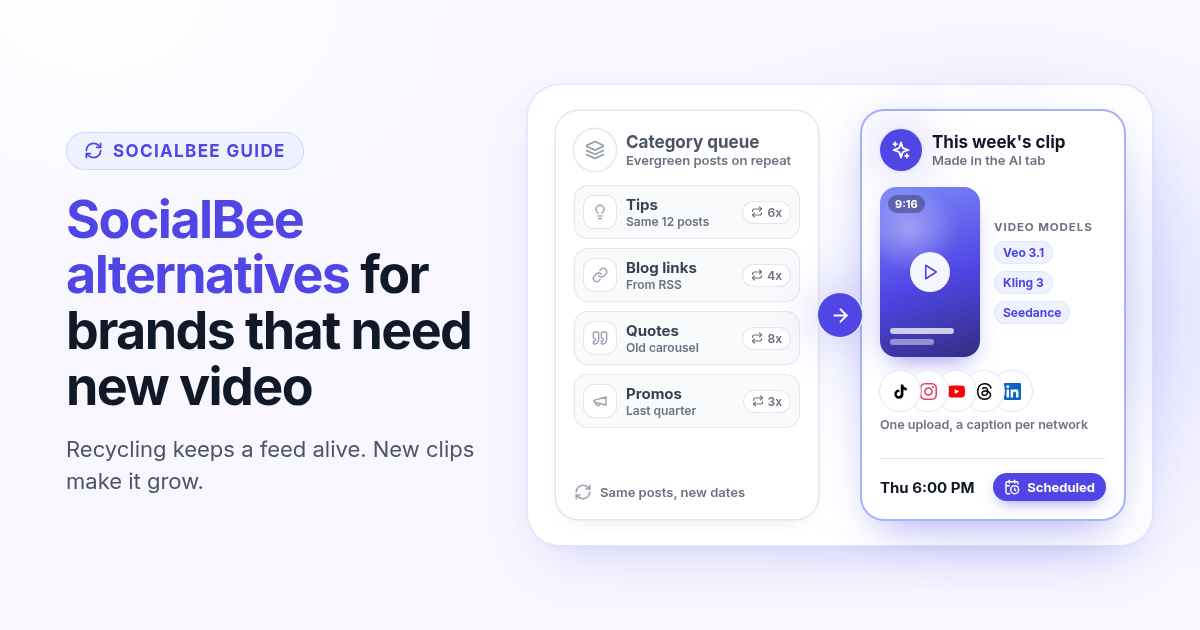
SocialBee alternatives in 2026: when recycled posts stop growing your accounts
SocialBee recycles evergreen posts by category, which keeps a feed active but rarely grows it on TikTok, Reels and Shorts. How SocialBee pricing works in 2026, how to audit your queue, and what to test in an alternative that makes new video.
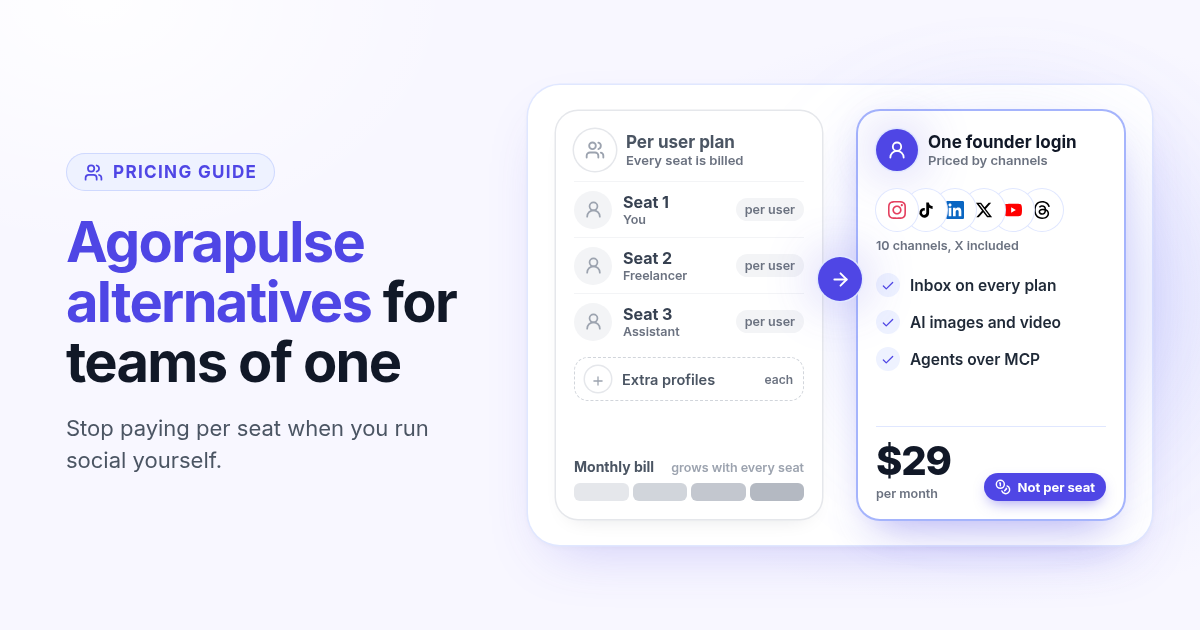
Agorapulse alternatives in 2026: when you pay per seat but post alone
Agorapulse prices every plan per user, which suits social teams more than founders. See how its pricing works in 2026, check which features you really use, and know what to test in any Agorapulse alternative before you switch.
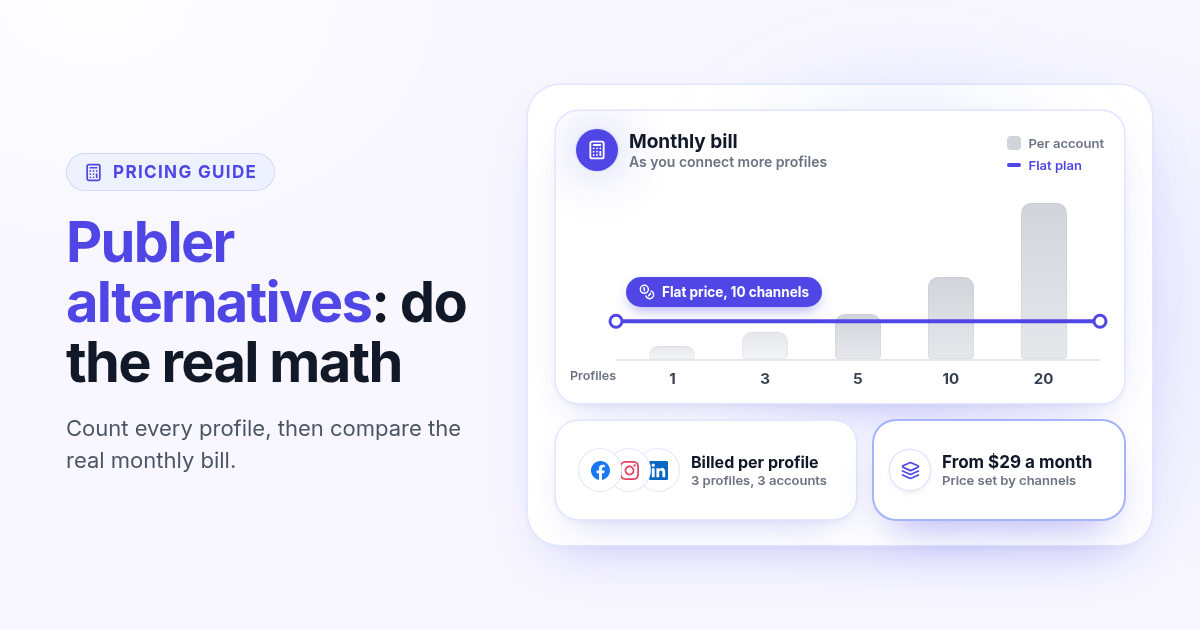
Publer alternatives in 2026: when per account pricing stops paying off
Publer bills per social account, so the price climbs with every Page and profile. Count what you really pay, spot the five signs you have outgrown it, and know what to test in any Publer alternative before you switch.
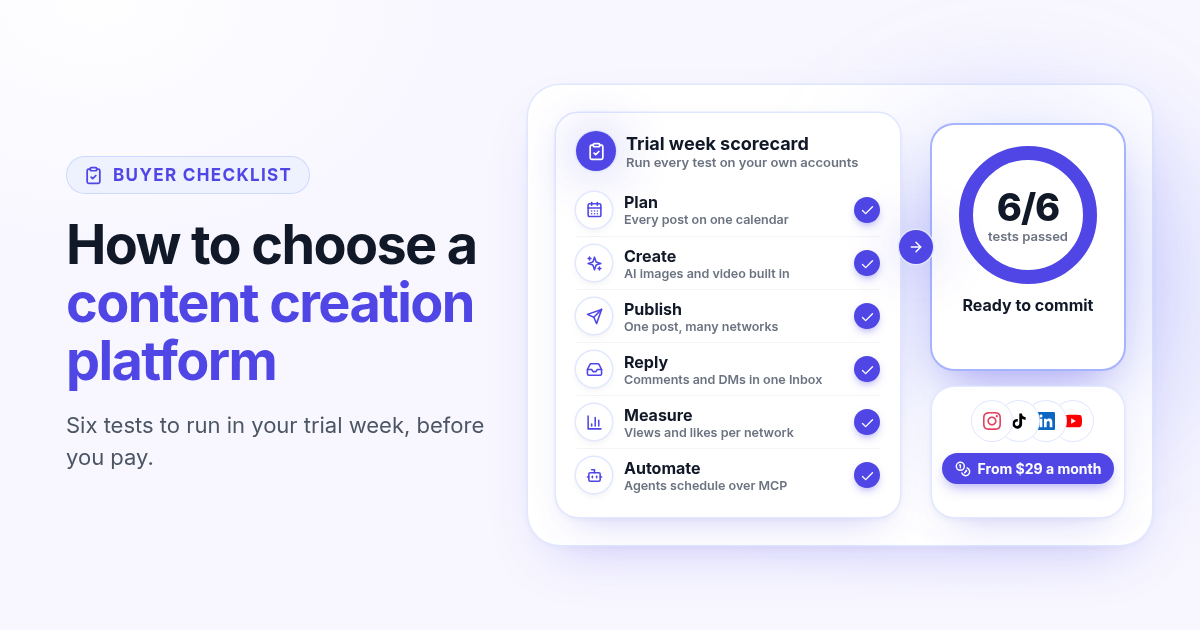
How to choose a content creation platform: 6 tests to run before you pay
A founder checklist for picking a content creation platform: add up the stack you pay for, then use a 7-day trial to test planning, AI images and video, publishing to every network, one Inbox for replies, per network numbers and AI agents.
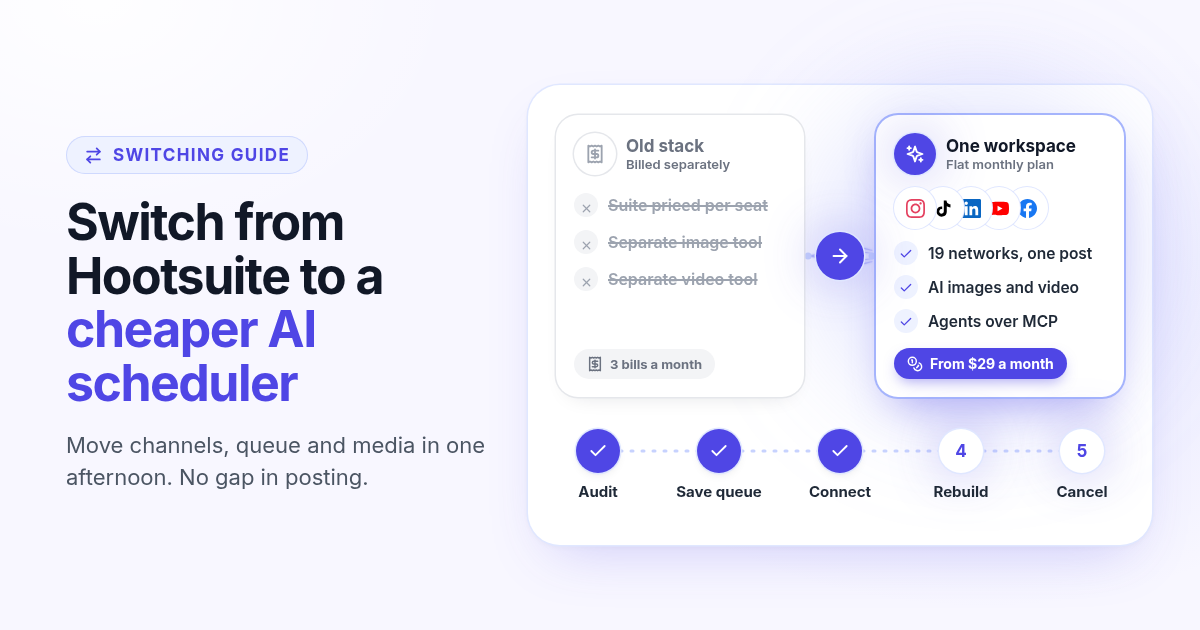
How to switch from Hootsuite to a cheaper AI scheduler in one afternoon
A step by step plan to leave Hootsuite without a gap in posting: audit what you use, save your queue and media, connect your channels, rebuild two weeks of posts, add AI images, video and agents, then cancel before renewal.
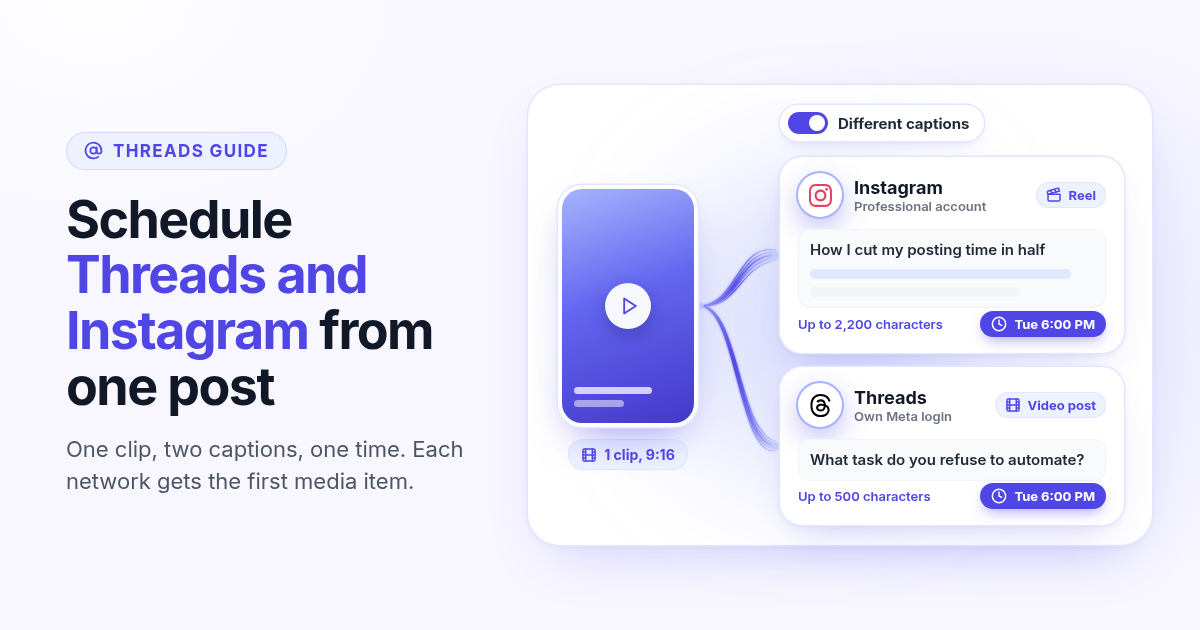
How to schedule Threads and Instagram together from one post
Schedule a Reel or photo to Instagram and Threads at the same time from one post. Connect both Meta accounts, attach one file, write a long Instagram caption and a short Threads caption, and pick one time.
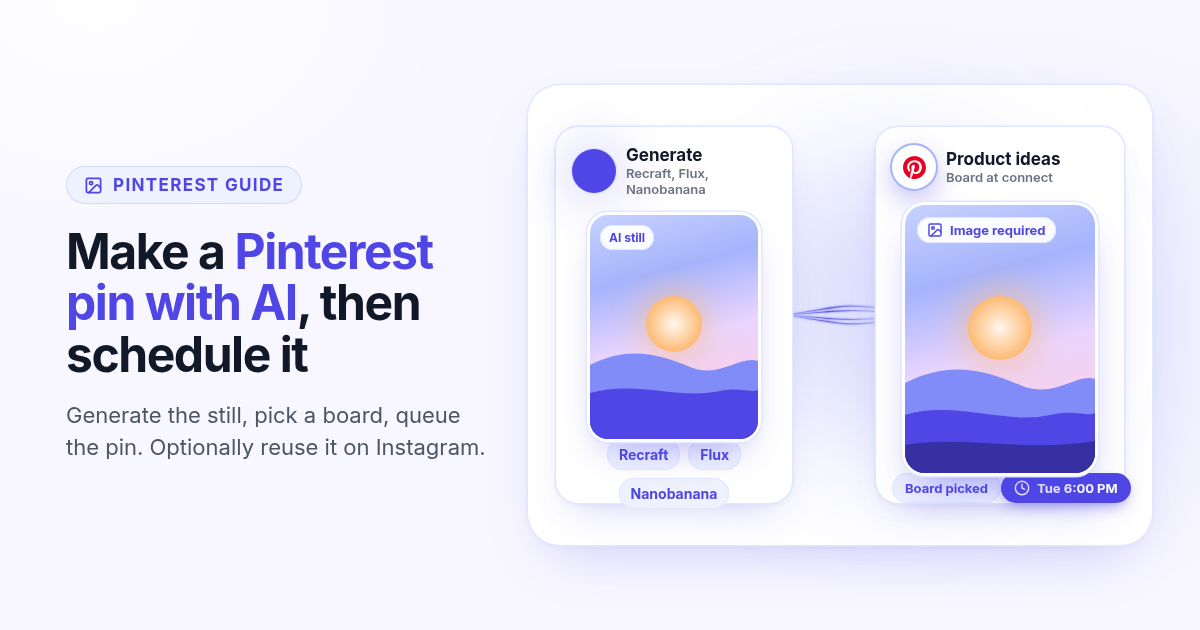
How to make a Pinterest pin with AI and schedule it to a board
Generate a Pinterest pin image with Recraft, Flux, or Nanobanana, pick a Business board at connect, and schedule the pin from Create. Image required. Optionally reuse the still on Instagram.
How to schedule a Dev.to article and the posts that point to it
Schedule a Dev.to article and the short X, LinkedIn, or Bluesky posts that point to it from one queue. Connect with an API key, write the title and body, then ship pointers instead of pasting the markdown.
How to schedule a Discord announcement and the public post together
Schedule a Discord announcement and the matching Instagram and X post from one queue. Add the bot to your server, pick the channel, send text to Discord and the visual to the public networks.
How to cross-post to Bluesky and Mastodon (and where video fails)
Cross-post Bluesky and Mastodon from one composer. Connect with an app password and a server token, share one still, and know why a Bluesky video will not publish as Mastodon video.
How to schedule Telegram channel posts as yourself (not as a bot)
Native Telegram schedule works for one message. Most tools post as a BotFather bot. Here is how to connect with your phone, pick a chat, and schedule posts as yourself with Postlaty.
How to schedule Pixelfed posts (a photo is required)
Pixelfed is photo-first and has no real content calendar. Here is how to connect any server with an access token, attach a photo, and schedule posts ahead with Postlaty.
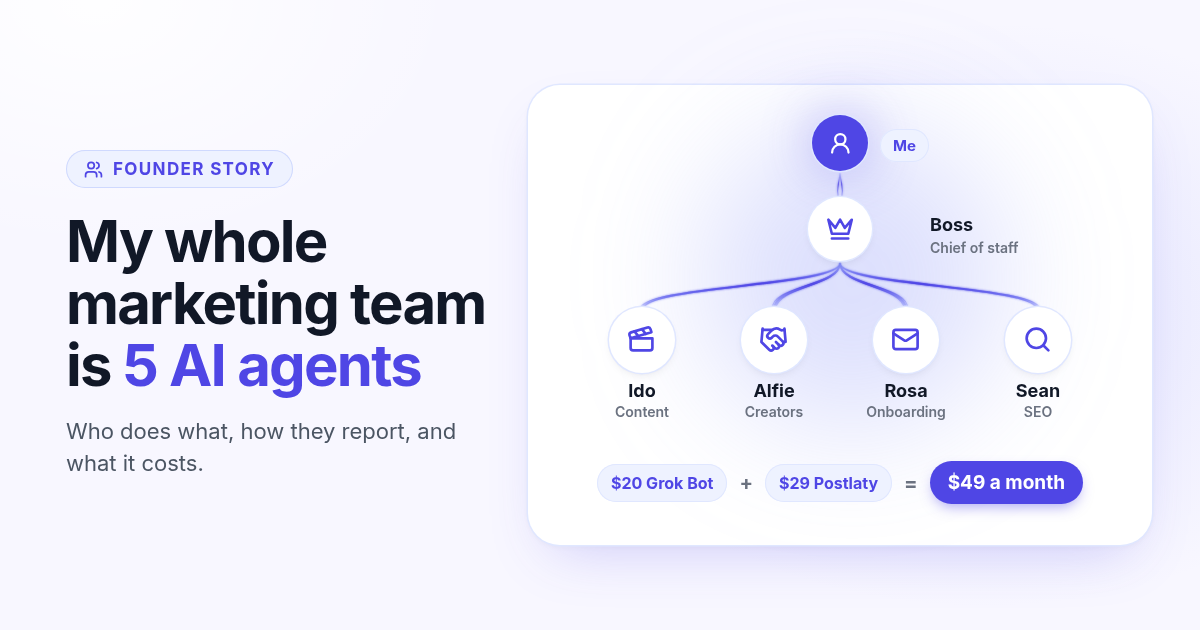
How I run my whole marketing team with AI agents for $49 a month
I am a solo founder. My marketing team is five AI agents that post, reach out, email, and write, then report to me daily. Here is who does what and what it costs.
How to schedule Whop posts to your community forum
Whop forums publish when you press Post. Here is how to schedule Whop posts ahead with a company API key, what to write, and how replies reach your inbox.
How to post the same short video to TikTok, Instagram Reels, and YouTube Shorts
One 9:16 file can feed TikTok, Reels, and Shorts. This guide covers aspect ratio, captions, covers, and a publish path that does not recrop three times.