Until this summer, most AI video models stopped at 15 seconds or less per clip. Since July three models have moved the ceiling to 30 seconds in one take: Seedance 2.5 from ByteDance, Wan 3 from Alibaba and Kling 4 from Kuaishou. All three run inside Postlaty, so I get asked the same question every week: which one should I use for TikTok, Reels and Shorts?
The honest answer depends on the job, not on a benchmark. This guide compares the three on what actually changes your week: clip length, resolution, what each second costs in tokens, and what each model can do in Postlaty today. Then it shows how to test all three on one prompt and schedule the winner.
Three models, one new length: 30 seconds
Here is what each company announced, from their official launch pages:
Seedance 2.5 (ByteDance), July 2026
Launched on 31 July 2026. Up to 30 seconds of video and audio in one pass, multi round extension of an existing output, and a large reference set of images, clips and audio in a single request.
Wan 3 (Alibaba), August 2026
Public beta on 6 August, general availability on 24 August 2026. Up to 30 seconds per clip, with editing and video extension, and documents and web pages as possible inputs on Alibaba Cloud Model Studio.
Kling 4 (Kuaishou), October 2026
Kling 4.0 officially launched on 15 October 2026. It generates 3 to 30 seconds in one pass, with steadier fast motion, stronger camera direction, up to 10 keyframes and 21:9 framing on the Kling app.
The shared headline is length. A 30 second take can hold a hook, a demo and a payoff, which is the whole shape of a good short. The differences are in control, price per second and how you get past 30 seconds.
Kling 4 vs Seedance 2.5 vs Wan 3 in Postlaty
These are the settings and prices you see in the Postlaty generator, not the API rates on each vendor's site. Postlaty charges tokens per second of output.
Wan 3: the cheapest seconds
2 to 30 seconds. 480p, 720p or 1080p at 1, 2 or 4 tokens per second. Sound is generated with the picture. Ratios include 9:16, 16:9, 1:1, 4:3, 3:4 and adaptive.
Kling 4: the cinematic middle
3 to 30 seconds. 720p or 1080p at 3 or 5 tokens per second. Ratios are 9:16, 16:9, 1:1 and the wide 21:9. Kuaishou built this release for camera moves and fast action.
Seedance 2.5: the longest stories
4 to 30 seconds. 480p, 720p or 1080p at 2, 5 or 12 tokens per second. Sound and lip sync in the same pass, reference images, clips and audio, and the only one with Extend.
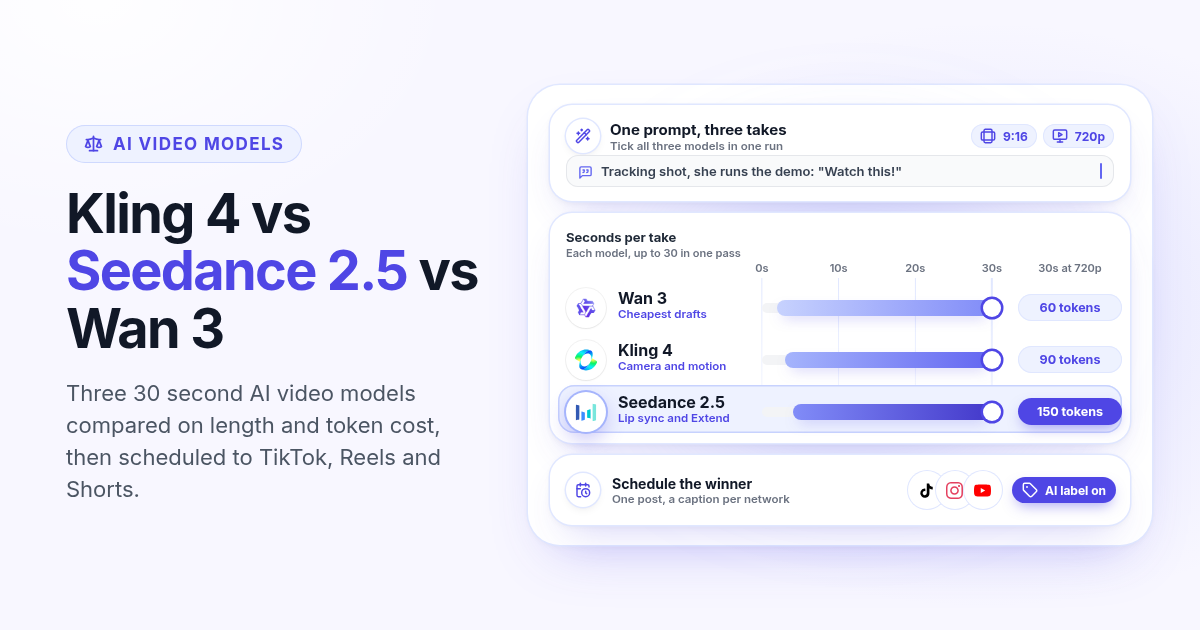
Here is what one full 30 second take costs at 720p, the resolution I post most shorts at:
60 tokens
Wan 3
90 tokens
Kling 4
150 tokens
Seedance 2.5
At 1080p the same 30 seconds is 120 tokens on Wan 3, 150 on Kling 4 and 360 on Seedance 2.5. Seedance also costs 1.5 times its normal rate, rounded up, when it has to read video, which covers every extension and any run with reference clips.
Which one to pick by the job
Many drafts, tight budget: Wan 3. At 480p a 30 second draft is 30 tokens, so you can try five hooks for the price of one Seedance take at 720p.
Motion and camera work: Kling 4. Tracking shots, orbits, sports and action scenes are where Kuaishou focused this release, and 21:9 is there for a wide brand film.
Talking clips and dialogue: Seedance 2.5. Put spoken lines in double quotes and it lip syncs them, with sound made in the same pass.
Anything longer than 30 seconds: Seedance 2.5, because Extend continues a clip from its last frame. Its guide is in the Seedance 2.5 extend walkthrough linked below.
A consistent face or product across posts: Seedance 2.5 with reference images, or any of the three in Editing mode with your own first frame.
For a full walkthrough of the long form path, read how to extend Seedance 2.5 clips past 30 seconds. For talking clips built from a library face, the AI UGC clip guide covers influencers and templates.
How to test all three on one prompt
You do not need three tabs. The Postlaty generator lets you tick several models in the same run, so you get three takes of one idea side by side.
- 1
Open the AI tab and pick video, then Generation
The Generate card in the media area of a new post opens the same generator.
- 2
Tick Kling 4, Seedance 2.5 and Wan 3
The token total on the button adds up every model you selected, so you see the full price before you run it.
- 3
Set 9:16, 720p and 5 seconds
A 5 second test costs 10 tokens on Wan 3, 15 on Kling 4 and 25 on Seedance 2.5, so 50 tokens for all three. Judge the hook first, then spend on length.
- 4
Write one prompt with motion, camera and light
Describe the action in order, name one camera move and the lighting, and put any spoken line in double quotes. The same text works for all three.
- 5
Render the winner at full length
Keep the model that nailed the hook and run it again at 15 to 30 seconds. If you have a strong opening still, switch to Editing and use it as the first frame, with an optional last frame.
Schedule the winner to TikTok, Reels and Shorts
Open the finished clip in the AI tab gallery and click Select. Postlaty opens a new post with the clip attached, whichever model made it.
One file, three networks
Add your TikTok, Instagram and YouTube channels to the same post. Instagram publishes the video as a Reel and YouTube uploads it as a Short.
A caption per network
Switch to Different captions so each network gets a line that fits, instead of one paragraph pasted three times.
The AI label, set once
Turn on AI-generated content in the post settings and Postlaty sends the AI disclosure flag with the upload to TikTok, YouTube and Instagram.
One slot on the calendar
Pick the time once. Channels count toward your plan, 10 on Starter, 20 on Pro and 50 on Premium, in any mix of networks.
For safe zones and the one file checklist, see how to schedule one video to TikTok, Instagram and YouTube.
My weekly split between the three
Monday: write five hooks and draft them on Wan 3 at 480p. Cheap, fast, and enough to see which idea moves.
Tuesday: run the best two on Kling 4 and Seedance 2.5 at 720p for 5 seconds, same prompt, side by side.
Wednesday: render the winner at 20 to 30 seconds. Extend it on Seedance 2.5 only if the story needs more.
Thursday: schedule it to TikTok, Reels and Shorts with Different captions and the AI label on.
Friday: check which clip held watch time and note the model and prompt that made it.
Limitations to know
Extend runs on Seedance 2.5 only in Postlaty. Kling 4 and Wan 3 clips stop at 30 seconds per take.
Kling 4 keyframes and Omni Reference live in the Kling app. In Postlaty, Kling 4 and Wan 3 take a text prompt or a first and optional last frame.
Kling 4 runs at 720p or 1080p in Postlaty. Kling lists 4K as coming soon on its own site.
Starter includes 10 tokens a month, which is a 5 second Wan 3 clip at 720p. Regular 30 second work needs Pro, Premium or a token pack.
The 7-day free trial is for scheduling. Your plan tokens arrive with the first paid invoice.
If a generation fails, the reserved tokens go back to your balance.
The bottom line
Use Wan 3 to find the idea cheaply, Kling 4 when the shot needs real camera work, and Seedance 2.5 when the clip talks or has to run past 30 seconds. Test all three on one prompt at 5 seconds, render the winner at full length, and schedule it to TikTok, Reels and Shorts from one post. Check the plans and token packs on pricing, and see how each network works on the TikTok, Instagram and YouTube pages.
FAQ
Frequently Asked Questions
It depends on the clip. Kling 4 is built for camera moves and fast action and costs less per second in Postlaty. Seedance 2.5 is the stronger pick for talking clips with lip sync and for videos longer than 30 seconds, because it is the one you can extend.
In Postlaty, Wan 3. A 30 second take at 720p is 60 tokens on Wan 3, 90 on Kling 4 and 150 on Seedance 2.5. At 480p a 30 second Wan 3 draft is 30 tokens.
Yes. In Postlaty, Kling 4 takes 3 to 30 seconds and Wan 3 takes 2 to 30 seconds per generation. Seedance 2.5 takes 4 to 30 seconds.
Not today. Extend runs on Seedance 2.5 only. You can upload a Kling 4 or Wan 3 clip of 30 seconds or less into Extend, and Seedance 2.5 continues it from the last frame.
Yes. All three take 9:16 in Postlaty, which is the format TikTok, Reels and Shorts want. Kling 4 also offers 21:9 for wide shots.
Postlaty has a 7-day free trial for scheduling. The AI models run on tokens, and your plan tokens arrive with the first paid invoice.
Blog
More articles
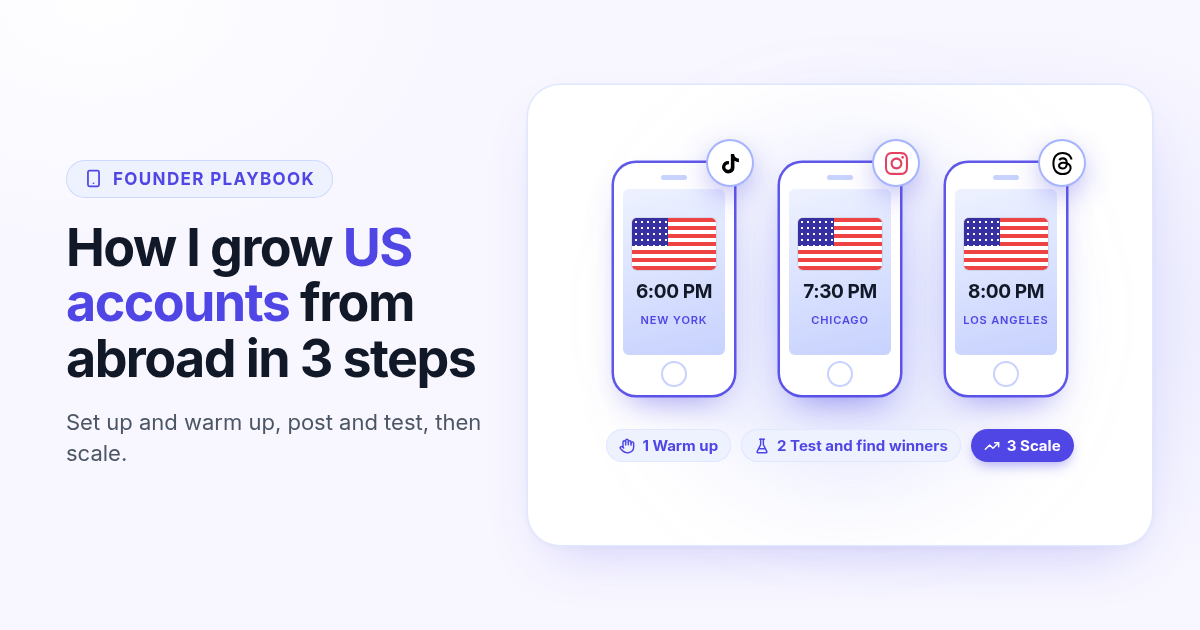
How I grow US TikTok accounts from abroad in 3 steps
I do not live in the US, but I grow accounts for a US audience. My 3 step playbook: set up and warm up a cheap dedicated phone, post and test for 30 days, then scale only the winners.
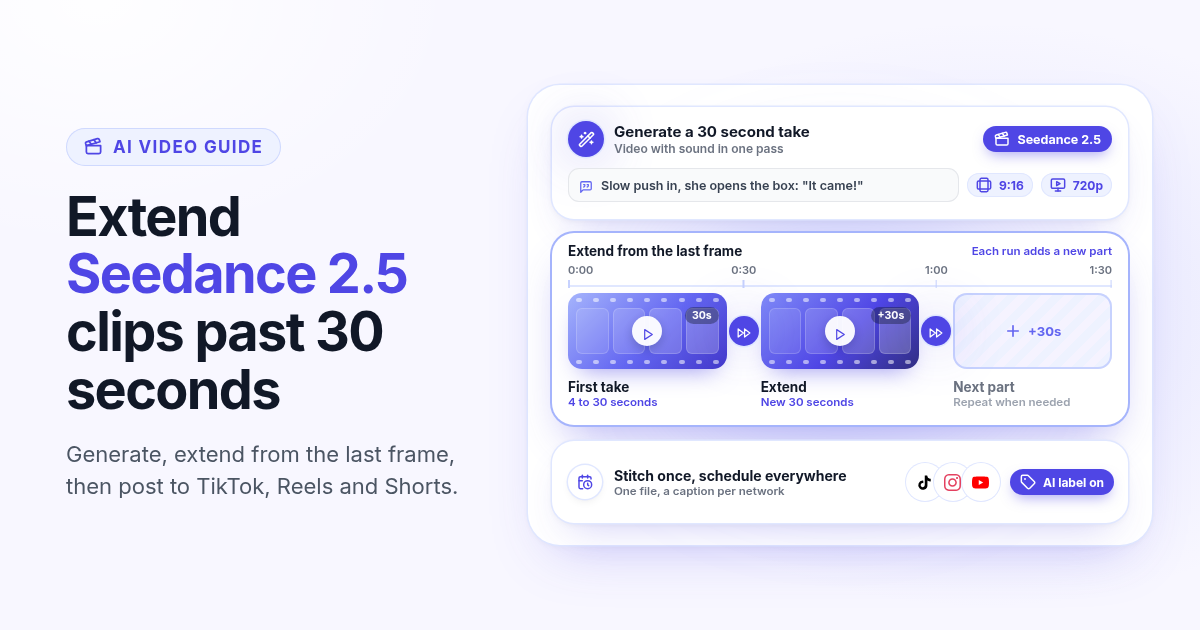
Seedance 2.5 AI video: how to extend clips past 30 seconds and post them to TikTok, Reels, and Shorts
Seedance 2.5 makes up to 30 seconds of video with sound in one take, and Extend continues it from the last frame. How to generate and extend a clip in Postlaty, what each second costs in tokens, and how to schedule it to TikTok, Reels and Shorts.
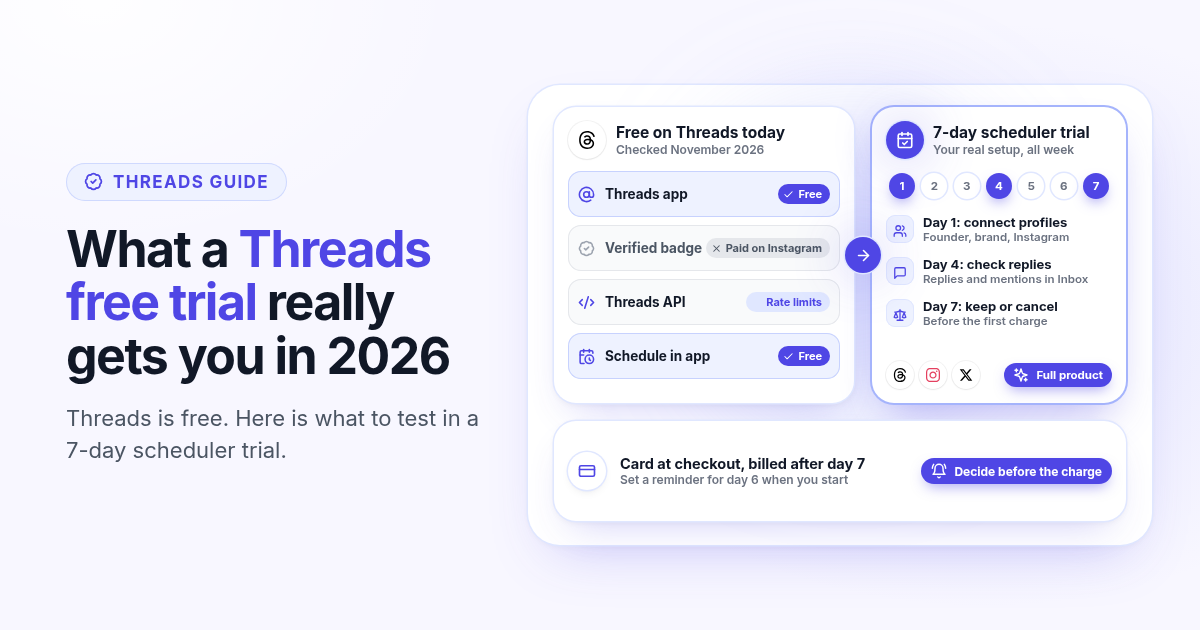
Threads free trial in 2026: what is free on Threads, and how to test a scheduler in 7 days
Threads has no paid plan, so there is no Threads free trial to start. Here is what a free Threads account already does, what the badge and the Threads API cost, and how to use a 7-day scheduler trial so you know by day 7 if a tool is worth paying for.
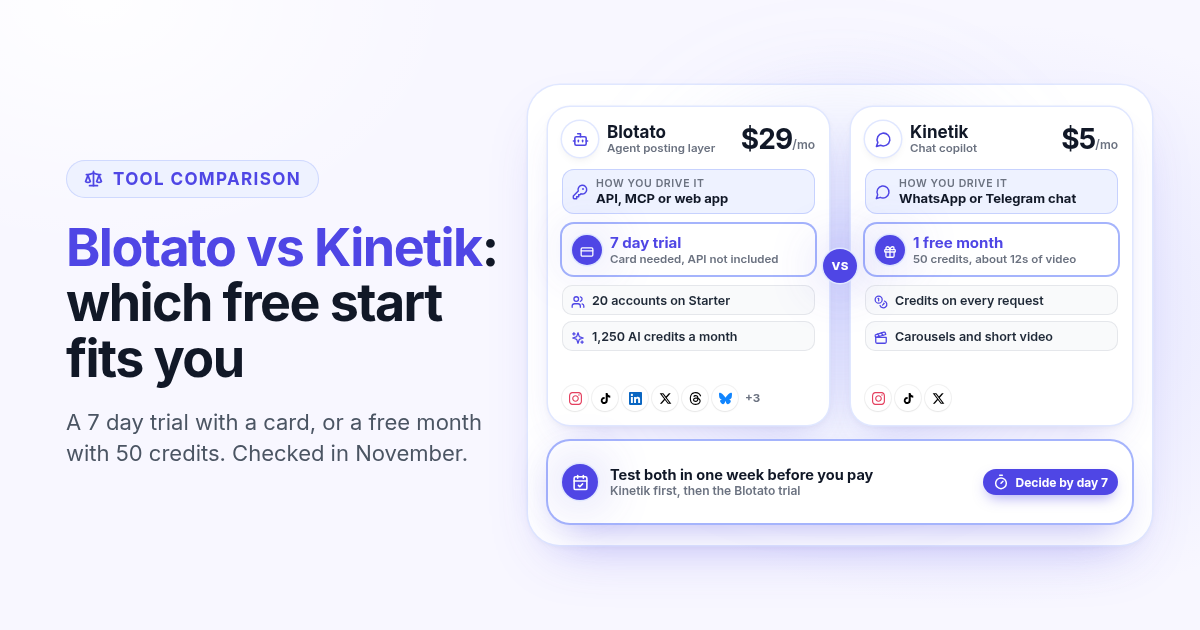
Blotato vs Kinetik in 2026: free trial, credits, and which AI social tool to test first
Blotato gives a 7-day trial with a card but no API, Kinetik gives a free month with 50 credits. Prices, credits, networks and how you drive each tool, checked November 2026, plus a one week test plan before you pay.
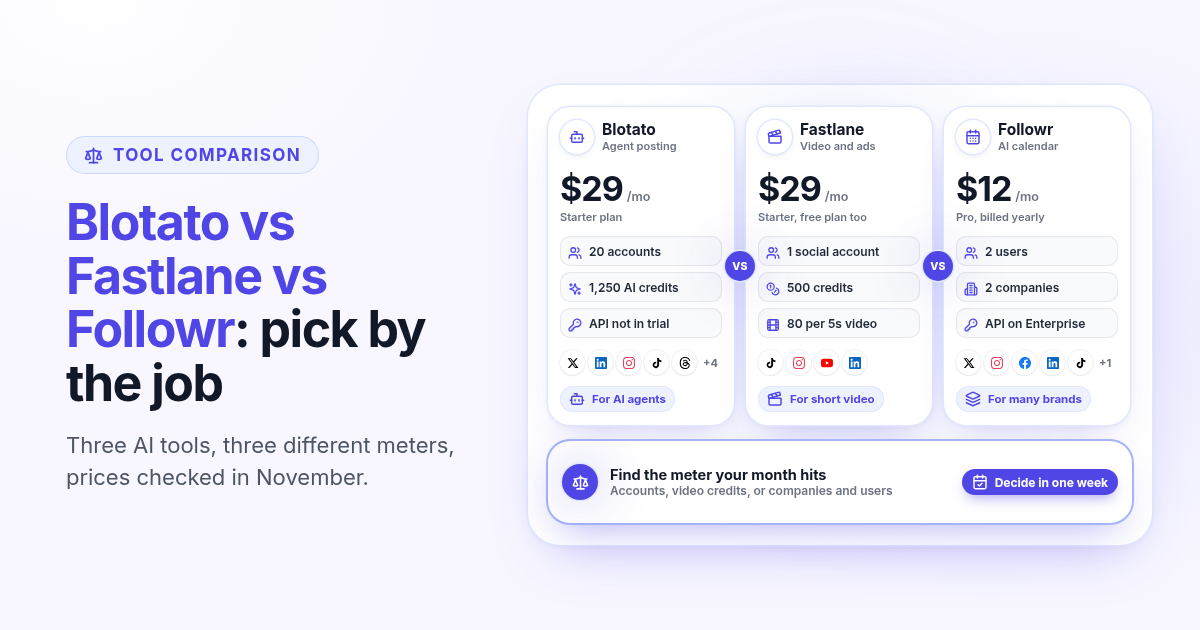
Blotato vs Fastlane vs Followr in 2026: which AI social media tool fits your job
Blotato, Fastlane and Followr all start cheap but meter different things: accounts and AI credits, video credits, or companies and users. Prices, networks and trials side by side, checked November 2026, and how to pick the right one in a week.
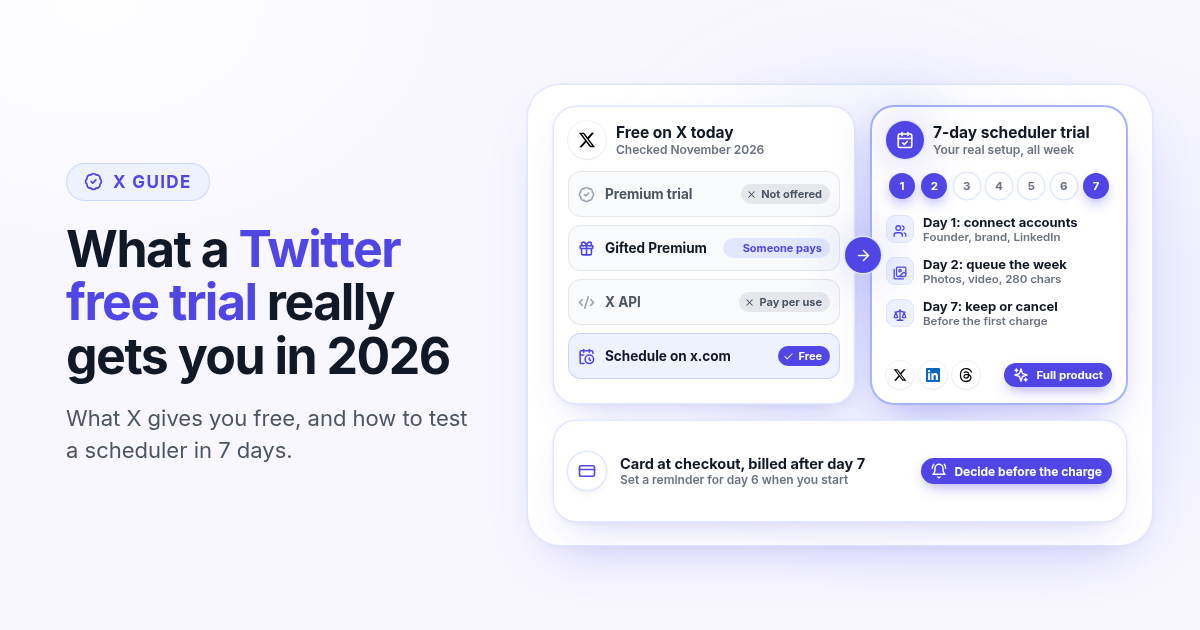
Twitter free trial in 2026: what X gives you for free, and how to test a scheduler in 7 days
X lists no free trial for Premium or The X Subscription, and the X API has no free plan for new developers. Here is what a free X account already does, what the API costs, and how to use a 7-day scheduler trial so you know by day 7 if it is worth paying for.
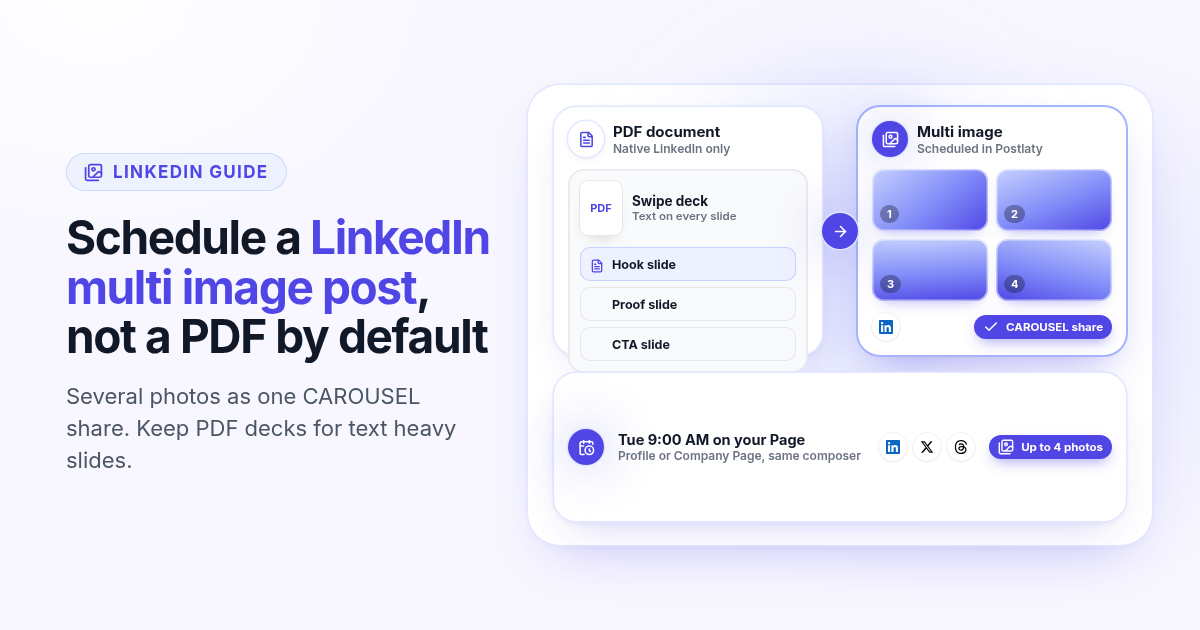
How to schedule a LinkedIn multi image post (and when a PDF carousel is better)
LinkedIn carousels usually mean a PDF. A multi image post is different: several photos as one share, including on a Company Page that cannot schedule multi photo posts natively. Here is how to queue the photo set in Postlaty, and when to stay with a document carousel.
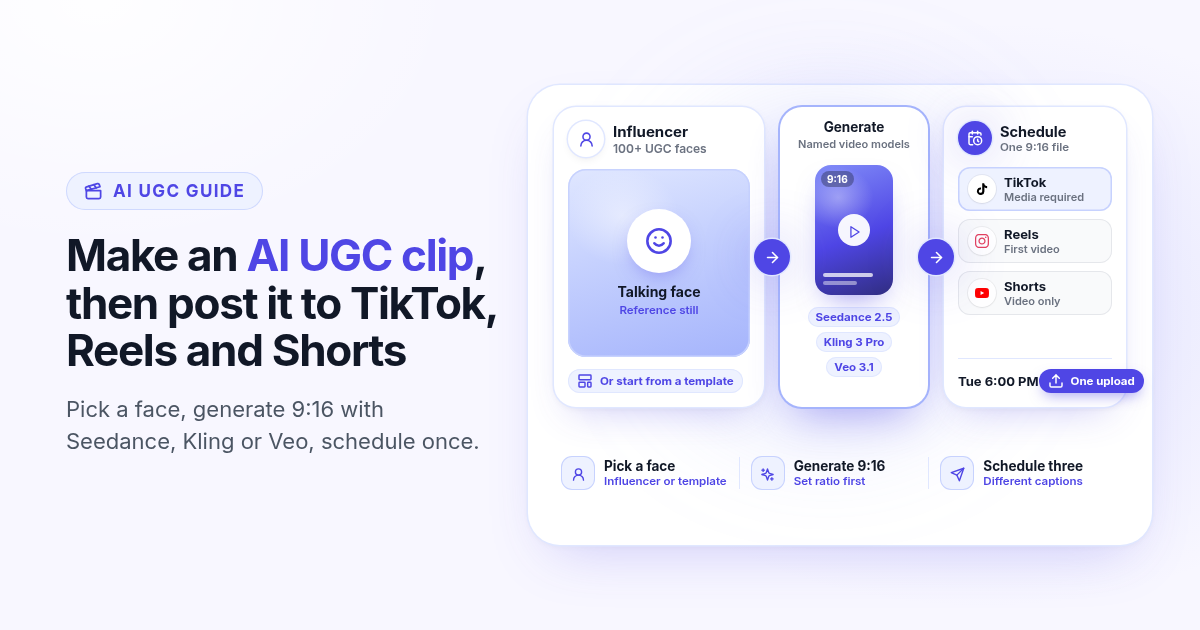
How to make an AI UGC clip and post it to TikTok, Reels, and Shorts
Pick a UGC influencer or template, generate a 9:16 talking clip with Seedance, Kling, Veo, or Grok Imagine, then schedule the same file to TikTok, Instagram Reels, and YouTube Shorts from one Postlaty post.
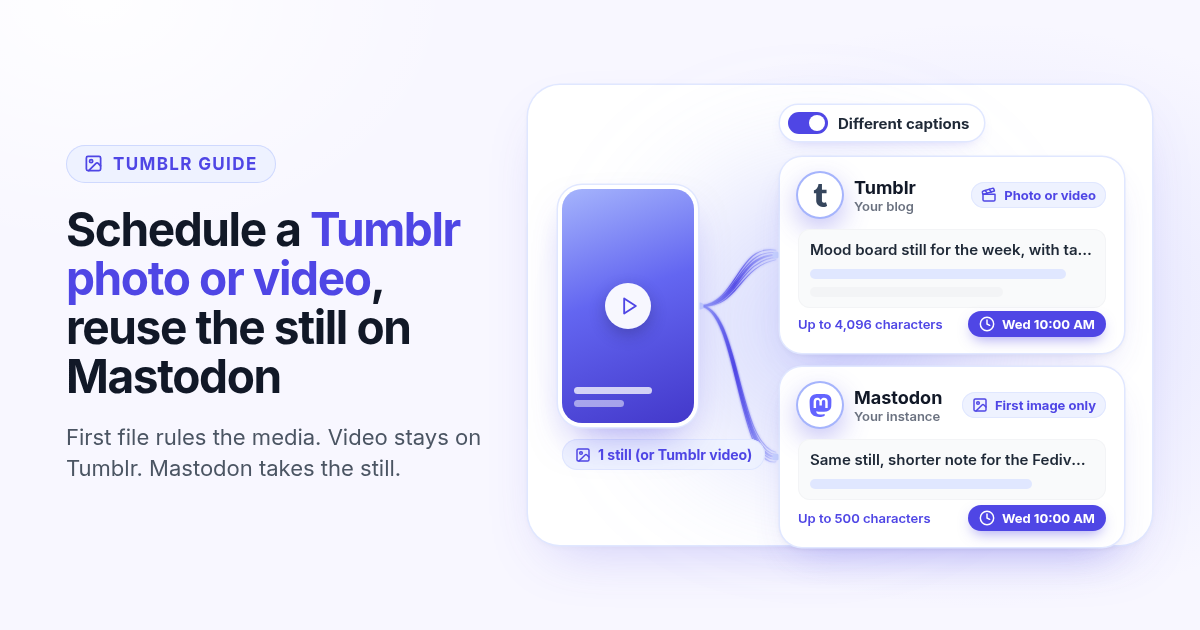
How to schedule a Tumblr photo or video (and reuse it on Mastodon)
Tumblr takes text plus the first image or video. Mastodon in Postlaty takes the first image and skips video. Connect both, attach one file, write two captions, and schedule the pair so the video stays on Tumblr only.
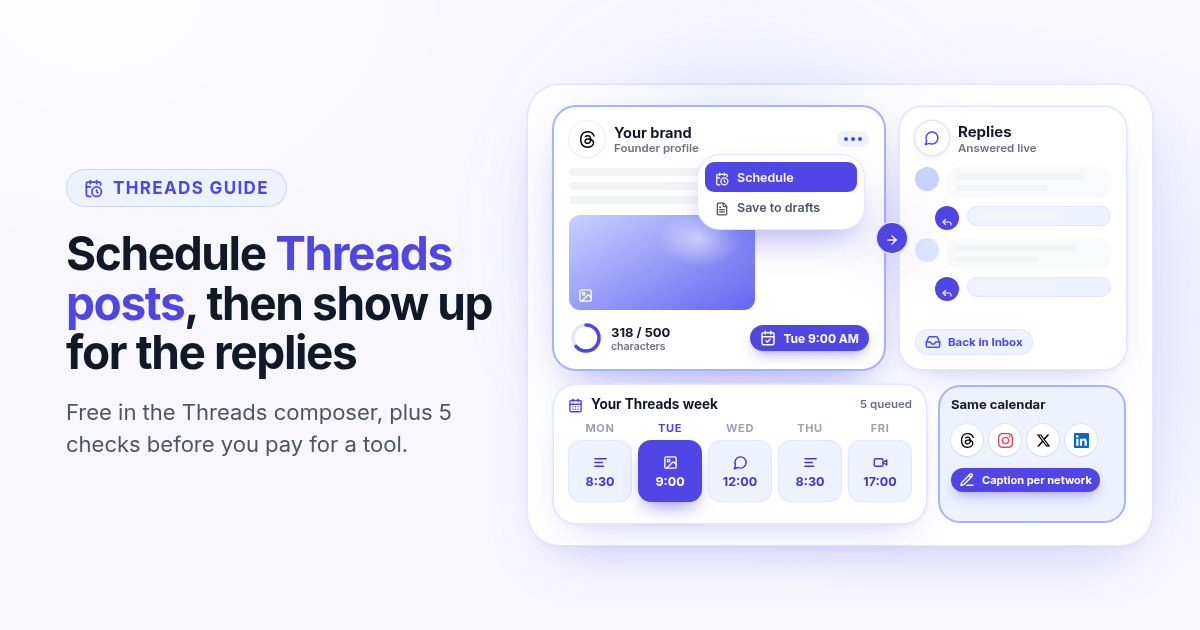
Threads scheduler in 2026: how to schedule Threads posts for free, and when a tool is worth it
Threads has a free scheduler in the composer three dot menu. How to use it step by step, where it stops (one profile, no week view, Threads only), five checks to run on any Threads scheduling tool, and a weekly routine built around replies.
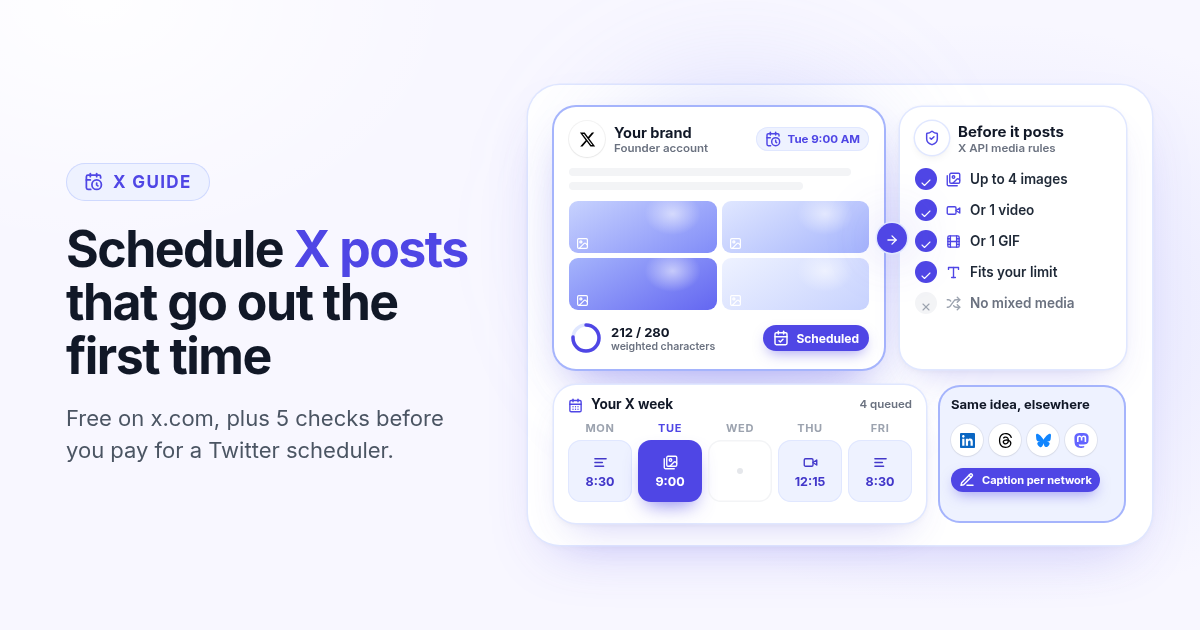
Twitter scheduler in 2026: how to schedule X posts for free, and 5 checks before you pay
X still has a free scheduler: the calendar icon in the x.com composer. How to use it step by step, where it stops (one account, no week view, no long posts on the web), and five checks to run on any paid Twitter scheduler during the trial.
How to schedule LinkedIn posts for free in 2026 (and when a paid tool is worth it)
LinkedIn's own scheduler is free: profile posts from 10 minutes to 3 months ahead, Company Page posts from 1 hour. How to use it step by step, what it cannot schedule, and five signs a paid LinkedIn scheduler is worth it.
TikTok scheduler apps in 2026: 7 checks before you trust one with your videos
What TikTok Studio already schedules for free, and seven checks to run on any TikTok scheduler app during the trial: direct posting, public visibility, TikTok settings, photo posts, editing, multiple accounts and cross posting.
Zoho Social alternatives in 2026: when you run more than one account per network
Zoho Social prices by brand, and a brand holds one account per network. How Zoho Social pricing works in 2026, what three TikToks and three Instagrams really cost, and what to look for in an alternative priced by channels.
NapoleonCat alternatives in 2026: when you create more than you moderate
NapoleonCat is a strong moderation and inbox suite priced by users and profiles. If you spend more time making posts than moderating comments, here is what its 2026 pricing covers and what to look for in an alternative.
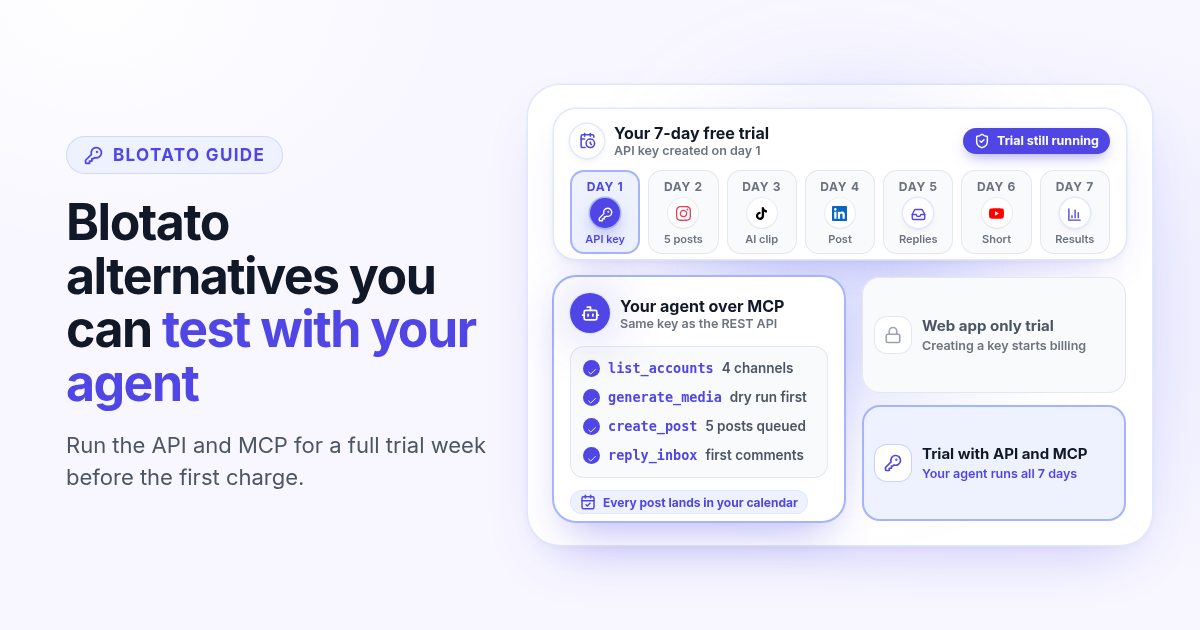
Blotato alternatives in 2026: when you want to test the API before you pay
Blotato starts at $29 a month for 20 accounts, but its free trial leaves out the API and MCP. How Blotato pricing works in 2026, why creating an API key ends the trial, and what to test in an alternative when an agent posts for you.
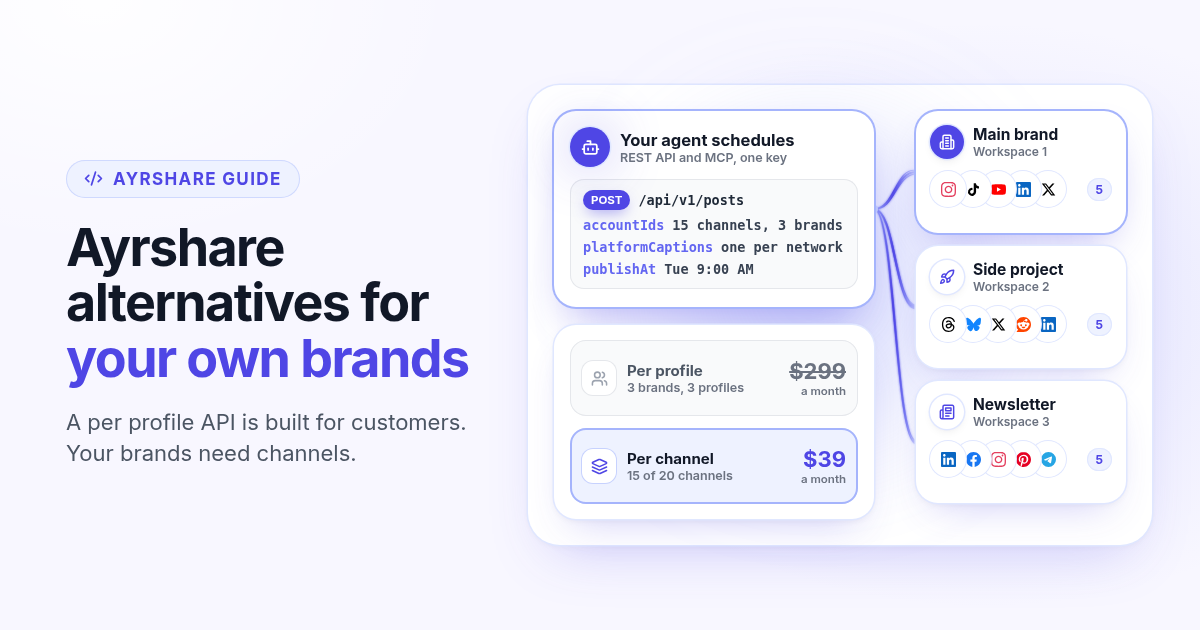
Ayrshare alternatives in 2026: when you post for your own brands, not customers
Ayrshare is a social media API billed per profile, from $149 a month for one. How Ayrshare pricing works in 2026, why profiles and channels lead to very different bills when the brands are yours, and what to test in an alternative with API and MCP on every plan.
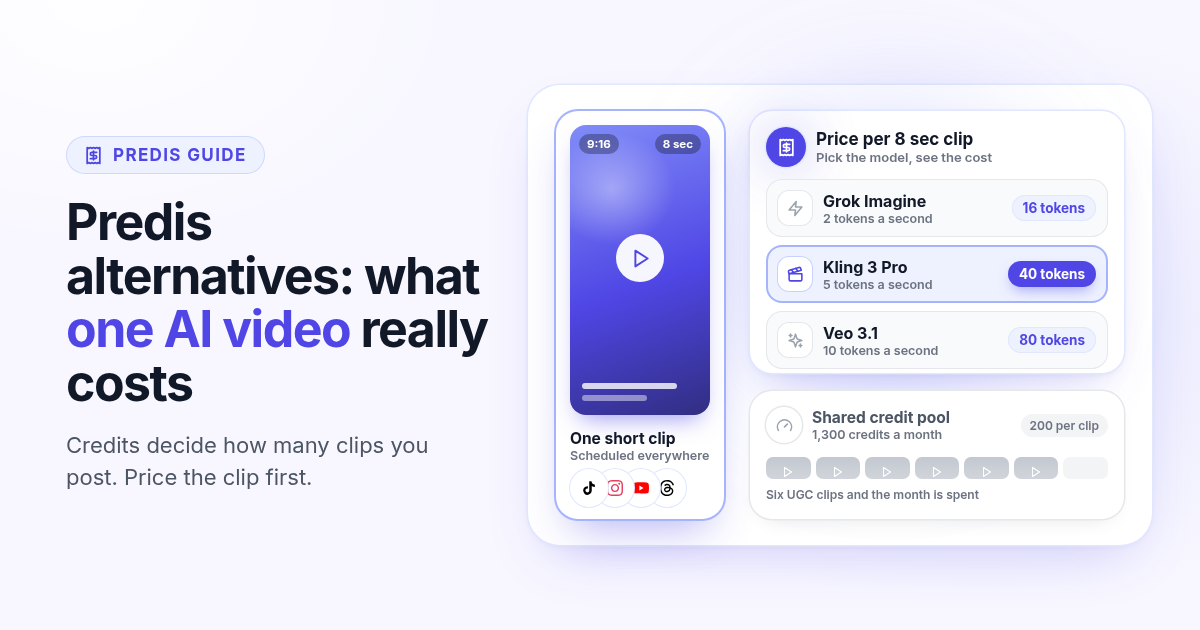
Predis alternatives in 2026: what one AI video really costs you
Predis.ai starts at $19 a month billed yearly, but credits decide how many AI videos you get. How Predis pricing works in 2026, what one clip costs on each plan, and how to price a real week of video in an alternative before you switch.
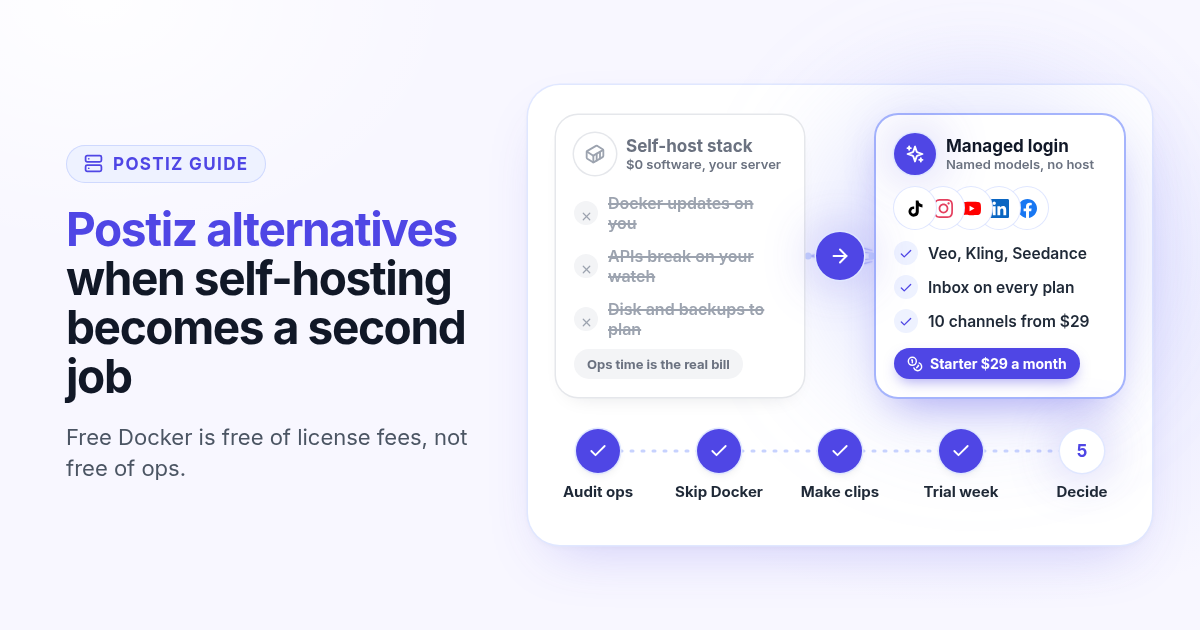
Postiz alternatives in 2026: when self-hosting becomes a second job
Postiz is a strong open-source scheduler with a free Docker install and hosted plans from $29. How Postiz pricing works in 2026, when self-hosting costs more than the bill, and what to test in a managed alternative with named AI video and inbox on the first plan.
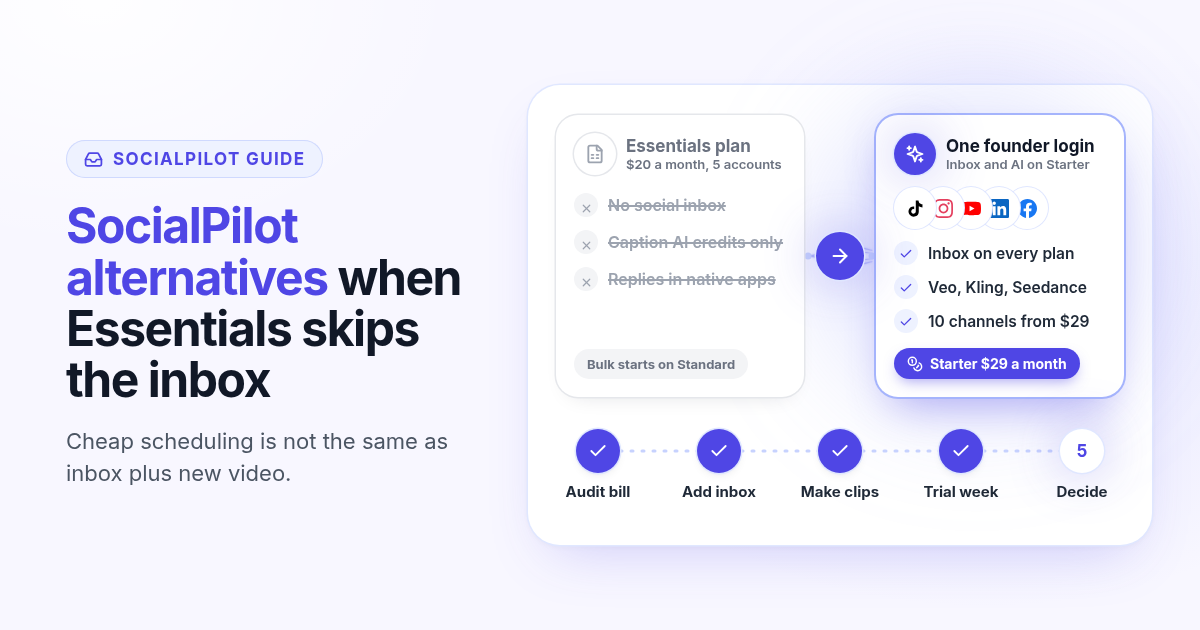
SocialPilot alternatives in 2026: when the cheap plan skips the inbox
SocialPilot Essentials is $20 a month for 5 accounts, but the inbox starts on Standard at $40. How SocialPilot pricing works in 2026, when bulk scheduling is enough, and what to test in an alternative that includes inbox and AI video on the first plan.
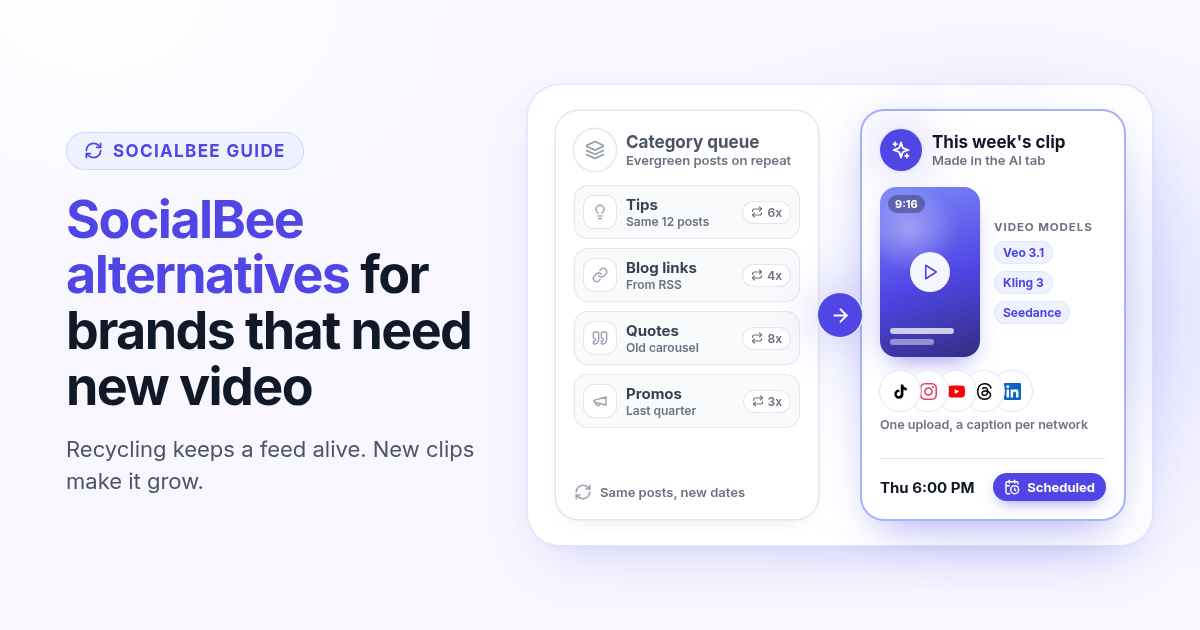
SocialBee alternatives in 2026: when recycled posts stop growing your accounts
SocialBee recycles evergreen posts by category, which keeps a feed active but rarely grows it on TikTok, Reels and Shorts. How SocialBee pricing works in 2026, how to audit your queue, and what to test in an alternative that makes new video.
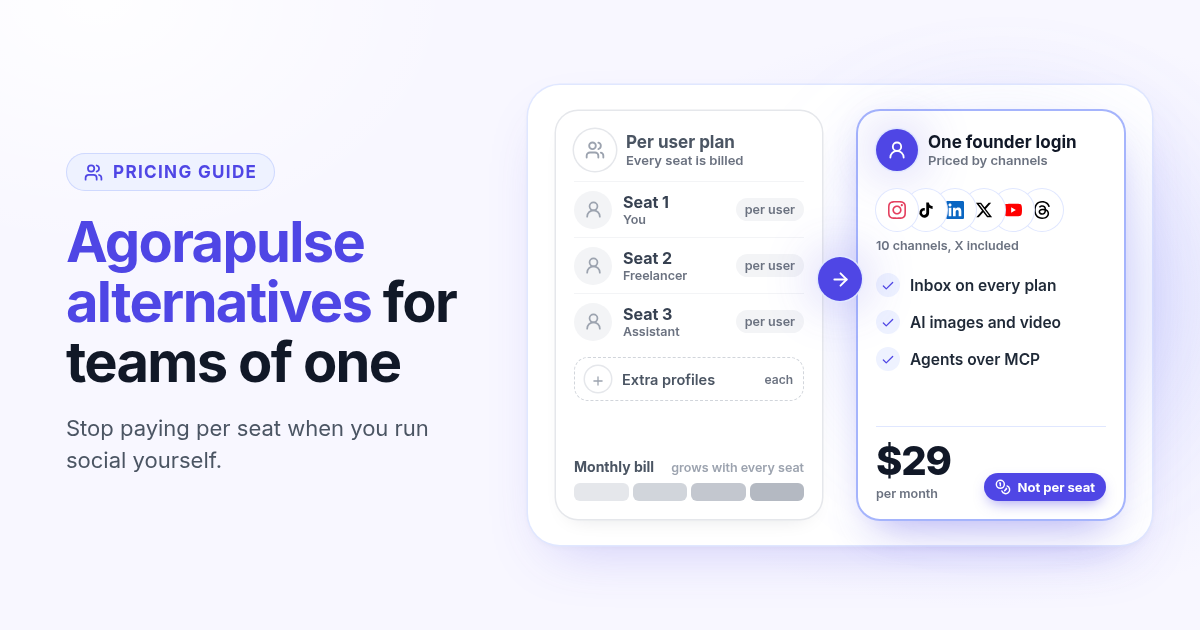
Agorapulse alternatives in 2026: when you pay per seat but post alone
Agorapulse prices every plan per user, which suits social teams more than founders. See how its pricing works in 2026, check which features you really use, and know what to test in any Agorapulse alternative before you switch.
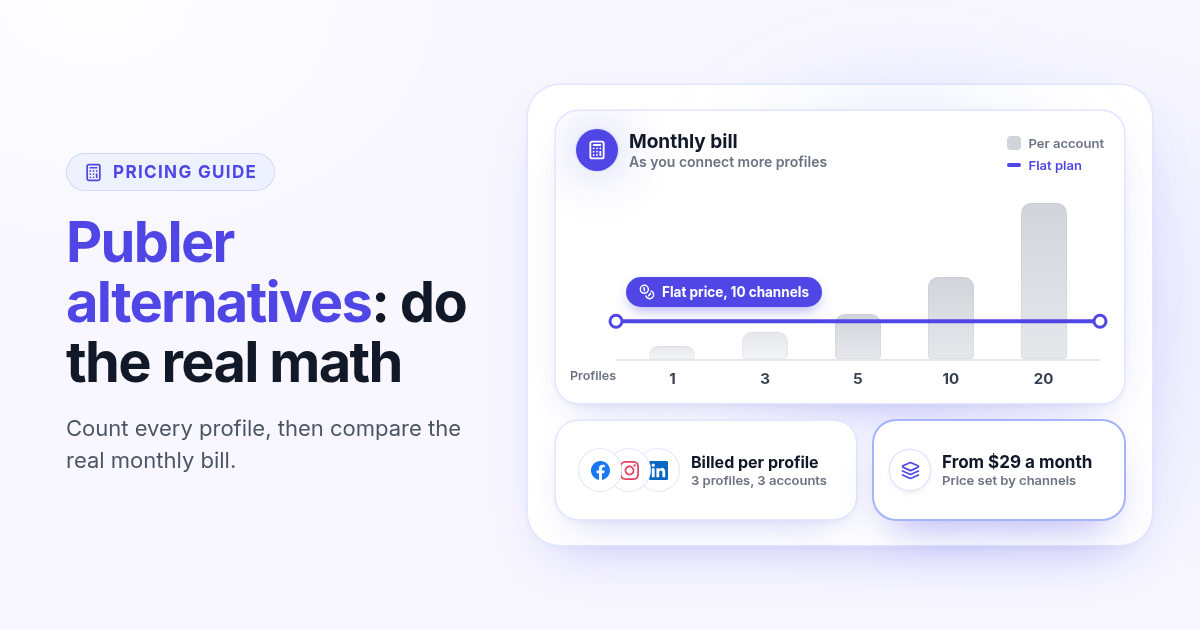
Publer alternatives in 2026: when per account pricing stops paying off
Publer bills per social account, so the price climbs with every Page and profile. Count what you really pay, spot the five signs you have outgrown it, and know what to test in any Publer alternative before you switch.
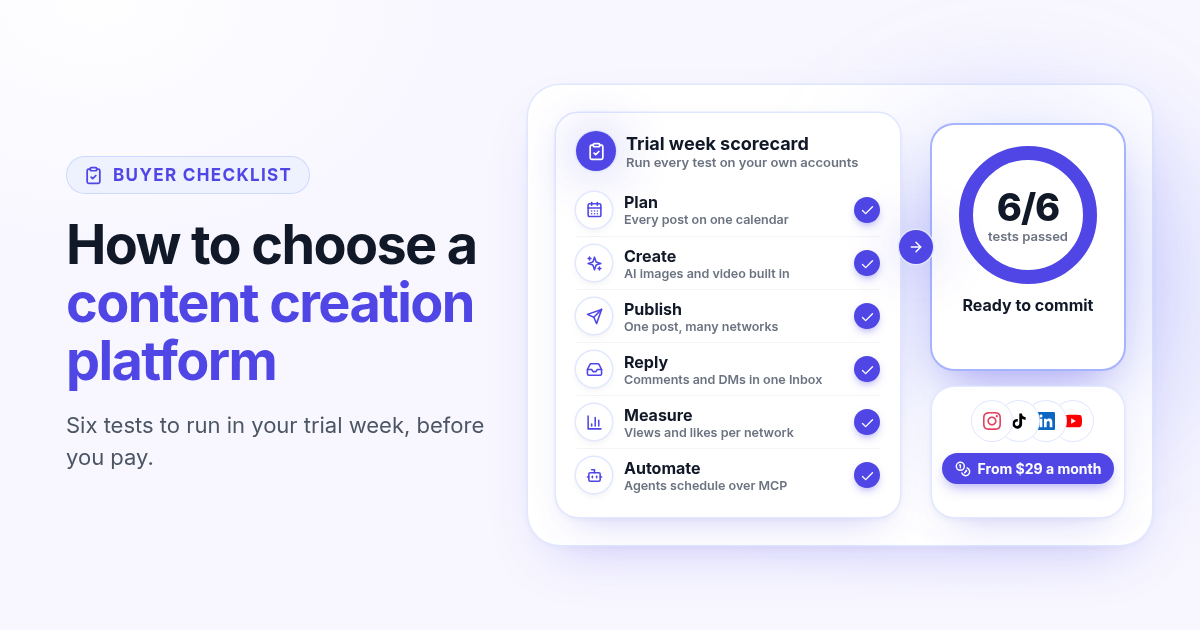
How to choose a content creation platform: 6 tests to run before you pay
A founder checklist for picking a content creation platform: add up the stack you pay for, then use a 7-day trial to test planning, AI images and video, publishing to every network, one Inbox for replies, per network numbers and AI agents.
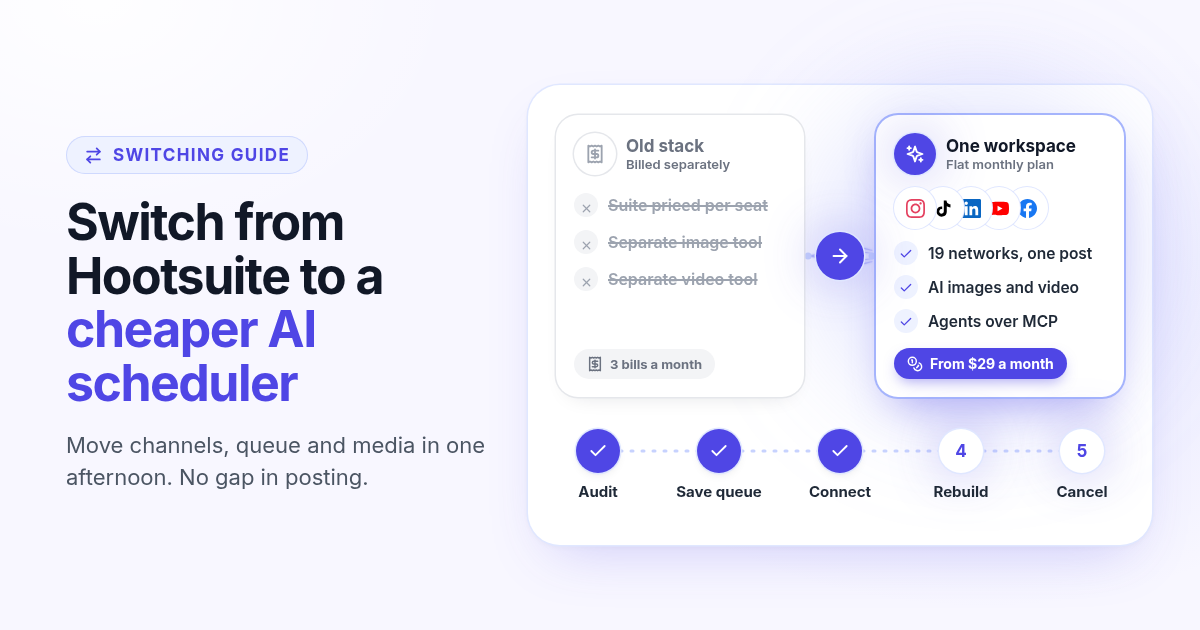
How to switch from Hootsuite to a cheaper AI scheduler in one afternoon
A step by step plan to leave Hootsuite without a gap in posting: audit what you use, save your queue and media, connect your channels, rebuild two weeks of posts, add AI images, video and agents, then cancel before renewal.
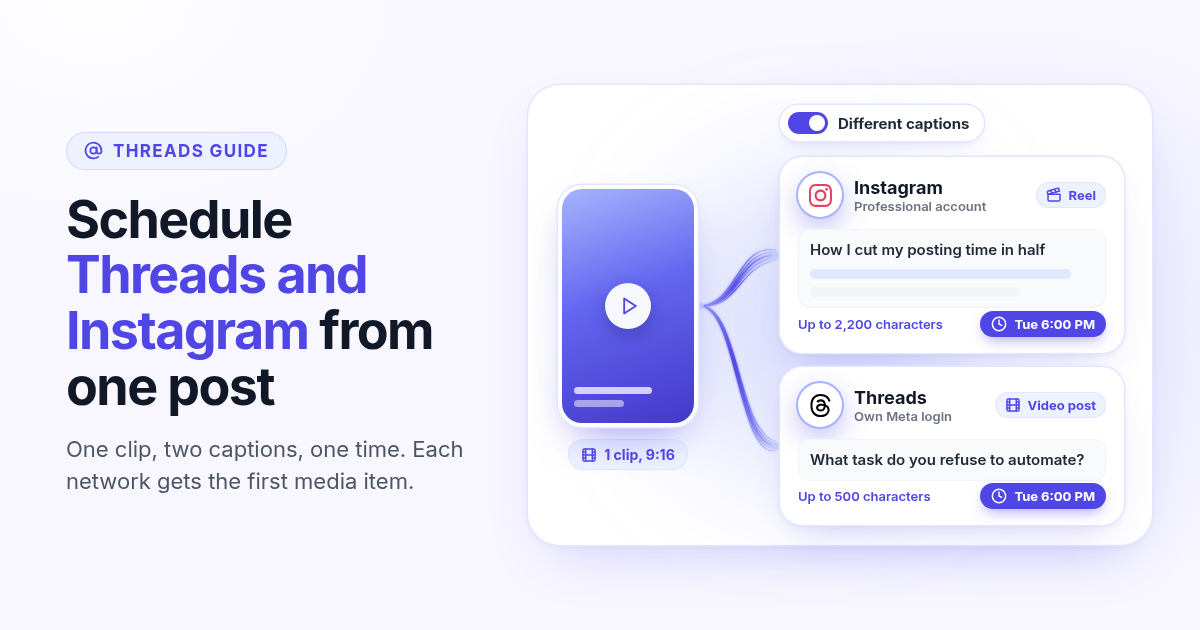
How to schedule Threads and Instagram together from one post
Schedule a Reel or photo to Instagram and Threads at the same time from one post. Connect both Meta accounts, attach one file, write a long Instagram caption and a short Threads caption, and pick one time.
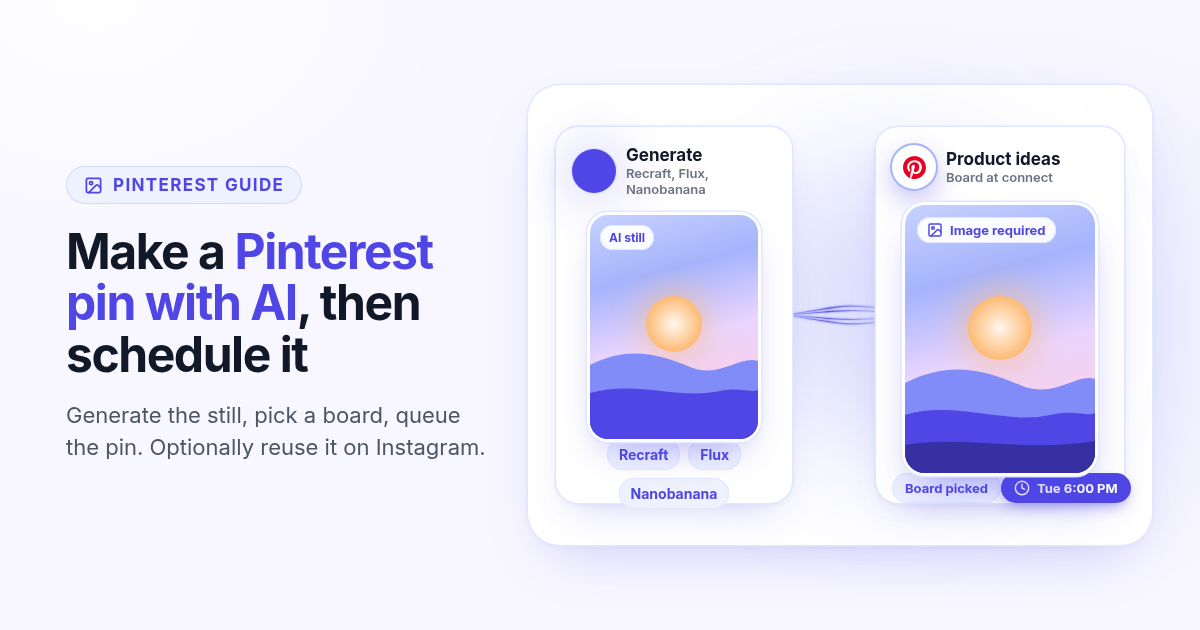
How to make a Pinterest pin with AI and schedule it to a board
Generate a Pinterest pin image with Recraft, Flux, or Nanobanana, pick a Business board at connect, and schedule the pin from Create. Image required. Optionally reuse the still on Instagram.
How to schedule a Dev.to article and the posts that point to it
Schedule a Dev.to article and the short X, LinkedIn, or Bluesky posts that point to it from one queue. Connect with an API key, write the title and body, then ship pointers instead of pasting the markdown.
How to schedule a Discord announcement and the public post together
Schedule a Discord announcement and the matching Instagram and X post from one queue. Add the bot to your server, pick the channel, send text to Discord and the visual to the public networks.
How to cross-post to Bluesky and Mastodon (and where video fails)
Cross-post Bluesky and Mastodon from one composer. Connect with an app password and a server token, share one still, and know why a Bluesky video will not publish as Mastodon video.
How to schedule Telegram channel posts as yourself (not as a bot)
Native Telegram schedule works for one message. Most tools post as a BotFather bot. Here is how to connect with your phone, pick a chat, and schedule posts as yourself with Postlaty.
How to schedule Pixelfed posts (a photo is required)
Pixelfed is photo-first and has no real content calendar. Here is how to connect any server with an access token, attach a photo, and schedule posts ahead with Postlaty.
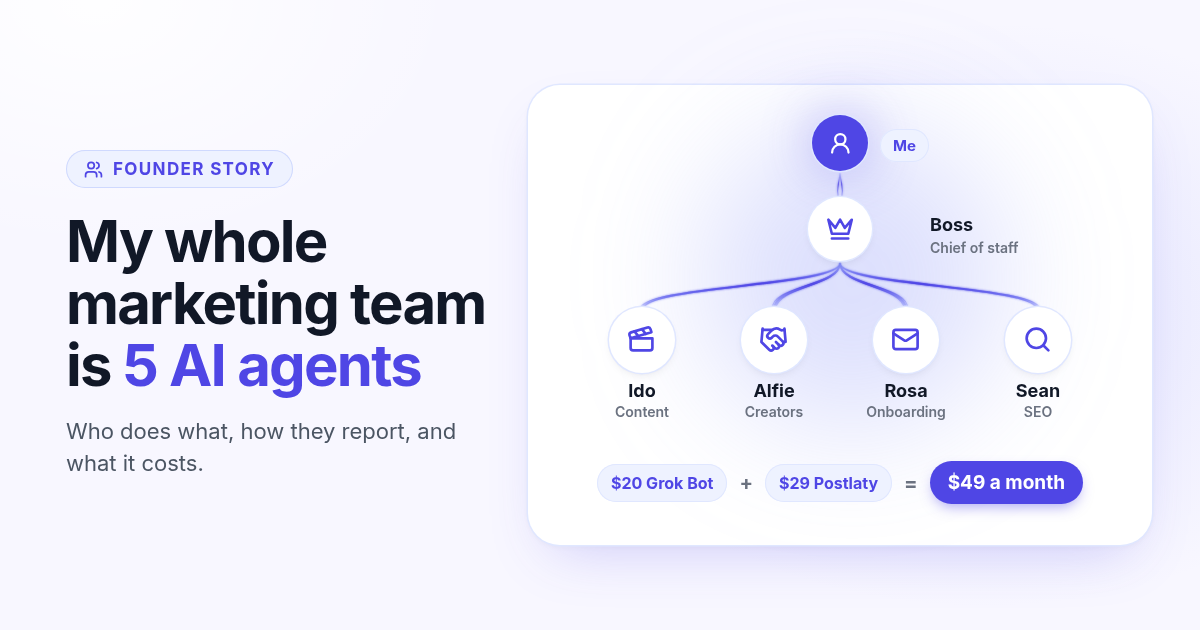
How I run my whole marketing team with AI agents for $49 a month
I am a solo founder. My marketing team is five AI agents that post, reach out, email, and write, then report to me daily. Here is who does what and what it costs.
How to schedule Whop posts to your community forum
Whop forums publish when you press Post. Here is how to schedule Whop posts ahead with a company API key, what to write, and how replies reach your inbox.
How to post the same short video to TikTok, Instagram Reels, and YouTube Shorts
One 9:16 file can feed TikTok, Reels, and Shorts. This guide covers aspect ratio, captions, covers, and a publish path that does not recrop three times.