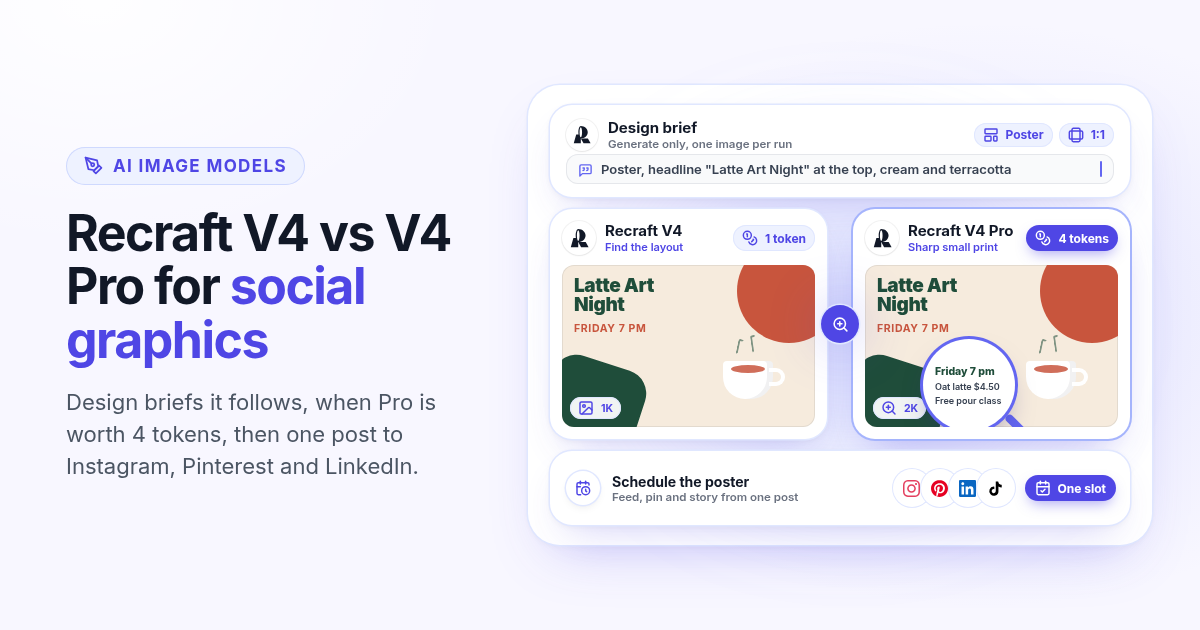
Most AI image models are tuned to make a pretty picture. Recraft is tuned to make a design: a poster, a quote card, an event announcement, a menu, an icon. When the image is the layout and not a photo, it is the model I reach for first, because the output looks art directed instead of stock.
Postlaty runs two versions of it: Recraft V4 at 1 token per image and Recraft V4 Pro at 4 tokens. This guide covers what each one is good at, how to write a design brief it follows, when the Pro version is actually worth four times the tokens for social posts, and how to schedule the finished graphic to Instagram, LinkedIn, Pinterest and the rest from one post.
What Recraft V4 is good at
Recraft released V4 in February 2026 as a ground up rebuild focused on what it calls design taste: balanced composition, cohesive color and detail that feels intentional. Its own documentation points to four strengths that matter for social content:
Layouts, not just scenes
Posters, flyers, packaging, menus and event cards come back with a real composition: a clear headline zone, margins and a visual hierarchy.
Readable short text
Recraft says V4 renders short and mid length phrases cleanly. A headline, a date and a call to action on one card is the sweet spot.
Graphic styles
Flat illustration, icons, bold geometric shapes and clean brand graphics are where it stands out from photo first models.
Strong prompt following
It follows detailed creative direction: what sits where, which colors, what material, what the background does.
If your post is a product photo that has to match your brand colors, the Flux 2 Pro guide is the better fit. If it is a dense infographic or a slide full of text, read the Nano Banana Pro vs GPT Image 2.6 comparison. Recraft is the one for designed graphics with a few words on them.
Recraft V4 vs V4 Pro: the only real difference
Recraft is clear about this: both versions share the same design taste and prompt understanding. The difference is resolution and detail. V4 Pro generates at a higher native resolution (2048 by 2048 for a square image, against about 1024 for V4) and Recraft recommends it for print ready assets, large formats and pixel dense detail. In Postlaty the token cost follows that split:
1 token
Recraft V4, one image
4 tokens
Recraft V4 Pro, one image
7 tokens
a week of V4 graphics, one a day
A phone screen shows a feed image at roughly 1080 pixels wide, so for most social graphics V4 already gives you enough pixels. Pro earns its 4 tokens in three cases:
Small text that people will zoom into: fine print on an event card, a price list, ingredients on packaging.
Dense detail across the whole frame, like a pattern, a crowded illustration or a textured background.
The same file has a second life outside social: a printed flyer, a banner on your site, a pitch deck cover.
For a bold headline on a square card, V4 is plenty. My rule: find the layout with V4, then run the winning prompt once on Pro only if the post needs it.
Cost and settings in Postlaty
Both versions sit in the AI tab image models list, next to Flux, Nano Banana, Seedream, Grok Imagine and GPT Image 2.6. The total shows on the Generate button before you spend anything.
Five ratios
9:16, 16:9, 1:1, 3:4 and 4:3. Pick the network shape first, because the layout is built around it.
One image per run
The image count picker is hidden for Recraft. Each run returns one design, so iterate by changing the brief.
Generation only
Recraft is not offered in Editing. To change a design, regenerate with a tighter brief, or edit the result with another model.
Failed runs refunded
If a generation fails, the reserved tokens go back to your balance.
How to write a design brief it follows
Treat Recraft like a designer, not a camera. Lead with the type of graphic, then the text, then palette and layout. Here is the pattern I use for an event post:
Square social media poster for a coffee shop, bold flat illustration of a steaming cup, headline "Latte Art Night" in a heavy rounded sans serif at the top, "Friday 7 pm" in smaller type below it, warm cream background with terracotta and deep green shapes, generous margins, nothing else on the poster
- 1
Name the graphic type first
Poster, quote card, logo, icon set, menu, product label. It tells the model which design rules to apply.
- 2
Quote every word that must appear
Put the headline and any short line in quotes, and say where each one sits: top, centered, bottom left.
- 3
Describe the type, not just the words
Weight, style and spacing: heavy rounded sans serif, thin serif, wide letter spacing.
- 4
Give the palette and the layout
Two or three colors with a job each (background, shapes, text), plus margins and where the empty space goes.
- 5
Close the brief
End with nothing else on the poster or no extra objects so the model does not add decoration you did not ask for.
Keep on image copy short. A headline plus one line is reliable. A paragraph belongs in the caption.
On Pro, add production constraints: a grid, fixed margins, print safe colors. The in app tips suggest exactly that.
Check every letter at full size before you schedule. Read the date and the price twice.
Five social graphics that suit Recraft
Event and launch announcements
Name, date, one visual. Square for the feed, 9:16 for a story or a TikTok photo post.
Quote cards
One short line in strong type on a designed background. Fast to make a week of them on V4.
Pinterest pins
A 3:4 poster with a headline that says what the pin links to.
Icons and simple brand marks
Profile badges, highlight covers, series icons. Generate a few and keep the one that fits your feed.
Menus, price lists, offers
The one case where I go straight to Pro, because people zoom in on prices.
Schedule the graphic where it fits
Open a finished image in the AI tab gallery and click Select, and Postlaty opens a new post with it attached. From the Generate card inside a post, the image you select is added to that post. Then plan it per network:
Ratio by network
Instagram feed images have to sit between 4:5 and 1.91:1, so use 1:1 or 4:3 there. Use 3:4 for a pin and 9:16 for a TikTok photo post.
Several graphics in one post
LinkedIn publishes a multi image post, X takes multiple images, Bluesky takes up to 4, and TikTok publishes them as a photo post.
First image only
Instagram, Pinterest, Threads and Facebook get the first image of the post. Put the strongest design first.
One slot on the calendar
Pick the time once and switch to Different captions so each network gets its own line. Channels count toward your plan: 10 on Starter, 20 on Pro and 50 on Premium.
For a full pin from prompt to board, see the AI Pinterest pin guide, and for a carousel of designs, how to schedule a LinkedIn multi image post.
Limitations to know
No editing with Recraft in Postlaty, and Recraft itself lists prompt based editing as not yet supported in V4.
Postlaty saves raster images. Recraft vector (SVG) output is not part of the generator.
Starter includes 10 tokens a month: ten V4 graphics or two Pro ones. Daily posting needs Pro (50), Premium (100) or a token pack.
The 7-day free trial is for scheduling. Your plan tokens arrive with the first paid invoice.
The bottom line
Use Recraft V4 when the post is a design: an announcement, a quote card, a pin, an icon. Write it like a brief (graphic type, quoted text, type style, palette, layout) and iterate at 1 token a run. Switch to V4 Pro only for small print, dense detail or a file that will also be printed. If you want an agent to write the briefs and fill the calendar for you, read how I run my marketing team with AI agents for $49 a month. Check plans and token packs on pricing, and see how each network handles images on the Instagram, LinkedIn and Pinterest pages.
FAQ
Frequently Asked Questions
Recraft says both share the same design taste and prompt understanding. V4 Pro generates at a higher resolution (2048 by 2048 for a square image) with finer detail, and Recraft recommends it for print ready and large format work.
Recraft V4 is 1 token per image and Recraft V4 Pro is 4 tokens per image. Each run returns one image, and failed runs are refunded to your balance.
Usually not. A feed image is shown at about 1080 pixels wide, so V4 is enough for a headline on a card. Use Pro for small print people zoom into, dense detail, or a file you will also print.
Yes. Recraft says V4 renders short and mid length phrases clearly. Put every word in quotes in the prompt, say where it sits and how the type looks, and check the spelling before you schedule.
No. Recraft is generation only in Postlaty, and Recraft lists prompt based editing as not yet supported in V4. Regenerate with a tighter brief, or edit the result with another model such as Flux 2 Pro.
Postlaty has a 7-day free trial for scheduling. The AI models run on tokens, and your plan tokens arrive with the first paid invoice.
Blog
More articles
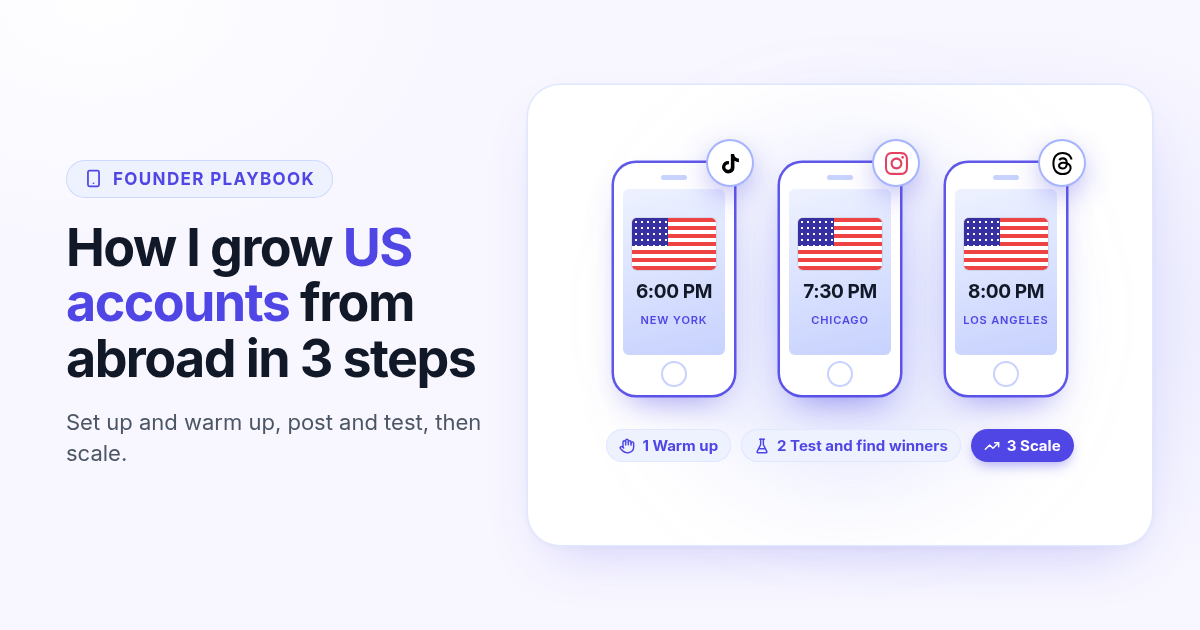
How I grow US TikTok accounts from abroad in 3 steps
I do not live in the US, but I grow accounts for a US audience. My 3 step playbook: set up and warm up a cheap dedicated phone, post and test for 30 days, then scale only the winners.
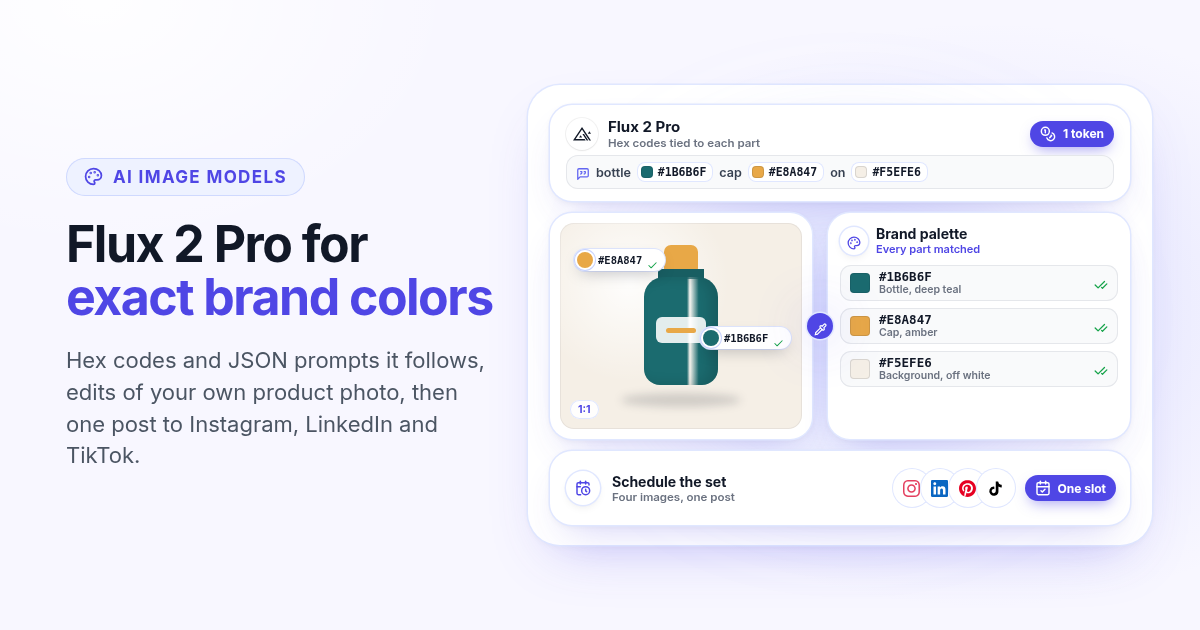
Flux 2 Pro for social images: exact brand colors with hex codes, JSON prompts and photo edits
Flux 2 Pro from Black Forest Labs matches hex codes you write in the prompt. How to write color and JSON prompts it follows, edit your own product photo with it, what it costs in Postlaty, and how to schedule the set to Instagram, LinkedIn, Pinterest and TikTok.
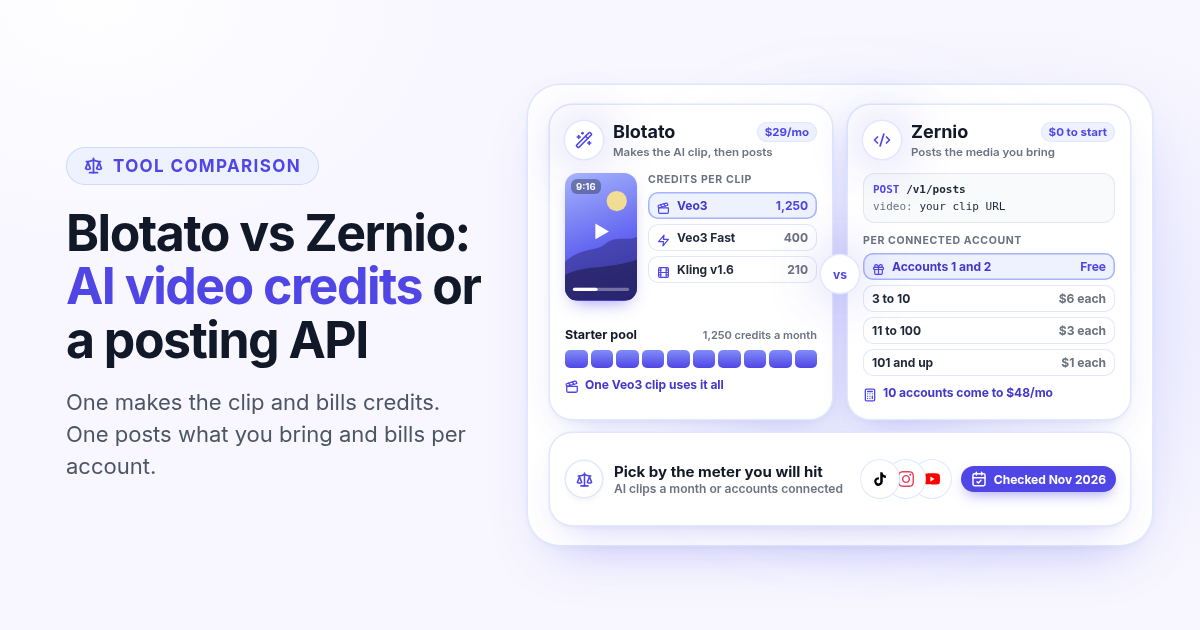
Blotato vs Zernio in 2026: AI video credits or a pay per account posting API
Blotato makes the AI clip and posts it, billed in credits. Zernio posts the media you bring, billed per connected account. Prices, free tiers, networks and AI video costs, checked 22 November 2026, plus how to pick in one afternoon.
Grok Imagine video guide: make 1 to 15 second AI clips for 2 tokens a second, then post them to TikTok, Reels, and Shorts
Grok Imagine from xAI lets you pick any clip length from 1 to 15 seconds. How to prompt it from text or a still, what it costs per second in Postlaty, and how to schedule the clip to TikTok, Reels and Shorts in one post.
Veo 3.1 talking video guide: write dialogue that lip syncs, then post it to TikTok, Reels, and Shorts
Veo 3.1 from Google makes the picture and the voice in one pass. How to write a line it actually says, how long that line can be in 4, 6 or 8 seconds, what it costs per second in Postlaty, and how to schedule the talking clip in one post.
How to schedule Bluesky posts with images in 2026, including AI images made for the feed
Bluesky still has no schedule button. How to queue Bluesky posts with up to four native images, make those images with AI at the right ratio, keep each file under 2 MB, and write 300 characters that double as alt text.
Kling Motion Control guide: copy a dance or gesture onto your own character for TikTok, Reels, and Shorts
Kling Motion Control takes the movement from a real video and puts it on your character. How to pick a reference clip that transfers cleanly, what to write in the prompt, what it costs per second in Postlaty, and how to schedule the clip in one post.
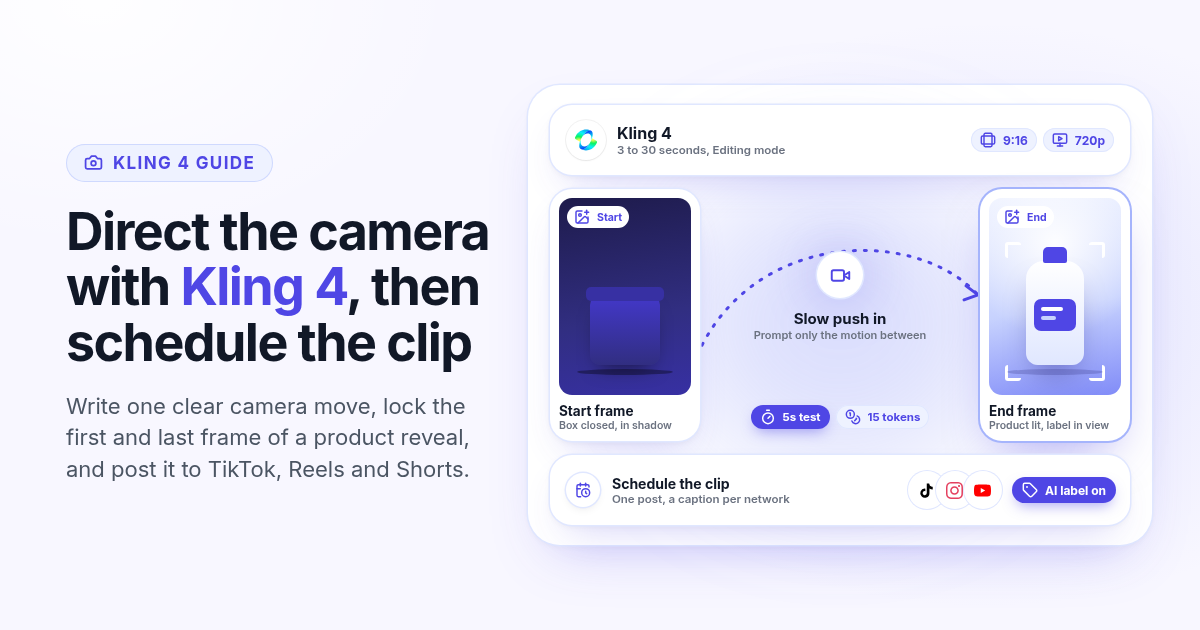
Kling 4 AI video guide: camera moves, start and end frames, and 30 second clips for TikTok, Reels, and Shorts
Kling 4 from Kuaishou is built around camera control and makes up to 30 seconds in one take. How to write camera moves it follows, how to lock a product reveal with a start and end frame, what it costs per second in Postlaty, and how to schedule the clip in one post.
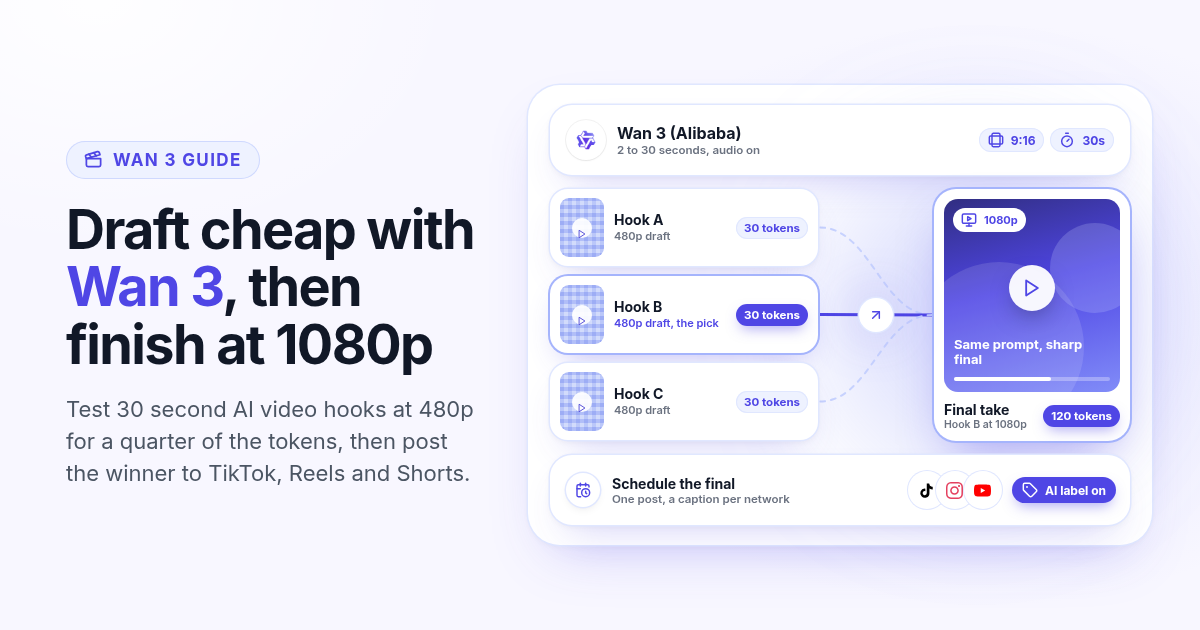
Wan 3 AI video guide: draft 30 second clips at 480p, finish at 1080p, and post them to TikTok, Reels, and Shorts
Wan 3 from Alibaba makes up to 30 seconds of video in one take, and in Postlaty a 480p draft costs a quarter of the same clip at 1080p. What the model is, what it costs per second, how to prompt it, and the draft then finish routine that ends in one scheduled post.
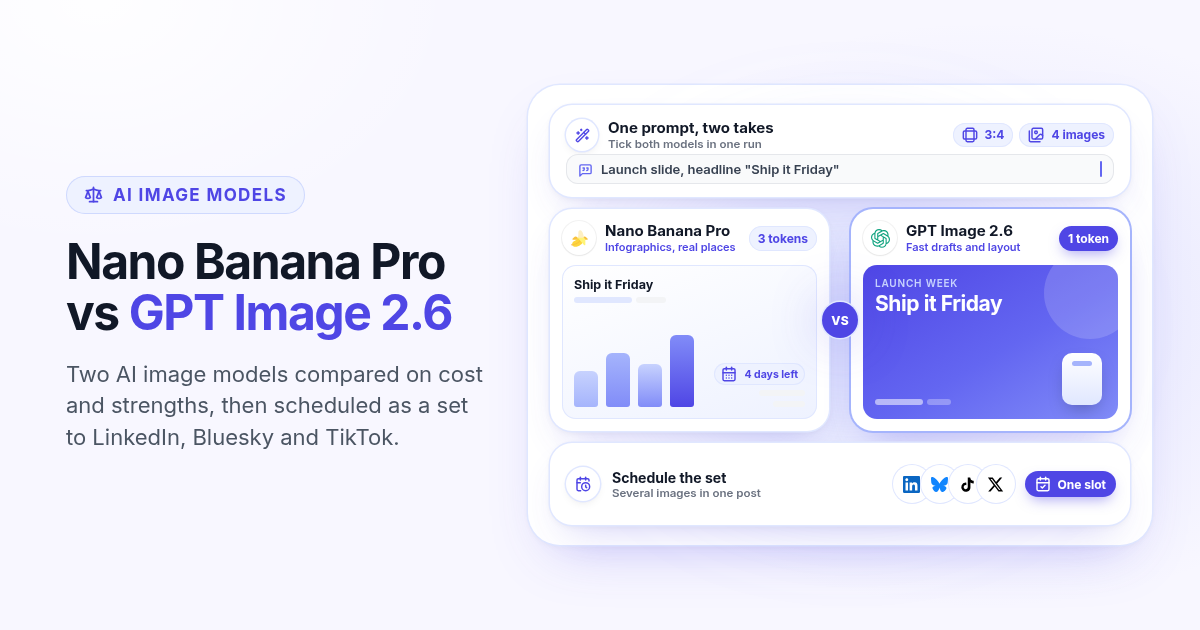
Nano Banana Pro vs GPT Image 2.6: which AI image model to use for pins, LinkedIn posts, and TikTok photo posts
GPT Image 2.6 from OpenAI launched on 4 November and is now tested everywhere against Nano Banana Pro from Google. How the two compare on what they are built for, token cost per image and editing, which one fits which post, and how to test both on one prompt and schedule the winner.
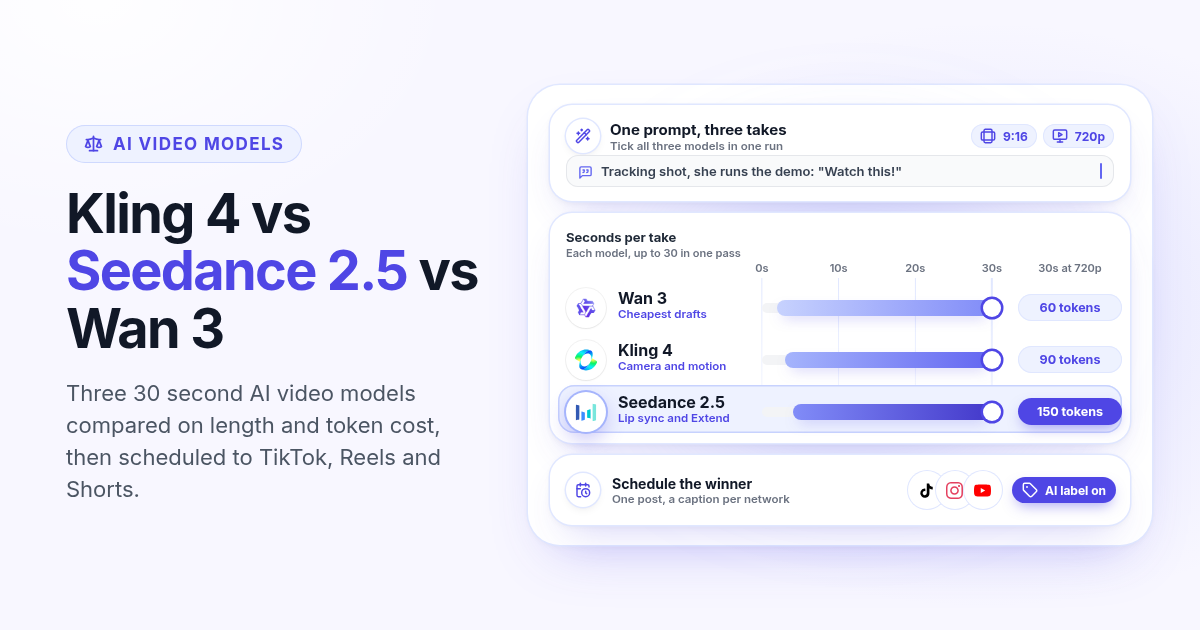
Kling 4 vs Seedance 2.5 vs Wan 3: which 30 second AI video model to use for TikTok, Reels, and Shorts
Kling 4, Seedance 2.5 and Wan 3 all make up to 30 seconds of video in one take. How they compare on length, resolution and token cost per second, which one fits which job, and how to test all three on one prompt and schedule the winner.
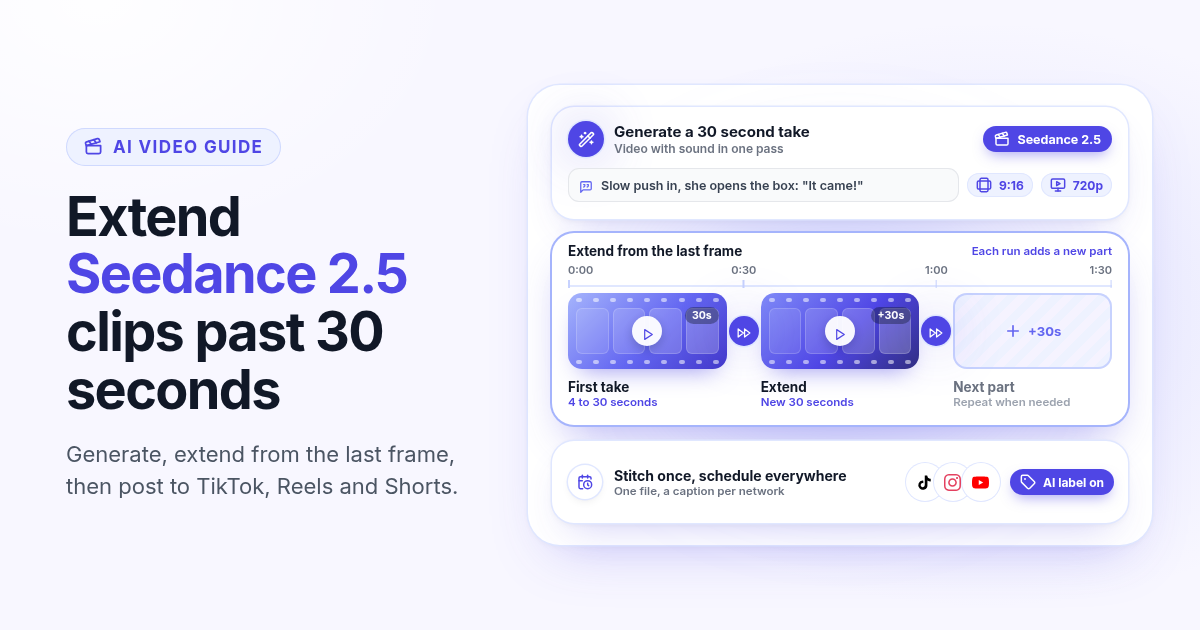
Seedance 2.5 AI video: how to extend clips past 30 seconds and post them to TikTok, Reels, and Shorts
Seedance 2.5 makes up to 30 seconds of video with sound in one take, and Extend continues it from the last frame. How to generate and extend a clip in Postlaty, what each second costs in tokens, and how to schedule it to TikTok, Reels and Shorts.
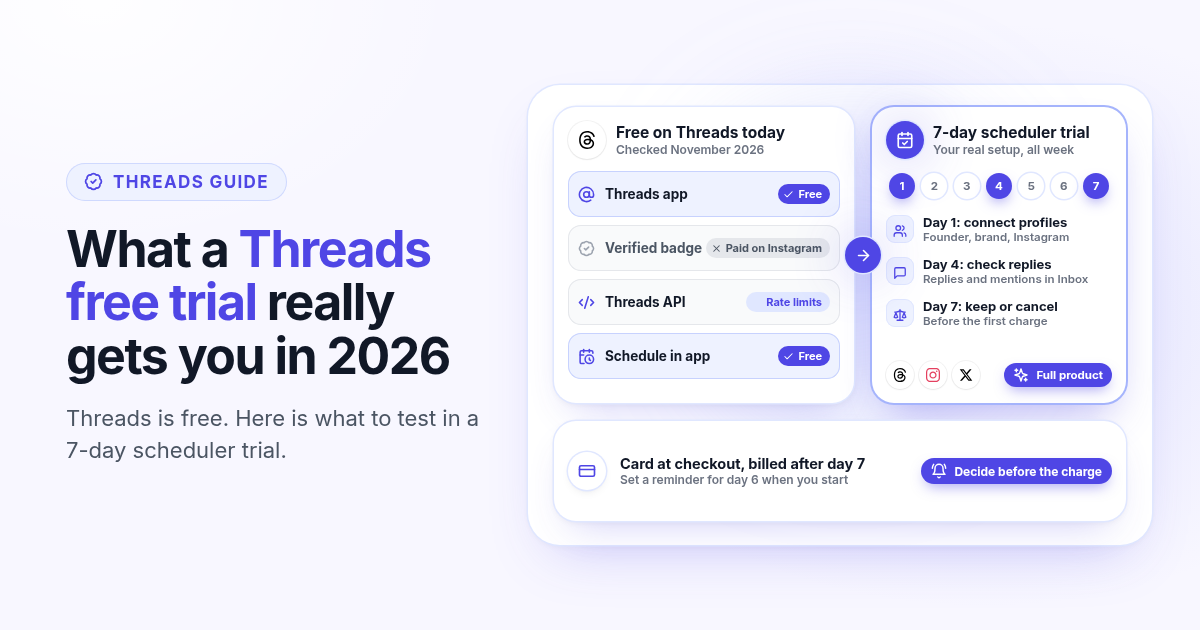
Threads free trial in 2026: what is free on Threads, and how to test a scheduler in 7 days
Threads has no paid plan, so there is no Threads free trial to start. Here is what a free Threads account already does, what the badge and the Threads API cost, and how to use a 7-day scheduler trial so you know by day 7 if a tool is worth paying for.
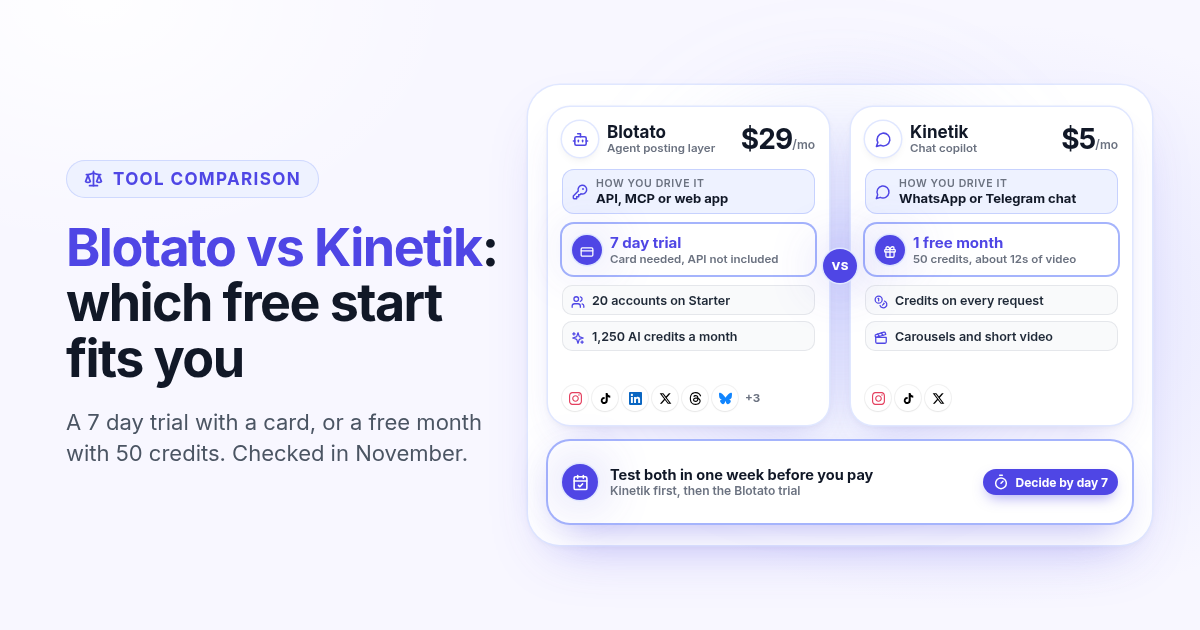
Blotato vs Kinetik in 2026: free trial, credits, and which AI social tool to test first
Blotato gives a 7-day trial with a card but no API, Kinetik gives a free month with 50 credits. Prices, credits, networks and how you drive each tool, checked November 2026, plus a one week test plan before you pay.
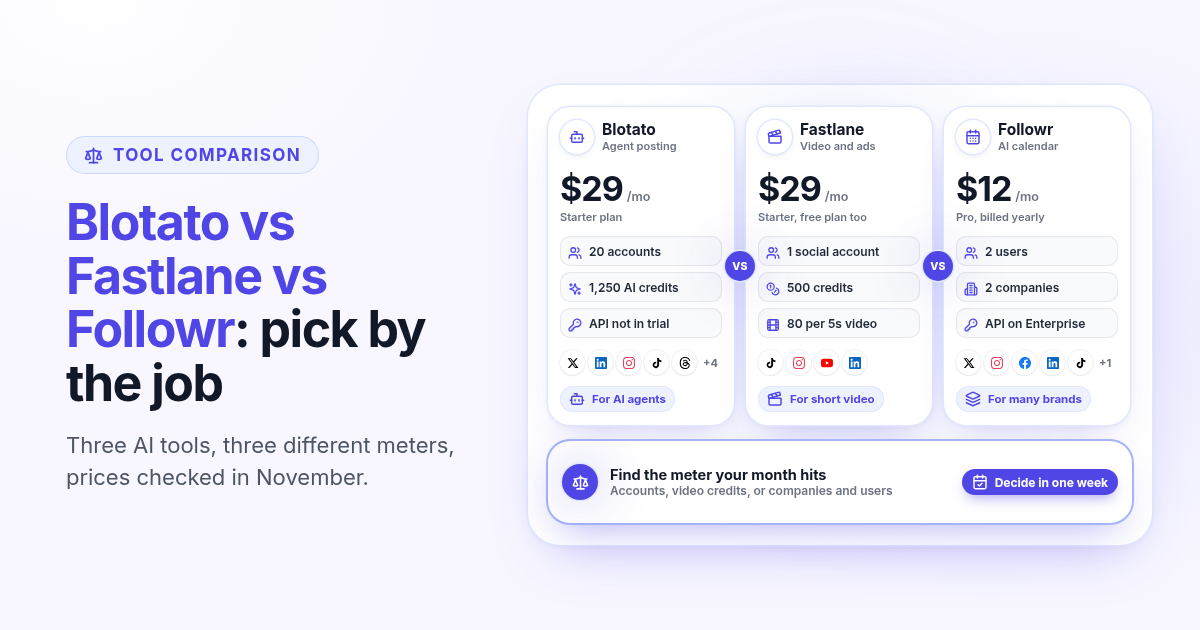
Blotato vs Fastlane vs Followr in 2026: which AI social media tool fits your job
Blotato, Fastlane and Followr all start cheap but meter different things: accounts and AI credits, video credits, or companies and users. Prices, networks and trials side by side, checked November 2026, and how to pick the right one in a week.
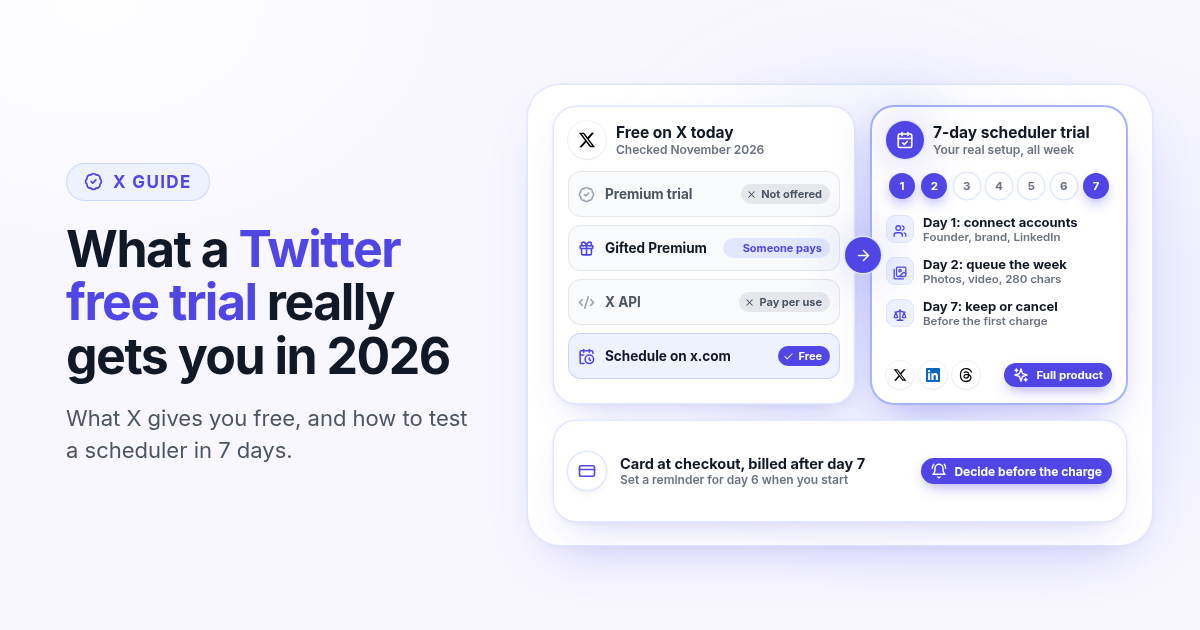
Twitter free trial in 2026: what X gives you for free, and how to test a scheduler in 7 days
X lists no free trial for Premium or The X Subscription, and the X API has no free plan for new developers. Here is what a free X account already does, what the API costs, and how to use a 7-day scheduler trial so you know by day 7 if it is worth paying for.
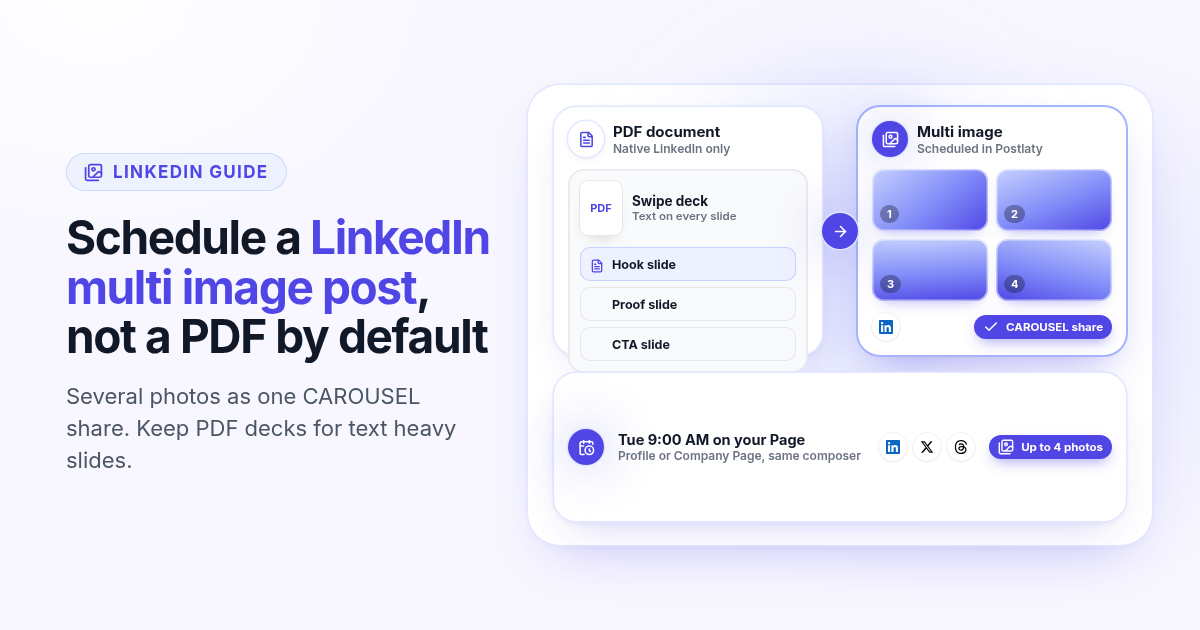
How to schedule a LinkedIn multi image post (and when a PDF carousel is better)
LinkedIn carousels usually mean a PDF. A multi image post is different: several photos as one share, including on a Company Page that cannot schedule multi photo posts natively. Here is how to queue the photo set in Postlaty, and when to stay with a document carousel.
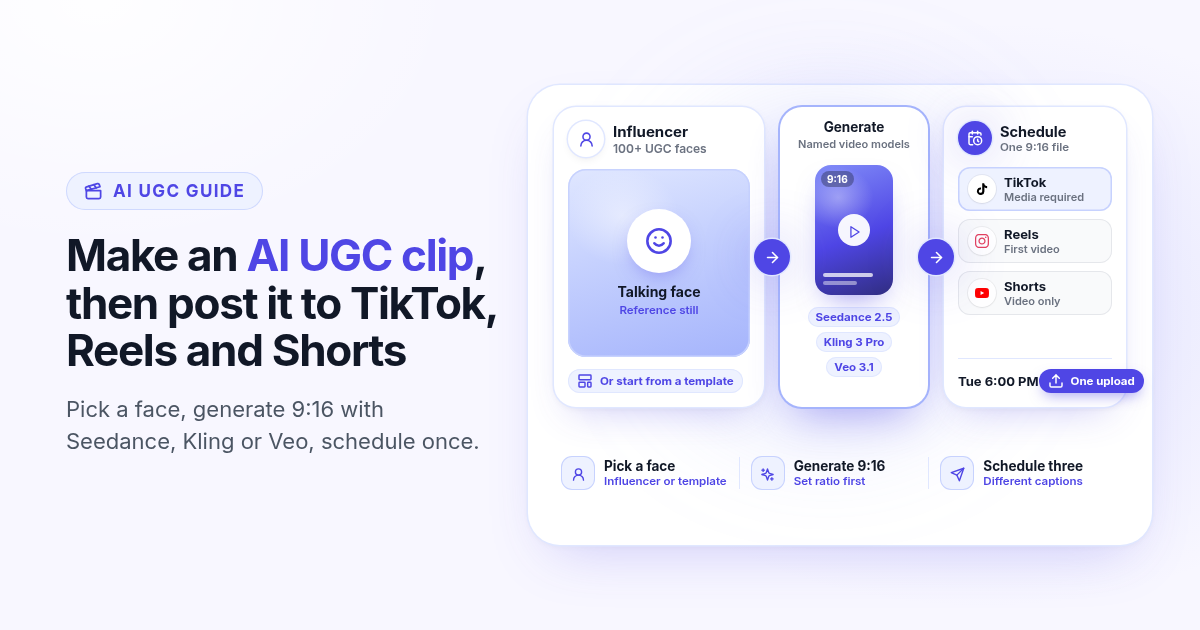
How to make an AI UGC clip and post it to TikTok, Reels, and Shorts
Pick a UGC influencer or template, generate a 9:16 talking clip with Seedance, Kling, Veo, or Grok Imagine, then schedule the same file to TikTok, Instagram Reels, and YouTube Shorts from one Postlaty post.
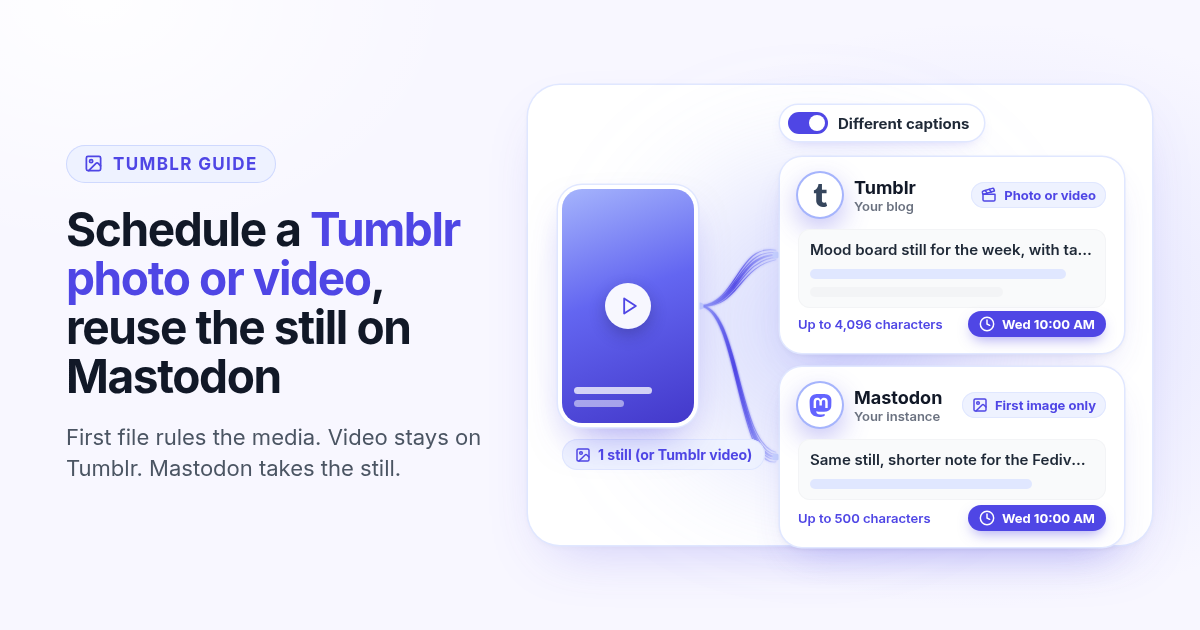
How to schedule a Tumblr photo or video (and reuse it on Mastodon)
Tumblr takes text plus the first image or video. Mastodon in Postlaty takes the first image and skips video. Connect both, attach one file, write two captions, and schedule the pair so the video stays on Tumblr only.
Threads scheduler in 2026: how to schedule Threads posts for free, and when a tool is worth it
Threads has a free scheduler in the composer three dot menu. How to use it step by step, where it stops (one profile, no week view, Threads only), five checks to run on any Threads scheduling tool, and a weekly routine built around replies.
Twitter scheduler in 2026: how to schedule X posts for free, and 5 checks before you pay
X still has a free scheduler: the calendar icon in the x.com composer. How to use it step by step, where it stops (one account, no week view, no long posts on the web), and five checks to run on any paid Twitter scheduler during the trial.
How to schedule LinkedIn posts for free in 2026 (and when a paid tool is worth it)
LinkedIn's own scheduler is free: profile posts from 10 minutes to 3 months ahead, Company Page posts from 1 hour. How to use it step by step, what it cannot schedule, and five signs a paid LinkedIn scheduler is worth it.
TikTok scheduler apps in 2026: 7 checks before you trust one with your videos
What TikTok Studio already schedules for free, and seven checks to run on any TikTok scheduler app during the trial: direct posting, public visibility, TikTok settings, photo posts, editing, multiple accounts and cross posting.
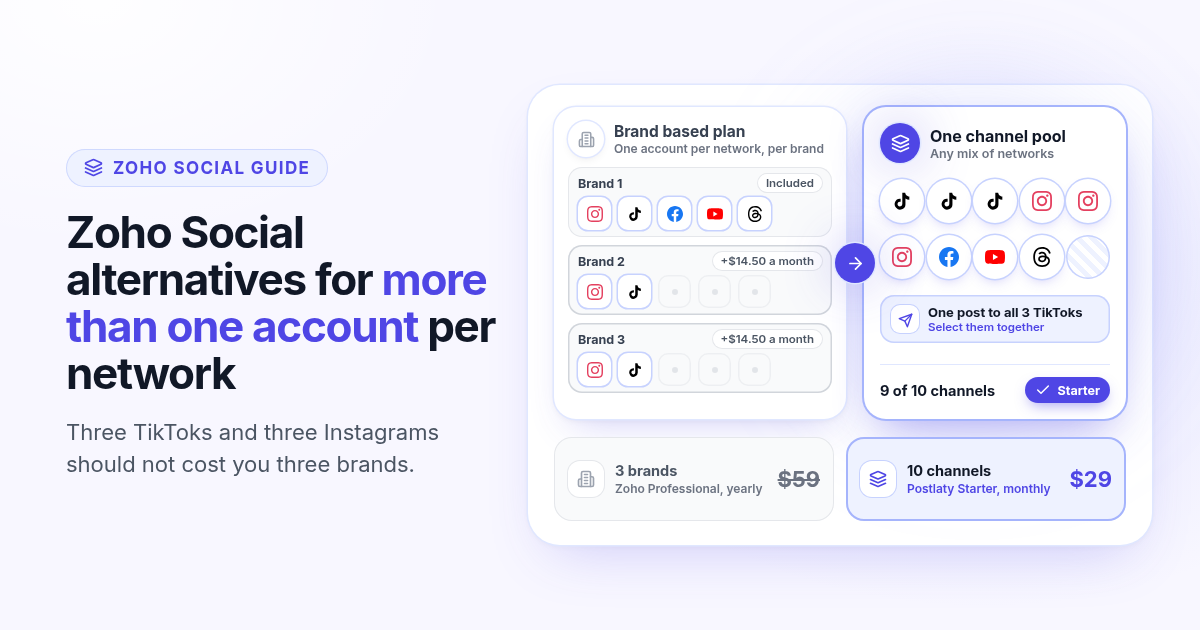
Zoho Social alternatives in 2026: when you run more than one account per network
Zoho Social prices by brand, and a brand holds one account per network. How Zoho Social pricing works in 2026, what three TikToks and three Instagrams really cost, and what to look for in an alternative priced by channels.
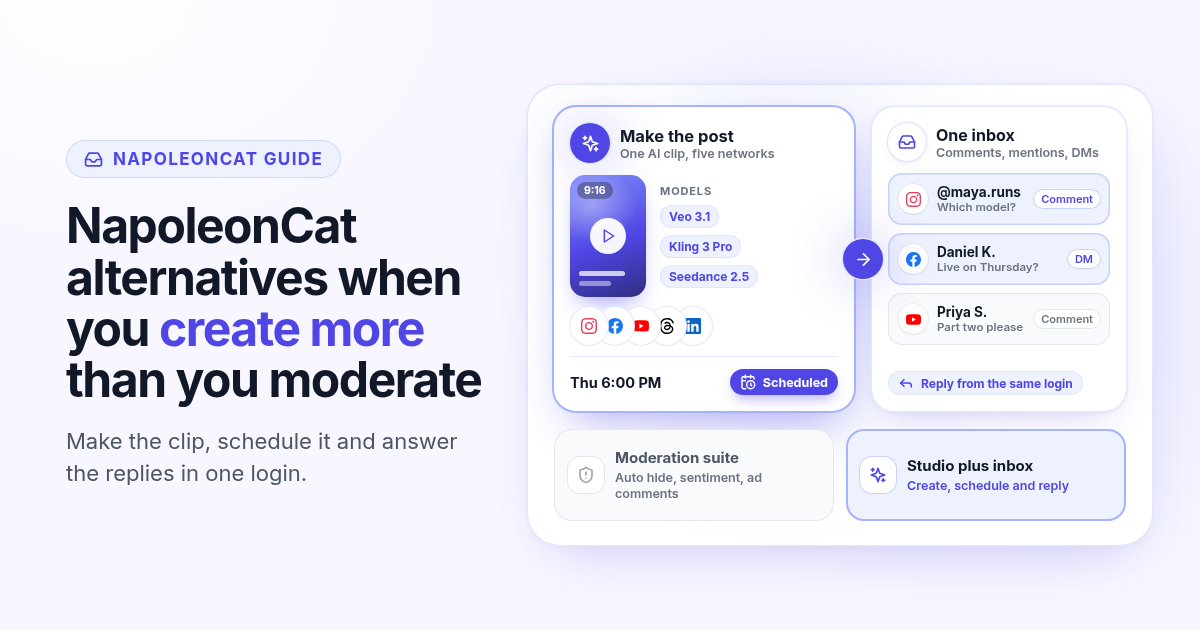
NapoleonCat alternatives in 2026: when you create more than you moderate
NapoleonCat is a strong moderation and inbox suite priced by users and profiles. If you spend more time making posts than moderating comments, here is what its 2026 pricing covers and what to look for in an alternative.
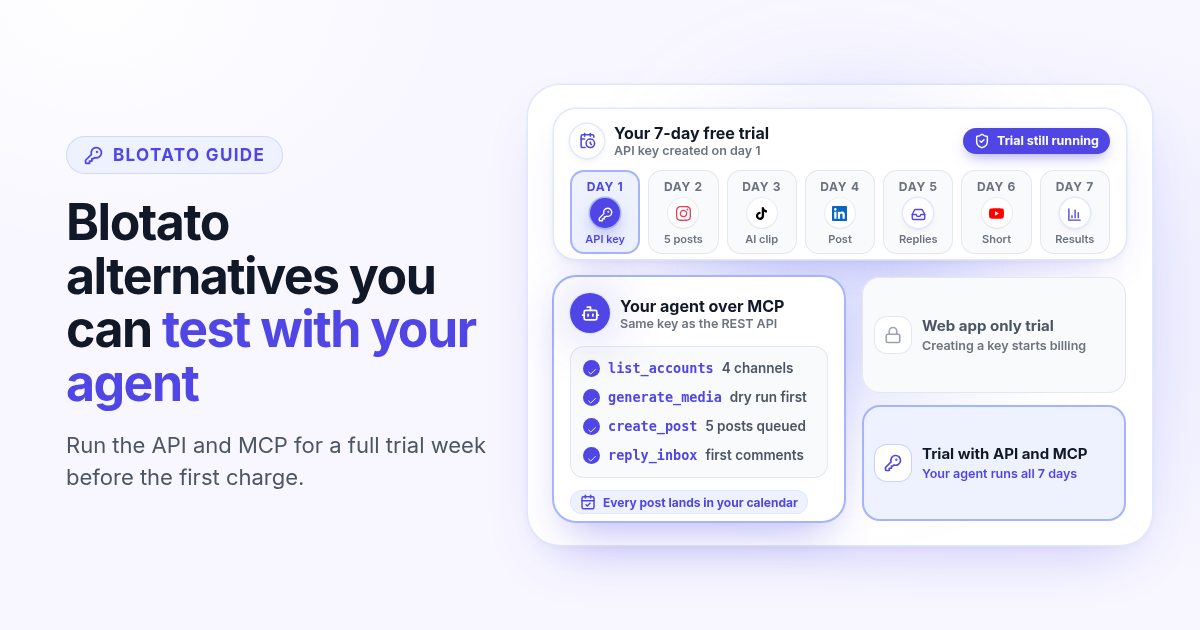
Blotato alternatives in 2026: when you want to test the API before you pay
Blotato starts at $29 a month for 20 accounts, but its free trial leaves out the API and MCP. How Blotato pricing works in 2026, why creating an API key ends the trial, and what to test in an alternative when an agent posts for you.
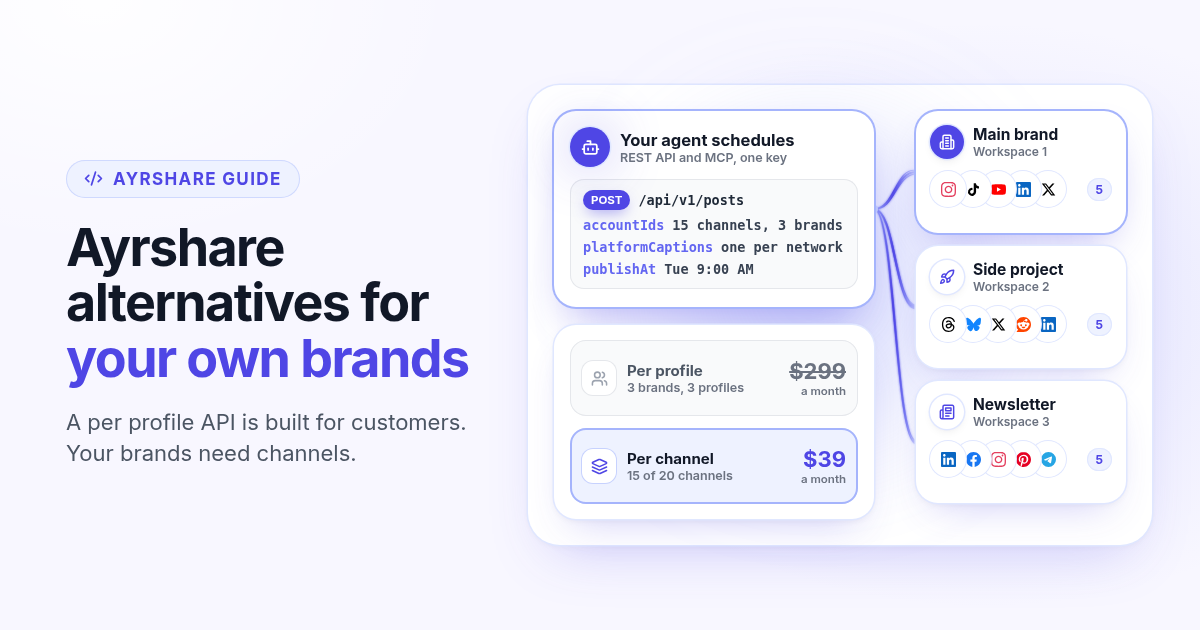
Ayrshare alternatives in 2026: when you post for your own brands, not customers
Ayrshare is a social media API billed per profile, from $149 a month for one. How Ayrshare pricing works in 2026, why profiles and channels lead to very different bills when the brands are yours, and what to test in an alternative with API and MCP on every plan.
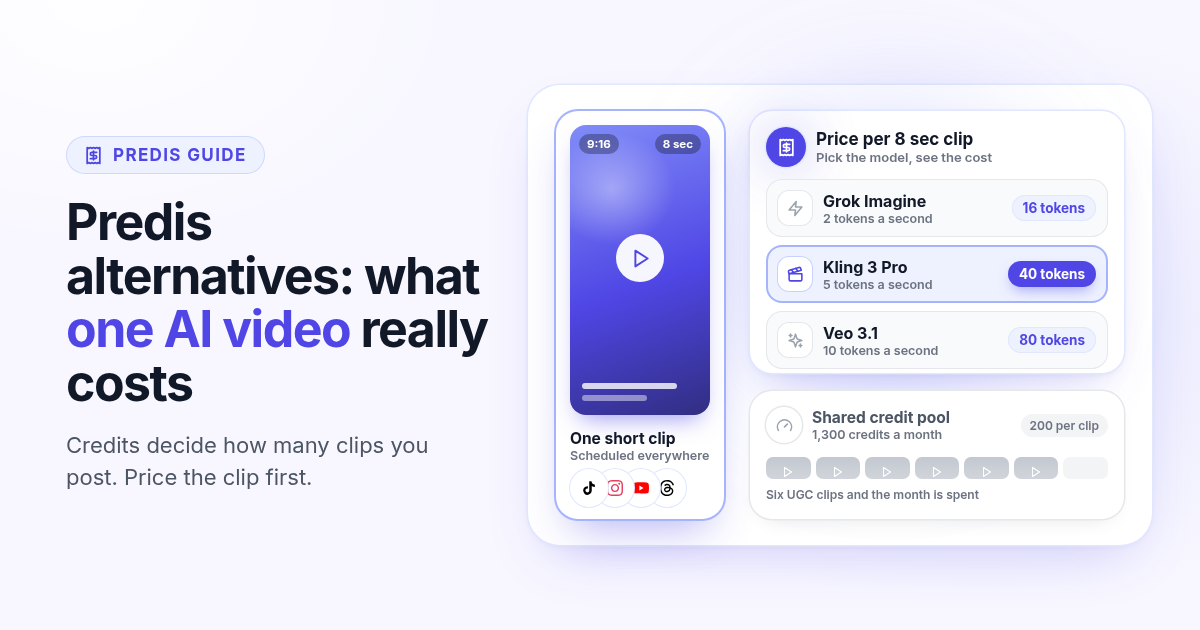
Predis alternatives in 2026: what one AI video really costs you
Predis.ai starts at $19 a month billed yearly, but credits decide how many AI videos you get. How Predis pricing works in 2026, what one clip costs on each plan, and how to price a real week of video in an alternative before you switch.
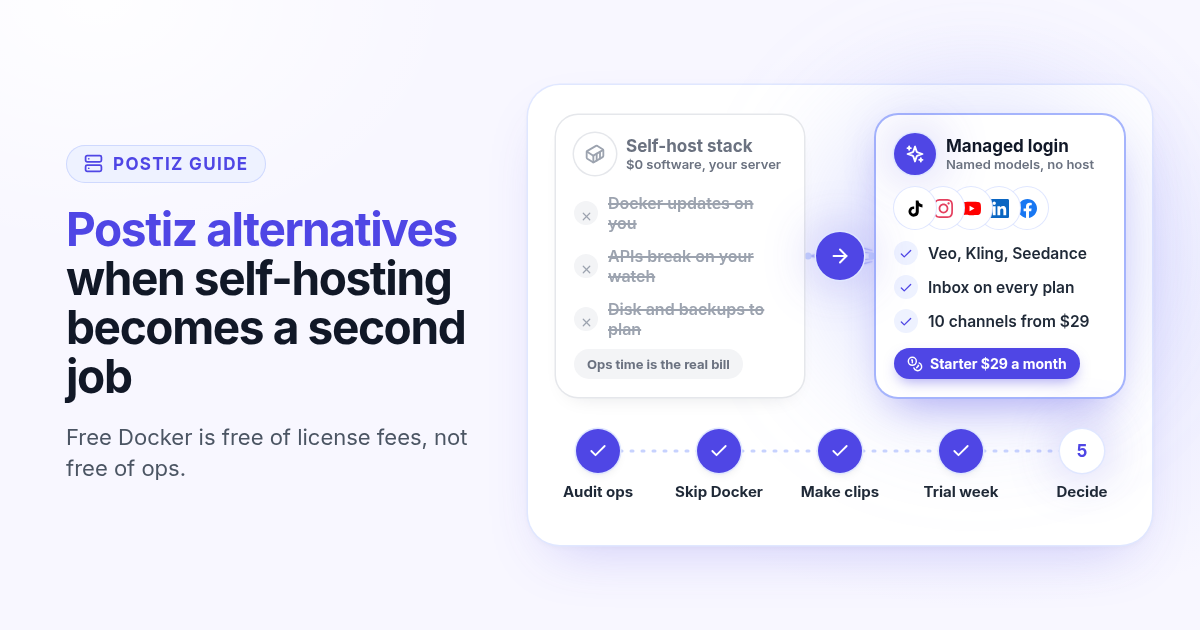
Postiz alternatives in 2026: when self-hosting becomes a second job
Postiz is a strong open-source scheduler with a free Docker install and hosted plans from $29. How Postiz pricing works in 2026, when self-hosting costs more than the bill, and what to test in a managed alternative with named AI video and inbox on the first plan.
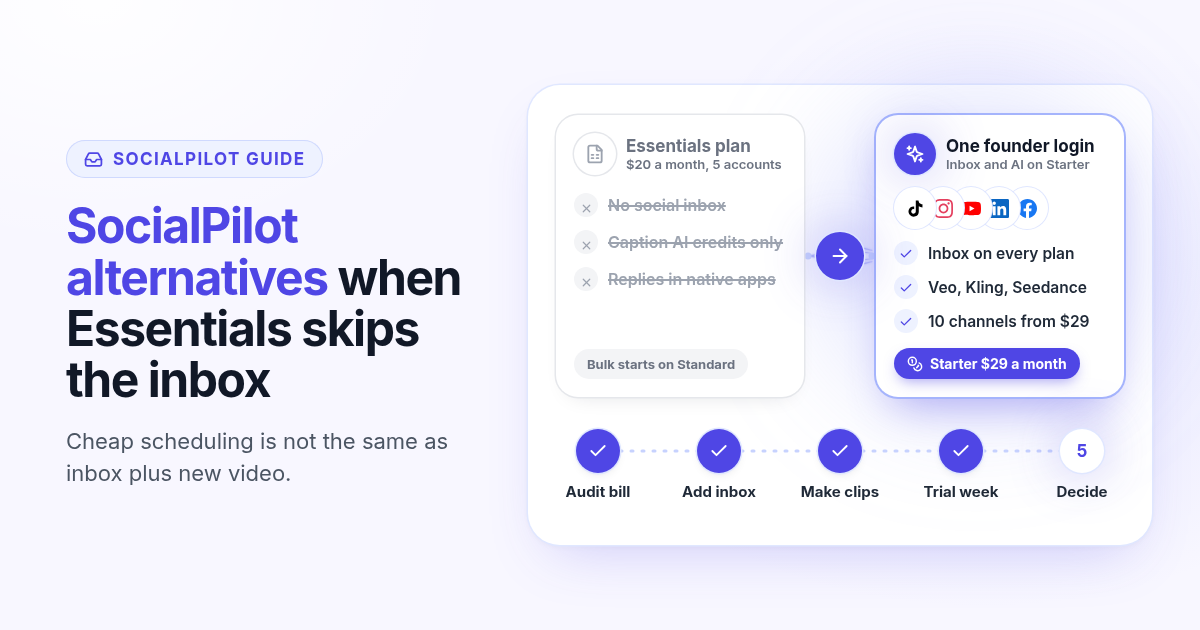
SocialPilot alternatives in 2026: when the cheap plan skips the inbox
SocialPilot Essentials is $20 a month for 5 accounts, but the inbox starts on Standard at $40. How SocialPilot pricing works in 2026, when bulk scheduling is enough, and what to test in an alternative that includes inbox and AI video on the first plan.
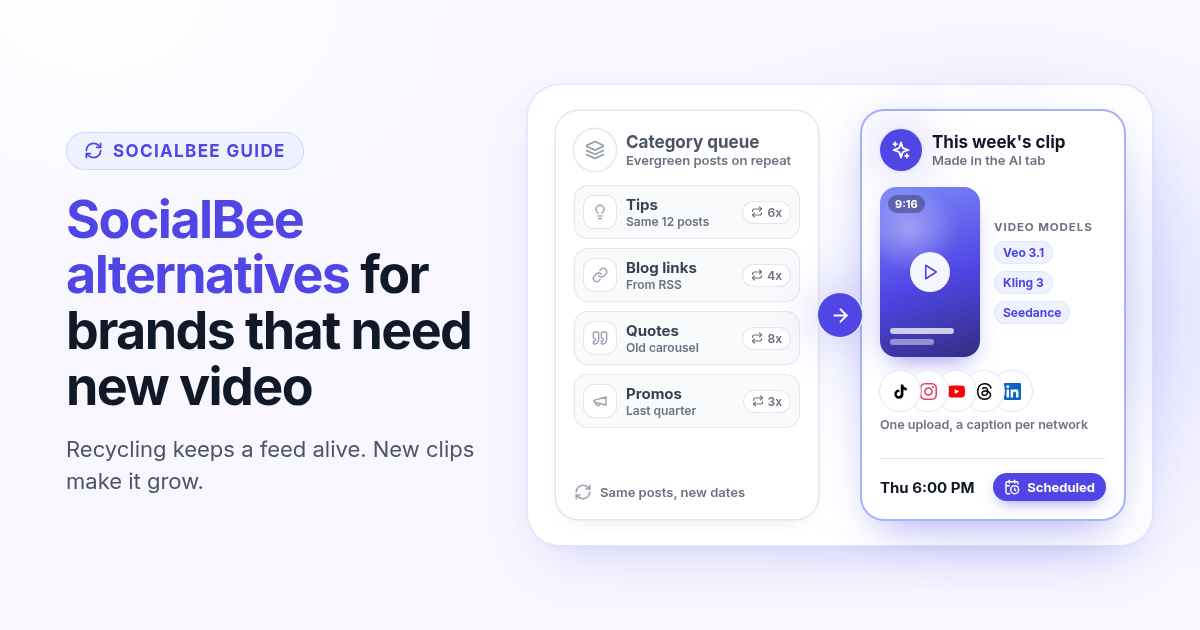
SocialBee alternatives in 2026: when recycled posts stop growing your accounts
SocialBee recycles evergreen posts by category, which keeps a feed active but rarely grows it on TikTok, Reels and Shorts. How SocialBee pricing works in 2026, how to audit your queue, and what to test in an alternative that makes new video.
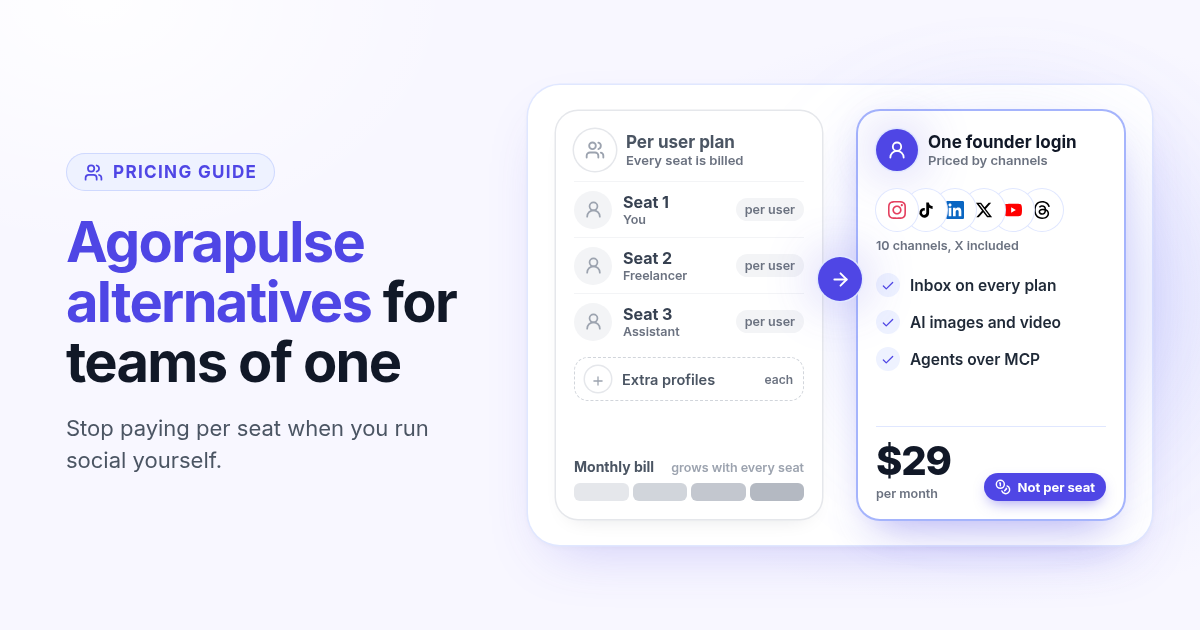
Agorapulse alternatives in 2026: when you pay per seat but post alone
Agorapulse prices every plan per user, which suits social teams more than founders. See how its pricing works in 2026, check which features you really use, and know what to test in any Agorapulse alternative before you switch.
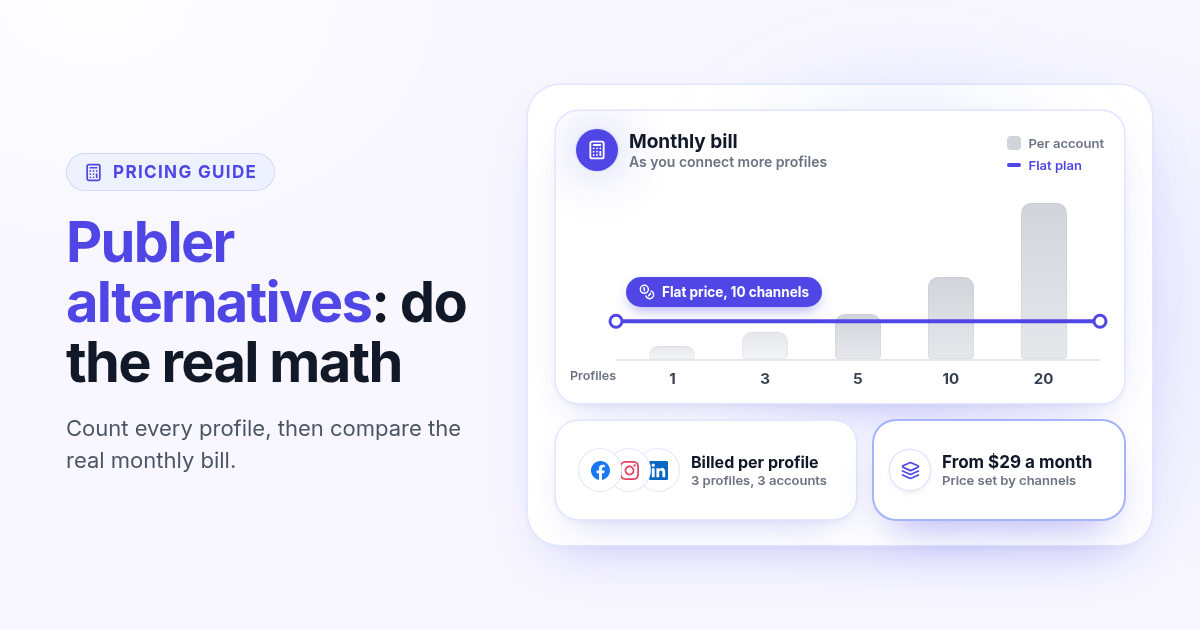
Publer alternatives in 2026: when per account pricing stops paying off
Publer bills per social account, so the price climbs with every Page and profile. Count what you really pay, spot the five signs you have outgrown it, and know what to test in any Publer alternative before you switch.
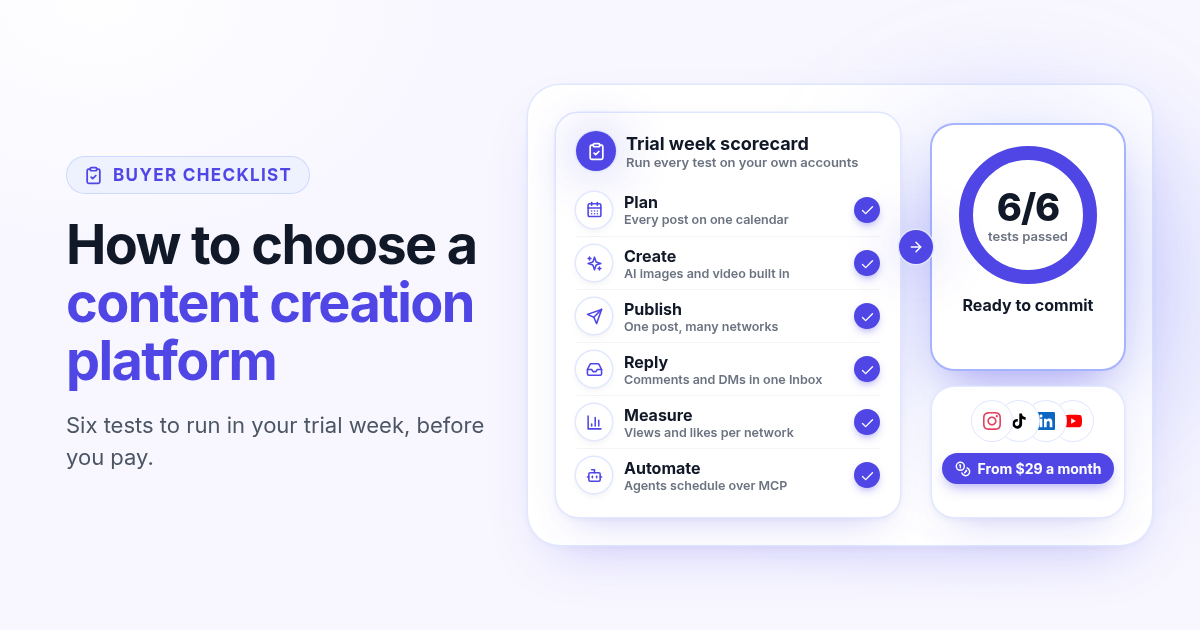
How to choose a content creation platform: 6 tests to run before you pay
A founder checklist for picking a content creation platform: add up the stack you pay for, then use a 7-day trial to test planning, AI images and video, publishing to every network, one Inbox for replies, per network numbers and AI agents.
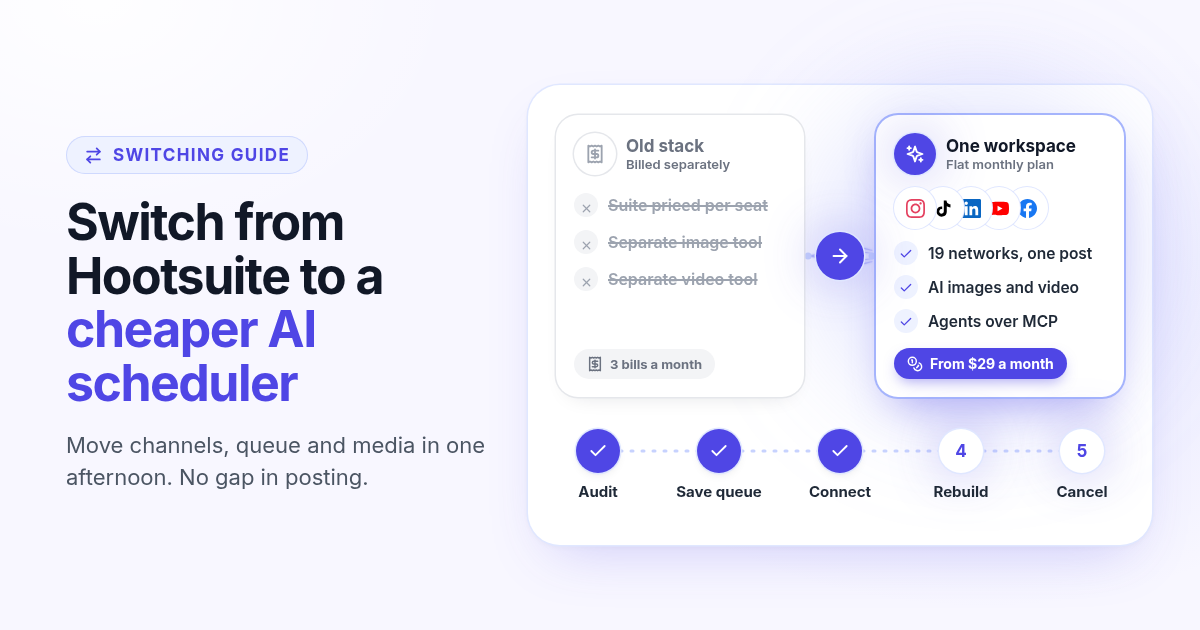
How to switch from Hootsuite to a cheaper AI scheduler in one afternoon
A step by step plan to leave Hootsuite without a gap in posting: audit what you use, save your queue and media, connect your channels, rebuild two weeks of posts, add AI images, video and agents, then cancel before renewal.
How to schedule Threads and Instagram together from one post
Schedule a Reel or photo to Instagram and Threads at the same time from one post. Connect both Meta accounts, attach one file, write a long Instagram caption and a short Threads caption, and pick one time.
How to make a Pinterest pin with AI and schedule it to a board
Generate a Pinterest pin image with Recraft, Flux, or Nanobanana, pick a Business board at connect, and schedule the pin from Create. Image required. Optionally reuse the still on Instagram.
How to schedule a Dev.to article and the posts that point to it
Schedule a Dev.to article and the short X, LinkedIn, or Bluesky posts that point to it from one queue. Connect with an API key, write the title and body, then ship pointers instead of pasting the markdown.
How to schedule a Discord announcement and the public post together
Schedule a Discord announcement and the matching Instagram and X post from one queue. Add the bot to your server, pick the channel, send text to Discord and the visual to the public networks.
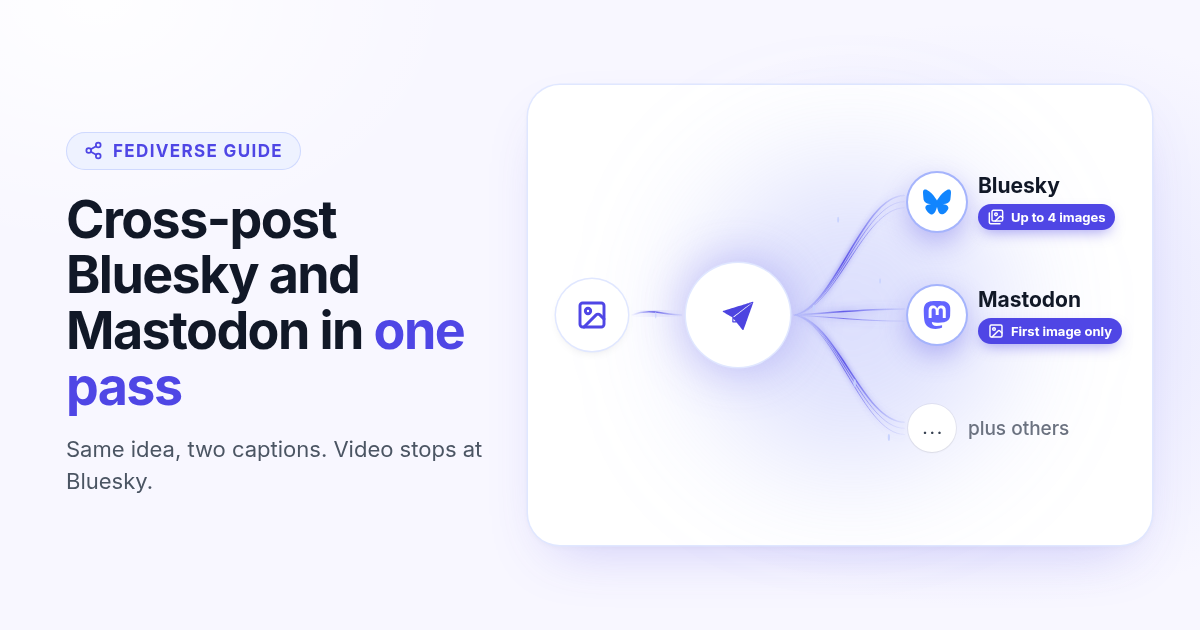
How to cross-post to Bluesky and Mastodon (and where video fails)
Cross-post Bluesky and Mastodon from one composer. Connect with an app password and a server token, share one still, and know why a Bluesky video will not publish as Mastodon video.
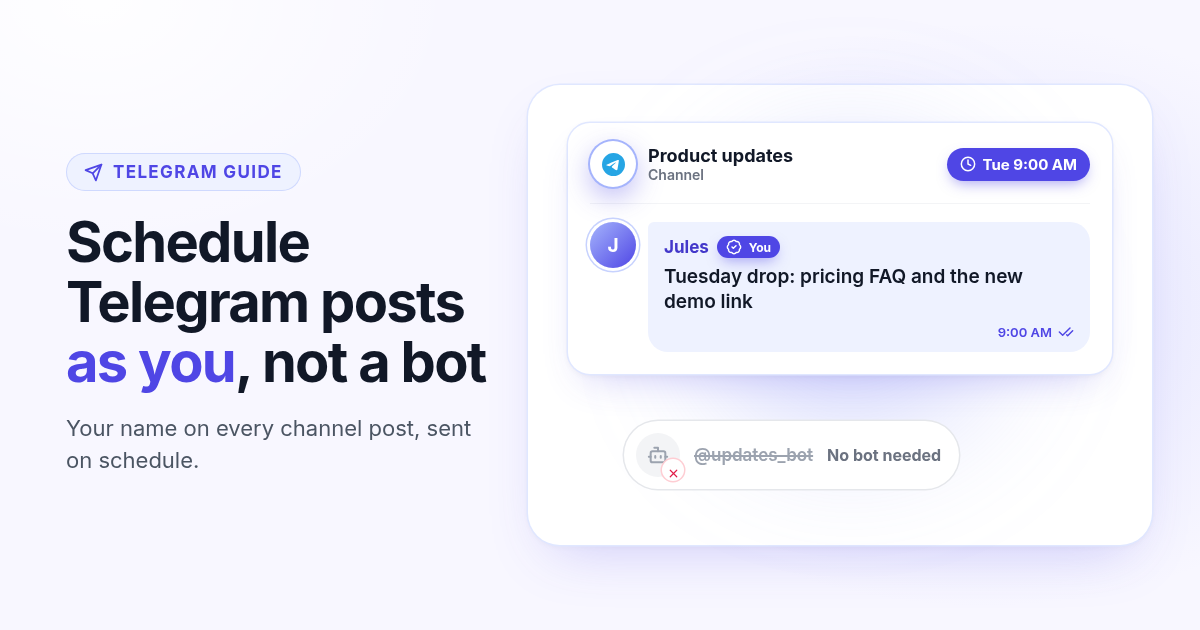
How to schedule Telegram channel posts as yourself (not as a bot)
Native Telegram schedule works for one message. Most tools post as a BotFather bot. Here is how to connect with your phone, pick a chat, and schedule posts as yourself with Postlaty.
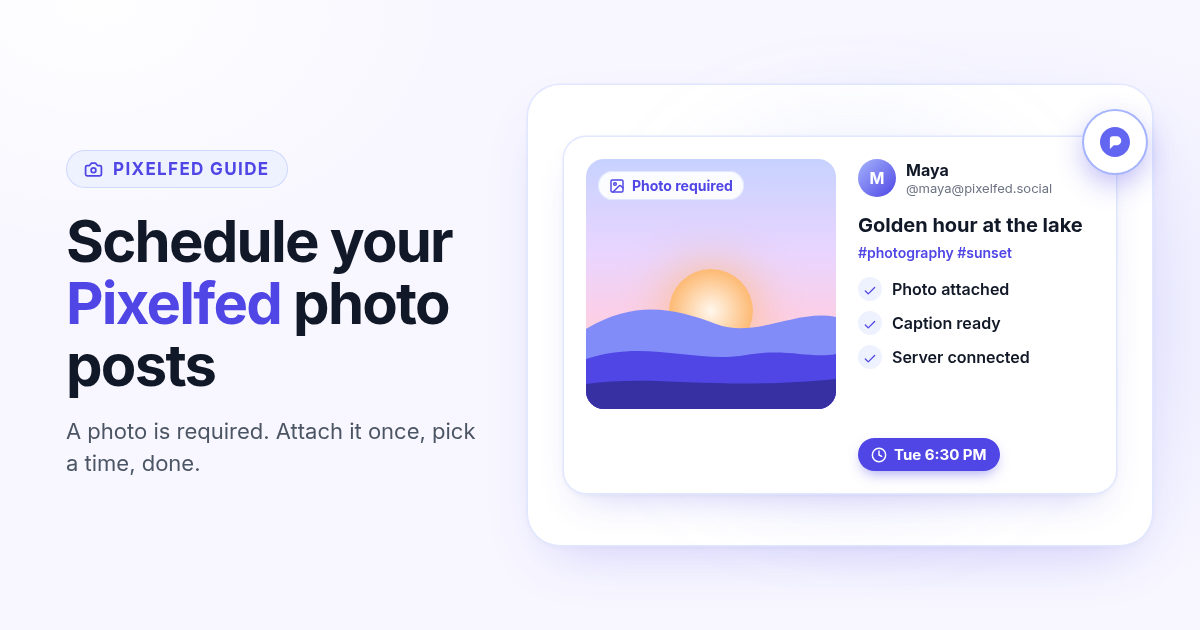
How to schedule Pixelfed posts (a photo is required)
Pixelfed is photo-first and has no real content calendar. Here is how to connect any server with an access token, attach a photo, and schedule posts ahead with Postlaty.
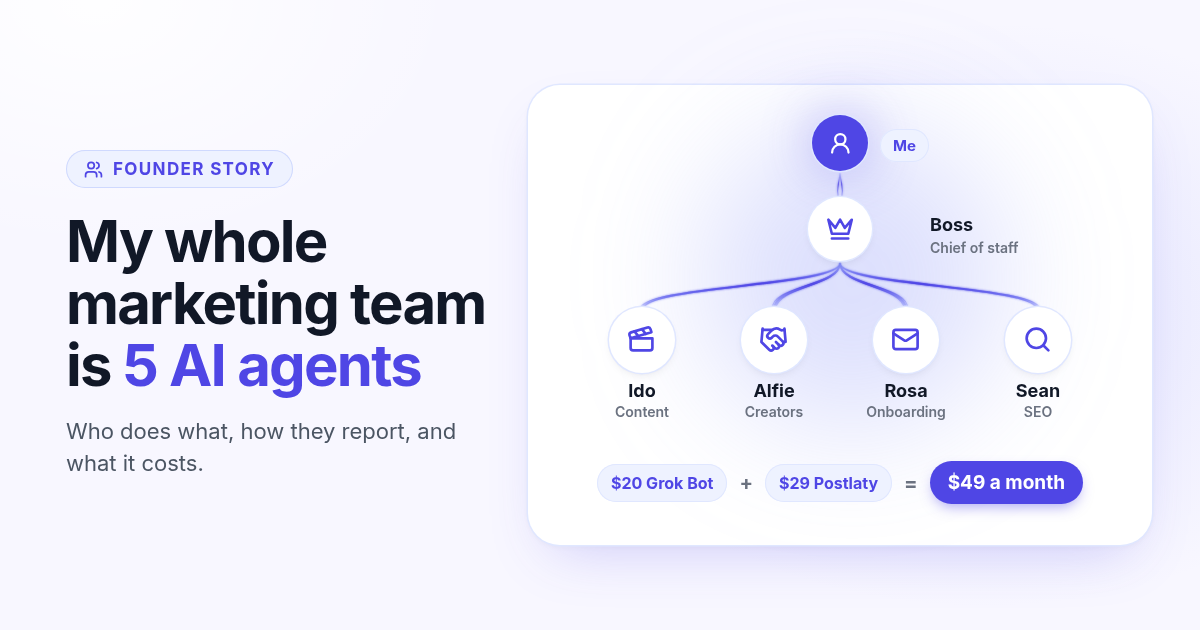
How I run my whole marketing team with AI agents for $49 a month
I am a solo founder. My marketing team is five AI agents that post, reach out, email, and write, then report to me daily. Here is who does what and what it costs.
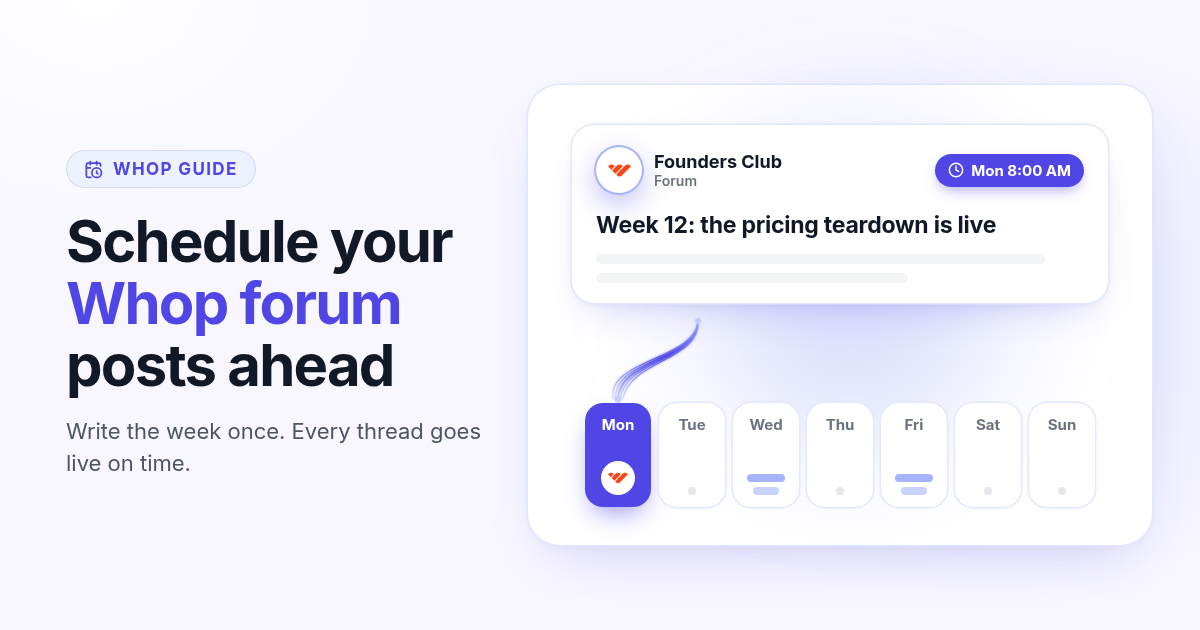
How to schedule Whop posts to your community forum
Whop forums publish when you press Post. Here is how to schedule Whop posts ahead with a company API key, what to write, and how replies reach your inbox.
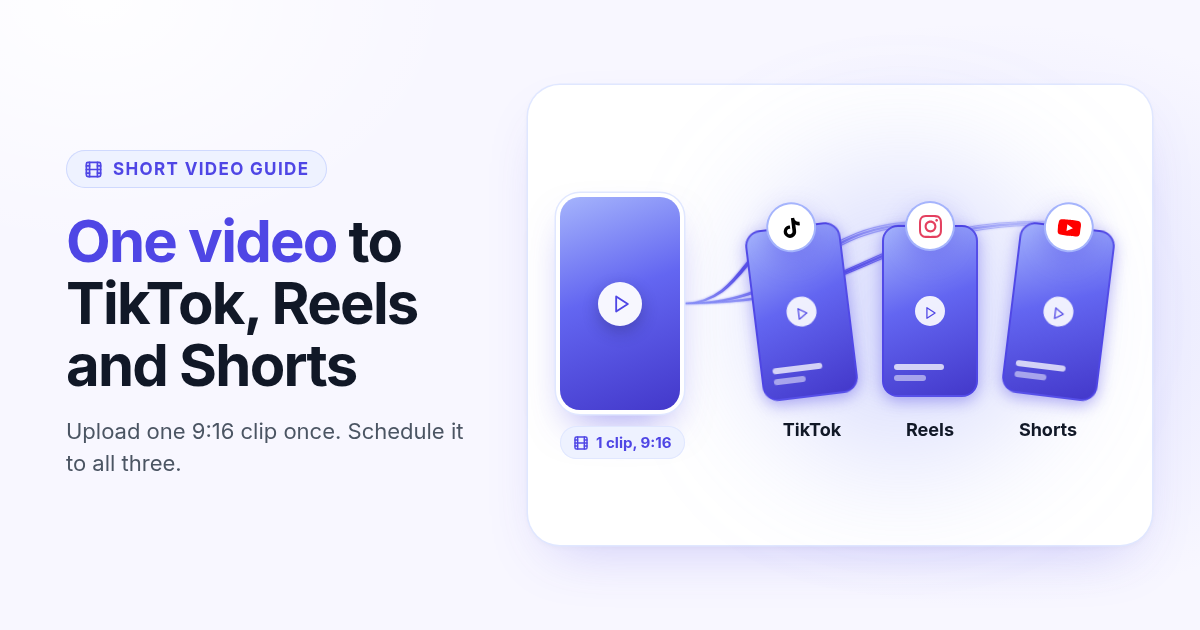
How to post the same short video to TikTok, Instagram Reels, and YouTube Shorts
One 9:16 file can feed TikTok, Reels, and Shorts. This guide covers aspect ratio, captions, covers, and a publish path that does not recrop three times.