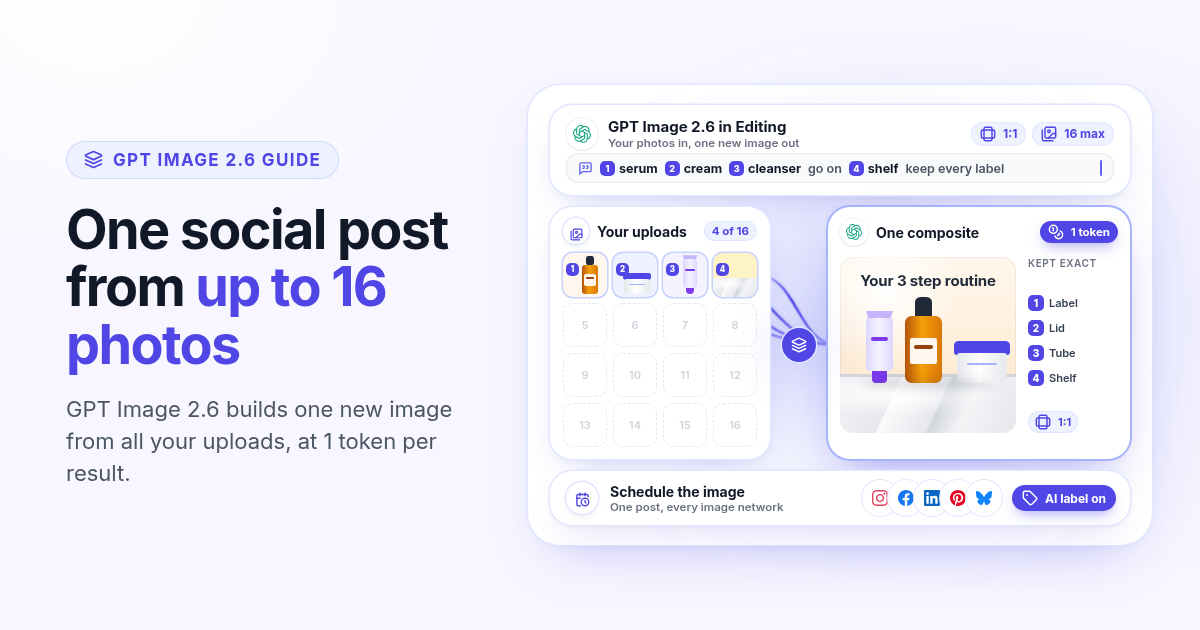
Most AI image edits start from one photo: change the background, fix the light, add a headline. That covers a lot, but a lot of social posts are made of several things at once. Four products in one flat lay. Your mascot in a real location. A launch graphic that has to use your logo, your colors and your packaging all together.
GPT Image 2.6 can take up to 16 images in one edit, and in Postlaty you can now upload all 16 in Editing mode. This guide shows what that is good for, how to write a prompt that keeps 16 inputs under control, what it costs, and how to schedule the result.
What a multi image edit does
OpenAI released GPT Image 2.6 on 4 November 2026. Its edit endpoint accepts up to 16 input images in one request and returns a new image built from them. OpenAI's own example is a gift basket: four product photos (a body lotion, a bath bomb, an incense kit and a soap) go in, and one photo of a basket holding all four comes out.
That is a different job from a normal edit:
Single image edit
One source photo. You say what changes and what stays. Good for backgrounds, light, a new headline or a seasonal version.
Multi image edit
Several sources, each with a job: the product, the place, the logo, the style. The model builds one new image from all of them.
The upside is control. Instead of describing your bottle in words and hoping, you show the bottle. The downside is that every extra input is one more thing the model can misread, which is why the prompt matters more here than anywhere else.
How it works in Postlaty
These are the settings you see in the Postlaty generator, not OpenAI's API prices:
Up to 16 uploads
Pick Image, switch to Editing and tick GPT Image 2.6. The upload area takes up to 16 images instead of the usual 2.
1 token per result
You pay per image that comes out, not per image you upload. Sixteen inputs and one output is 1 token.
Your ratio, not the source
Pick 9:16, 16:9, 1:1, 3:4 or 4:3 and the edit comes back in that shape, even if your photos are a different size.
One to four takes
Ask for up to 4 results per run. Each one is its own take from the same inputs, so you can pick the best.
16
images in one GPT Image 2.6 edit
1
token per finished image
4
tokens for four takes of one composite
If you tick another model next to GPT Image 2.6 in the same run, that model only reads the first two uploads. Nano Banana Pro and Flux 2 Pro still take two images in Editing. The Generate button shows the token total before you spend anything, and if a generation fails, the reserved tokens go back to your balance.
Social posts where several inputs pay off
Product lineup or flat lay
Upload each product shot and ask for one styled scene with all of them. Labels and shapes come from your photos, not from a guess.
On brand launch graphic
Logo, packaging, a color swatch and a layout sketch in, one launch post out. The sketch tells the model where things go.
Character in a real place
Your mascot or product from a few angles plus a photo of the location. More angles help the model keep the same look.
Event recap
A handful of event photos turned into one poster style recap image for the day after. Keep it to the shots that matter.
Sixteen is a ceiling, not a target. OpenAI's own guidance for ChatGPT is that a small number of images is usually easier to manage than many. My rule: start with the fewest inputs that show what the model cannot guess, usually two to five, and add more only when a detail keeps coming out wrong.
How to write the prompt
The model sees your uploads in order. The Postlaty tip for GPT Image 2.6 is to name them in the prompt as image 1, image 2 or @image1. OpenAI gives the same advice: refer to each image by its order and say how they relate.
Give every input a role in the first lines: image 1 is the product, image 2 is the room, image 3 is the logo.
Say what must stay exact: label text, bottle shape, logo colors. Then say what may change.
Place things with plain position words: left, right, foreground, background, top corner.
Put any on image text in quotes and say where it goes. Ask for no extra text if you want none.
Here is a prompt for a four product post:
Image 1 is our serum bottle, image 2 the face cream, image 3 the cleanser, image 4 a marble bathroom shelf. Place the three products from images 1 to 3 on the shelf from image 4, serum in front, soft morning light from the left. Keep every label and bottle shape exactly as in the photos. Add the headline "Your 3 step routine" at the top. No other text, no extra products.
If one product drifts, do not rewrite the whole prompt. Upload a clearer photo of that product, or a second angle of it, and repeat the line that says what must stay the same.
Step by step in Postlaty
- 1
Open the AI tab, choose Image, then Editing
Editing is where your own photos become the source.
- 2
Tick GPT Image 2.6
The upload area switches to 16 slots. Add your images in the order you will name them in the prompt.
- 3
Pick the ratio for where it will post
1:1 or 4:3 for an Instagram or Facebook feed image, 3:4 for a pin, 9:16 for a TikTok photo post, 16:9 or 1:1 for LinkedIn and X.
- 4
Write roles, rules and positions
Name each image, say what stays exact, and say where everything goes. Keep the on image text in quotes.
- 5
Run two to four takes
Check the total on the Generate button, run it and keep the take with the cleanest labels.
If you are still choosing an image model for posts made from scratch, read Nano Banana Pro vs GPT Image 2.6, and for exact brand colors from hex codes, the Flux 2 Pro guide covers that method.
Schedule the image to every network
Open the finished image in the AI tab gallery and click Select, and Postlaty opens a new post with it attached. Because a multi image edit gives you one finished image, it works on every network you post images to.
One post, many channels
Tick Instagram, Facebook, LinkedIn, X, Threads, Bluesky or Pinterest. TikTok publishes images as a photo post.
Mind the Instagram range
Instagram feed images have to sit between 4:5 and 1.91:1, so a 1:1 or 4:3 edit fits there and on most other feeds.
Turn on the AI label
The AI-generated content setting adds the native AI label on TikTok, YouTube, Instagram, Facebook and X.
Pick one time
Switch to Different captions so each network gets its own line. Channels count toward your plan: 10 on Starter, 20 on Pro and 50 on Premium.
For a single image that works across feeds, see scheduling Bluesky posts with images and the AI Pinterest pin guide.
Limitations to know
The 16 image limit is for GPT Image 2.6 in Editing. The other image models in Editing take up to two.
More inputs means more room for mixups. Small labels and fine print can still come out wrong, so check every take before posting.
Starter includes 10 tokens a month, Pro 50 and Premium 100. Four takes of one composite is 4 tokens.
Each run is a fresh take. Expect to run a prompt two or three times before you keep one.
Only upload products, logos and faces you have the right to use.
The bottom line
Use a multi image edit when the post depends on things the model cannot guess: your real products, your logo, a real place. Give every upload a role, say what stays exact, start with two to five inputs and go toward 16 only when a detail keeps slipping. At 1 token per finished image, testing four takes costs less than one stock photo. Check plans and token packs on pricing, and see how images publish on the Instagram, LinkedIn and Pinterest pages. If you want to see how images like these fit into a full weekly routine, read how I run my whole marketing team with AI agents for $49 a month.
FAQ
Frequently Asked Questions
OpenAI accepts up to 16 input images in one GPT Image 2.6 edit. In Postlaty, Editing mode takes up to 16 uploads when GPT Image 2.6 is selected, and the result is one new image built from them.
Not in Postlaty. GPT Image 2.6 costs 1 token per finished image, whether you upload 1 photo or 16. Four takes from the same inputs cost 4 tokens.
Name the uploads in the order you added them: image 1, image 2, or @image1. Give each one a role in the first line of the prompt, say what must stay exact, and use position words like left, right and background.
Not in Postlaty today. Those models take up to two images in Editing. If you tick one of them next to GPT Image 2.6 in the same run, it reads the first two uploads only.
The one you pick: 9:16, 16:9, 1:1, 3:4 or 4:3. The edit follows that ratio even when your photos have a different shape. Use 1:1 or 4:3 for Instagram and Facebook feeds.
Postlaty has a 7-day free trial for scheduling. The AI models run on tokens, and your plan tokens arrive with the first paid invoice.
Blog
More articles
How I grow US TikTok accounts from abroad in 3 steps
I do not live in the US, but I grow accounts for a US audience. My 3 step playbook: set up and warm up a cheap dedicated phone, post and test for 30 days, then scale only the winners.
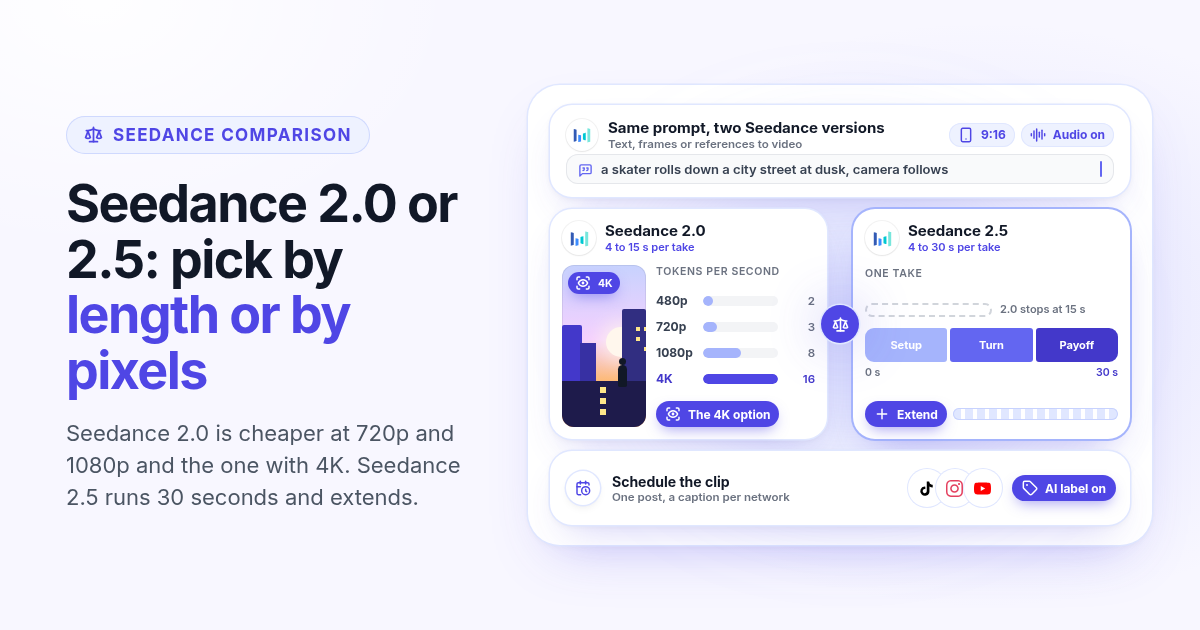
Seedance 2.0 vs Seedance 2.5: when the older model is the smarter pick for social clips
Seedance 2.0 costs less per second than Seedance 2.5 at 720p and 1080p in Postlaty and is the only one with 4K. Seedance 2.5 runs 30 seconds per take and extends. The token math, which to pick for which clip, and how to schedule it to TikTok, Reels and Shorts.
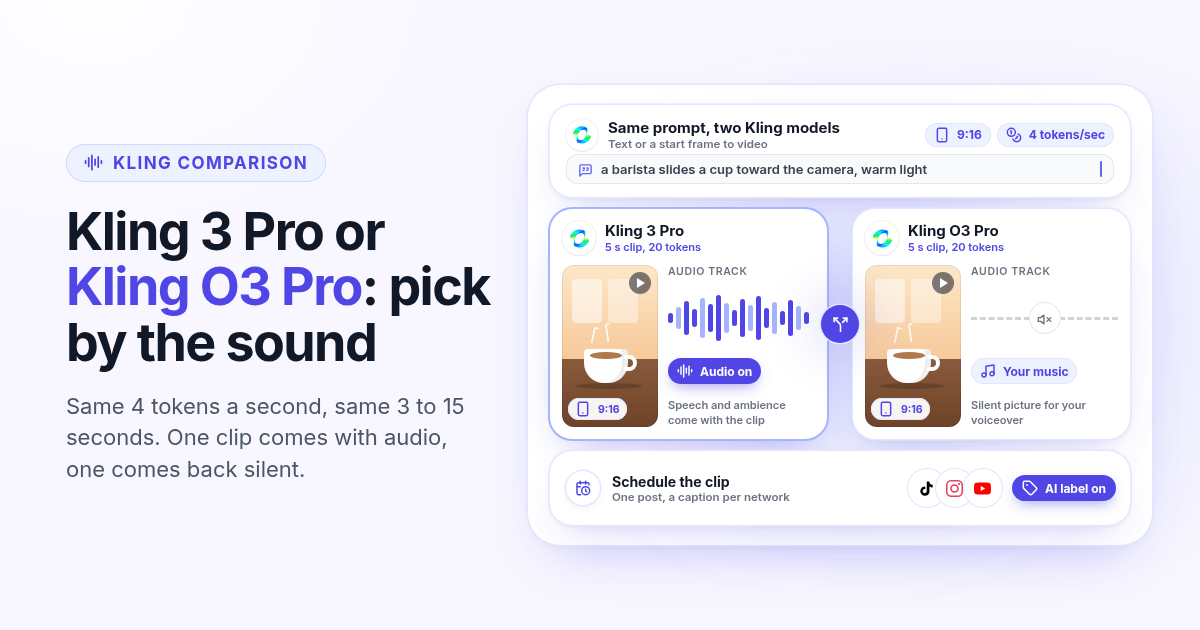
Kling 3 Pro vs Kling O3 Pro: which Kling model to pick for social clips at 4 tokens a second
Kling 3 Pro and Kling O3 Pro cost the same 4 tokens a second in Postlaty and both make 3 to 15 second clips. What Kling says each is for, the sound difference that decides most picks, start and end frames, and how to schedule the clip to TikTok, Reels and Shorts.
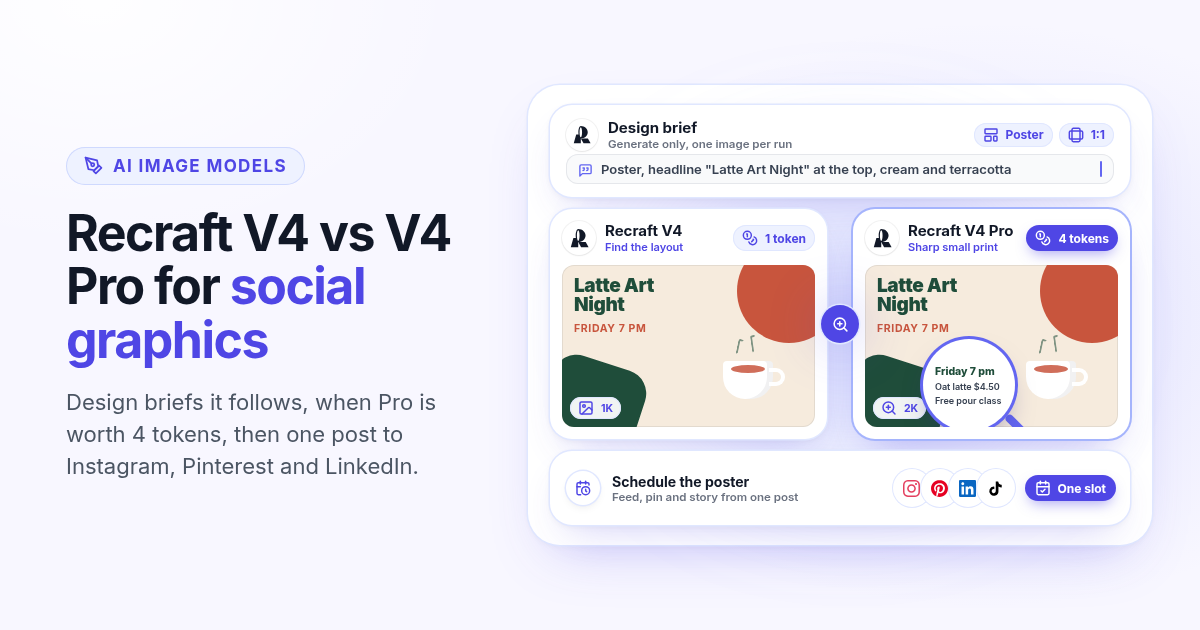
Recraft V4 vs V4 Pro for social graphics: when the 4 token version is worth it
Recraft V4 makes designed graphics, not stock photos: posters, quote cards, pins and icons with short readable text. What V4 and V4 Pro each cost in Postlaty, how to write a design brief it follows, when Pro is worth 4 tokens, and how to schedule the result.
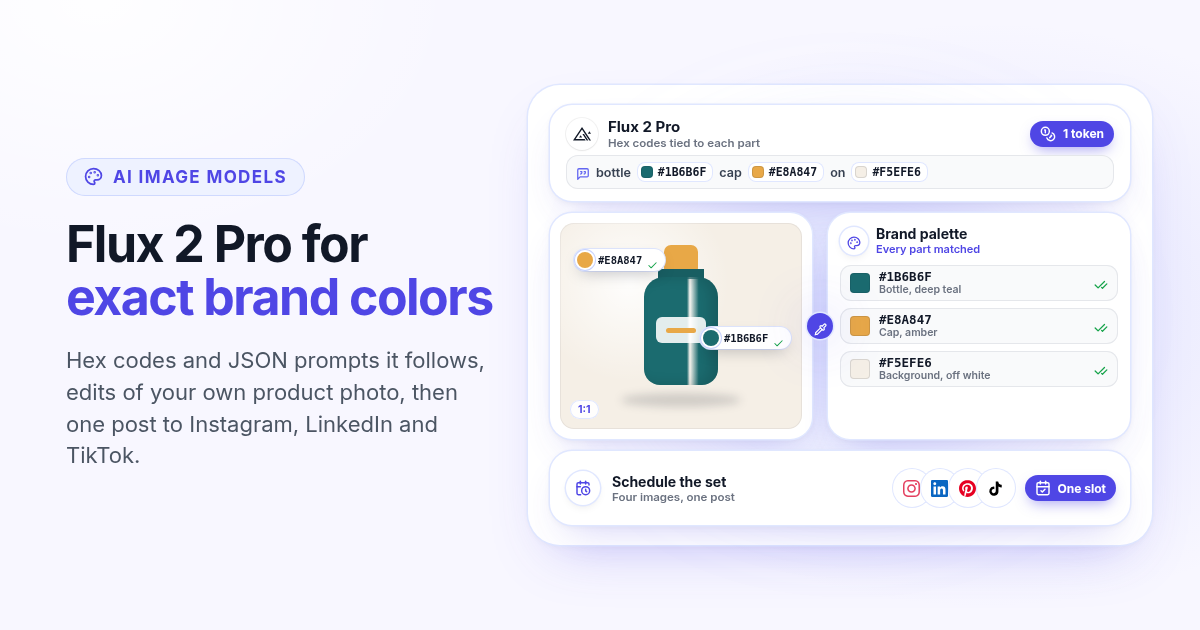
Flux 2 Pro for social images: exact brand colors with hex codes, JSON prompts and photo edits
Flux 2 Pro from Black Forest Labs matches hex codes you write in the prompt. How to write color and JSON prompts it follows, edit your own product photo with it, what it costs in Postlaty, and how to schedule the set to Instagram, LinkedIn, Pinterest and TikTok.
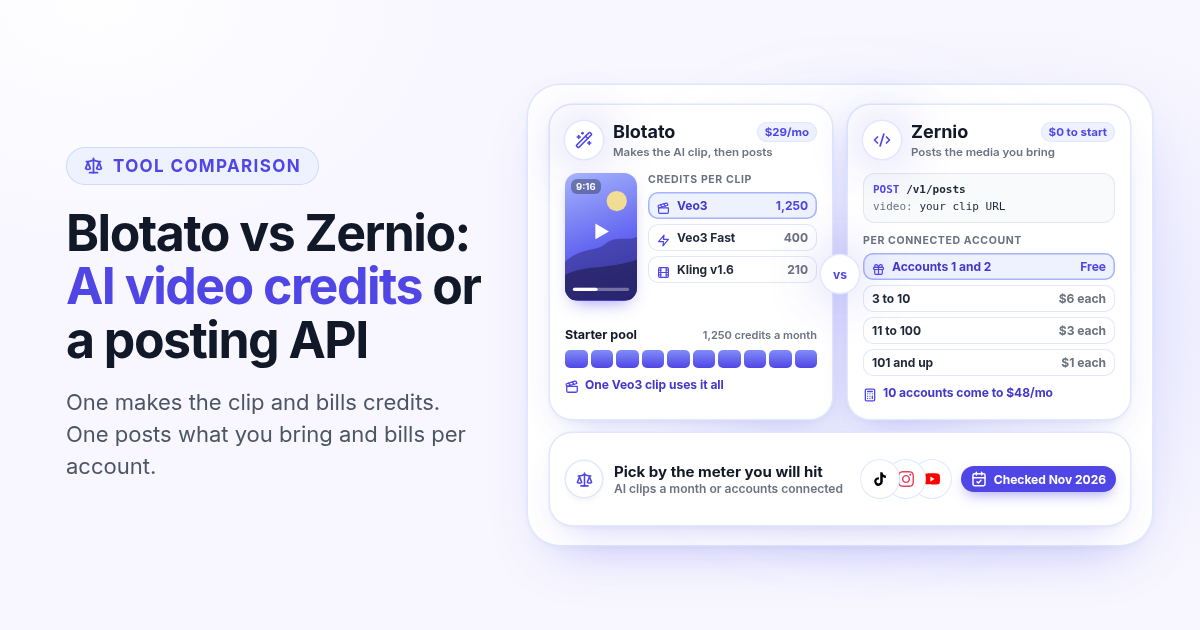
Blotato vs Zernio in 2026: AI video credits or a pay per account posting API
Blotato makes the AI clip and posts it, billed in credits. Zernio posts the media you bring, billed per connected account. Prices, free tiers, networks and AI video costs, checked 22 November 2026, plus how to pick in one afternoon.
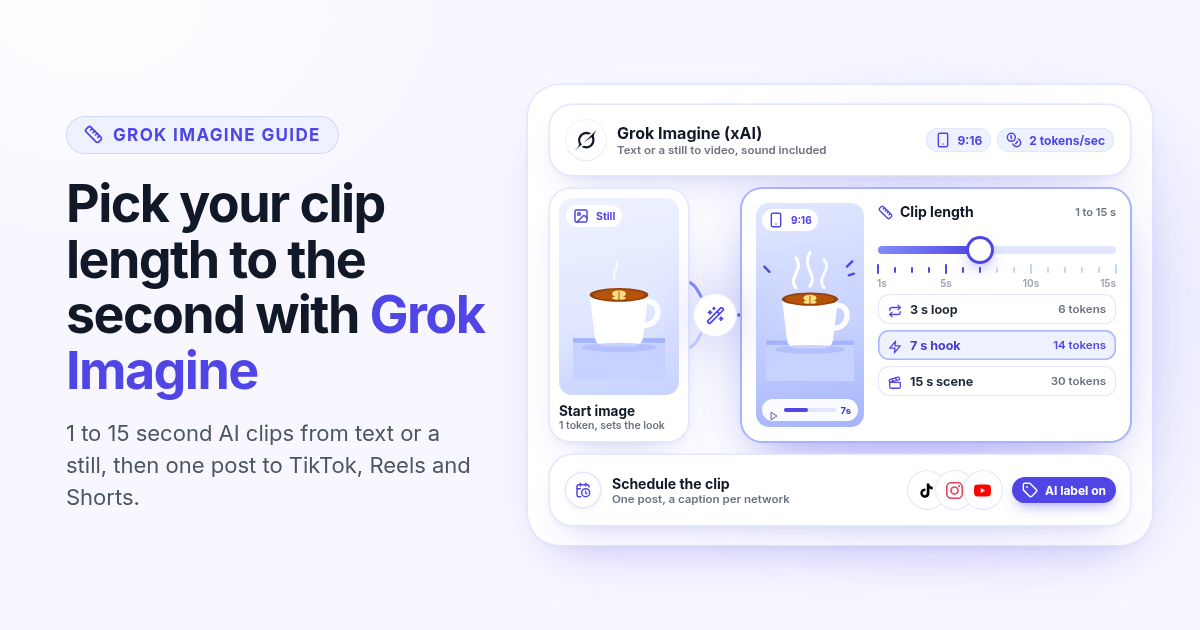
Grok Imagine video guide: make 1 to 15 second AI clips for 2 tokens a second, then post them to TikTok, Reels, and Shorts
Grok Imagine from xAI lets you pick any clip length from 1 to 15 seconds. How to prompt it from text or a still, what it costs per second in Postlaty, and how to schedule the clip to TikTok, Reels and Shorts in one post.
Veo 3.1 talking video guide: write dialogue that lip syncs, then post it to TikTok, Reels, and Shorts
Veo 3.1 from Google makes the picture and the voice in one pass. How to write a line it actually says, how long that line can be in 4, 6 or 8 seconds, what it costs per second in Postlaty, and how to schedule the talking clip in one post.
How to schedule Bluesky posts with images in 2026, including AI images made for the feed
Bluesky still has no schedule button. How to queue Bluesky posts with up to four native images, make those images with AI at the right ratio, keep each file under 2 MB, and write 300 characters that double as alt text.
Kling Motion Control guide: copy a dance or gesture onto your own character for TikTok, Reels, and Shorts
Kling Motion Control takes the movement from a real video and puts it on your character. How to pick a reference clip that transfers cleanly, what to write in the prompt, what it costs per second in Postlaty, and how to schedule the clip in one post.
Kling 4 AI video guide: camera moves, start and end frames, and 30 second clips for TikTok, Reels, and Shorts
Kling 4 from Kuaishou is built around camera control and makes up to 30 seconds in one take. How to write camera moves it follows, how to lock a product reveal with a start and end frame, what it costs per second in Postlaty, and how to schedule the clip in one post.
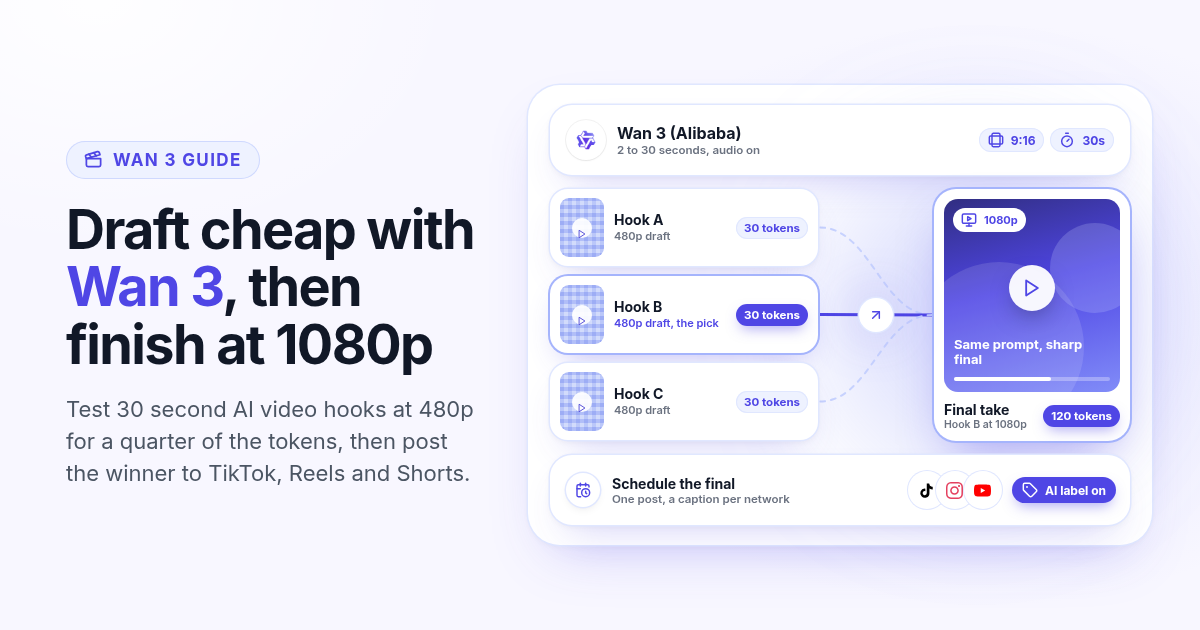
Wan 3 AI video guide: draft 30 second clips at 480p, finish at 1080p, and post them to TikTok, Reels, and Shorts
Wan 3 from Alibaba makes up to 30 seconds of video in one take, and in Postlaty a 480p draft costs a quarter of the same clip at 1080p. What the model is, what it costs per second, how to prompt it, and the draft then finish routine that ends in one scheduled post.
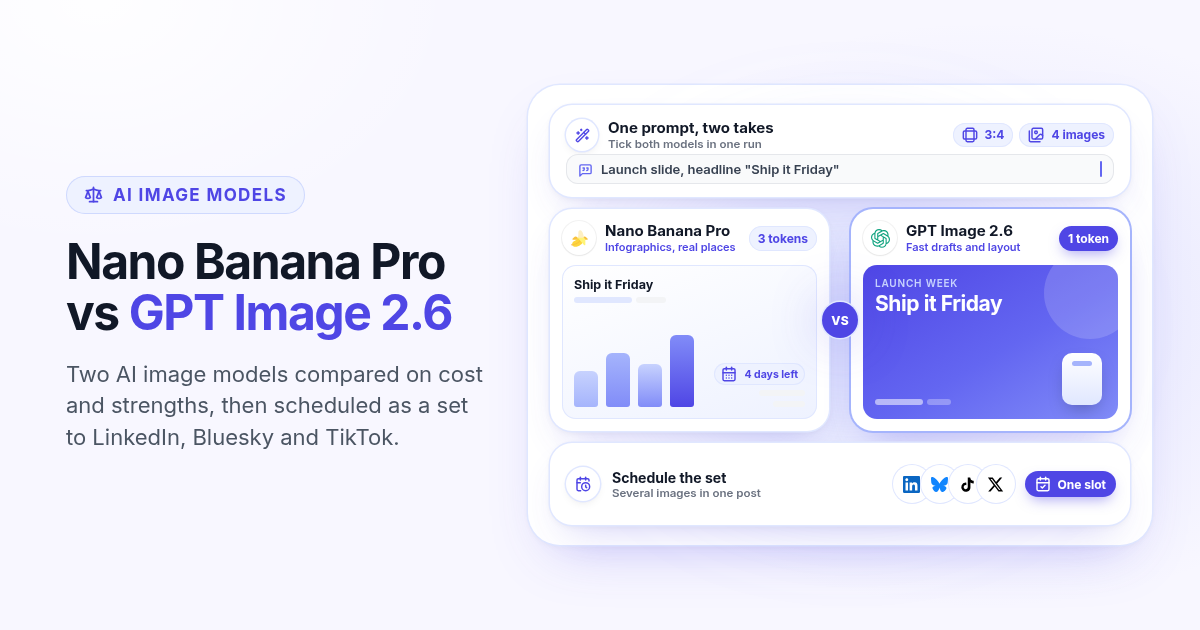
Nano Banana Pro vs GPT Image 2.6: which AI image model to use for pins, LinkedIn posts, and TikTok photo posts
GPT Image 2.6 from OpenAI launched on 4 November and is now tested everywhere against Nano Banana Pro from Google. How the two compare on what they are built for, token cost per image and editing, which one fits which post, and how to test both on one prompt and schedule the winner.
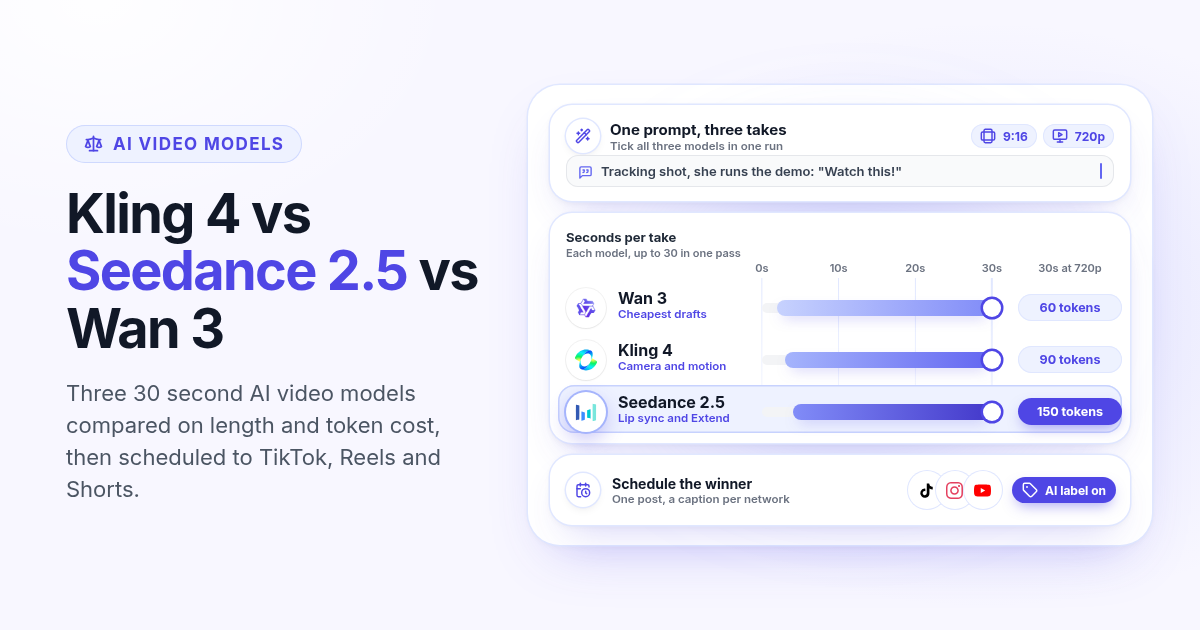
Kling 4 vs Seedance 2.5 vs Wan 3: which 30 second AI video model to use for TikTok, Reels, and Shorts
Kling 4, Seedance 2.5 and Wan 3 all make up to 30 seconds of video in one take. How they compare on length, resolution and token cost per second, which one fits which job, and how to test all three on one prompt and schedule the winner.
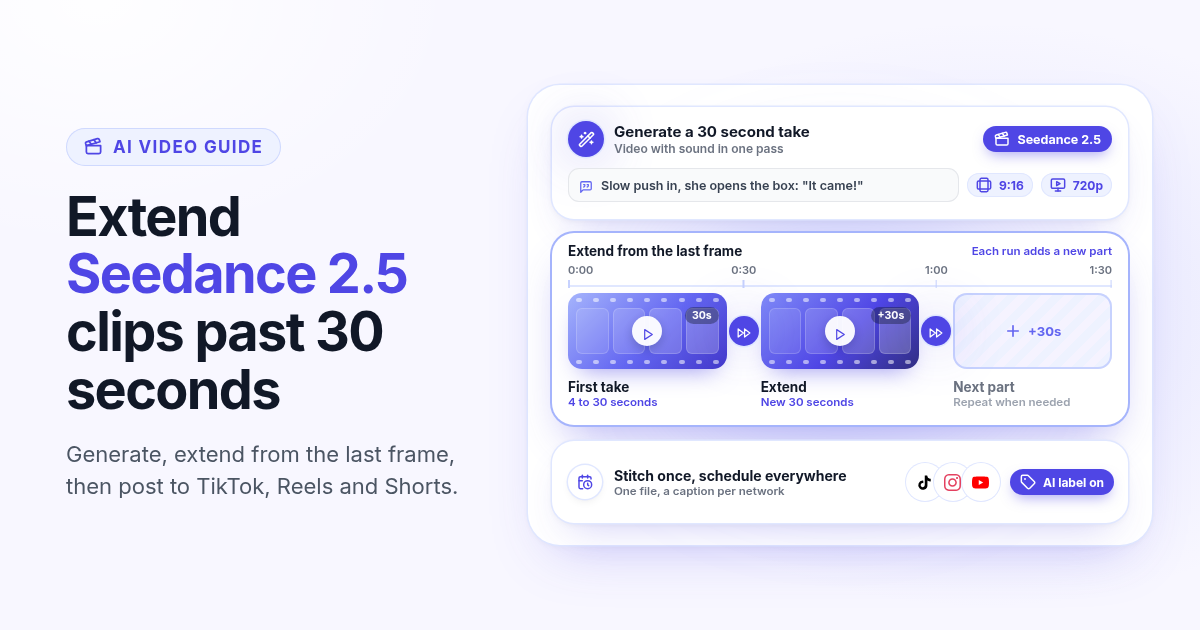
Seedance 2.5 AI video: how to extend clips past 30 seconds and post them to TikTok, Reels, and Shorts
Seedance 2.5 makes up to 30 seconds of video with sound in one take, and Extend continues it from the last frame. How to generate and extend a clip in Postlaty, what each second costs in tokens, and how to schedule it to TikTok, Reels and Shorts.
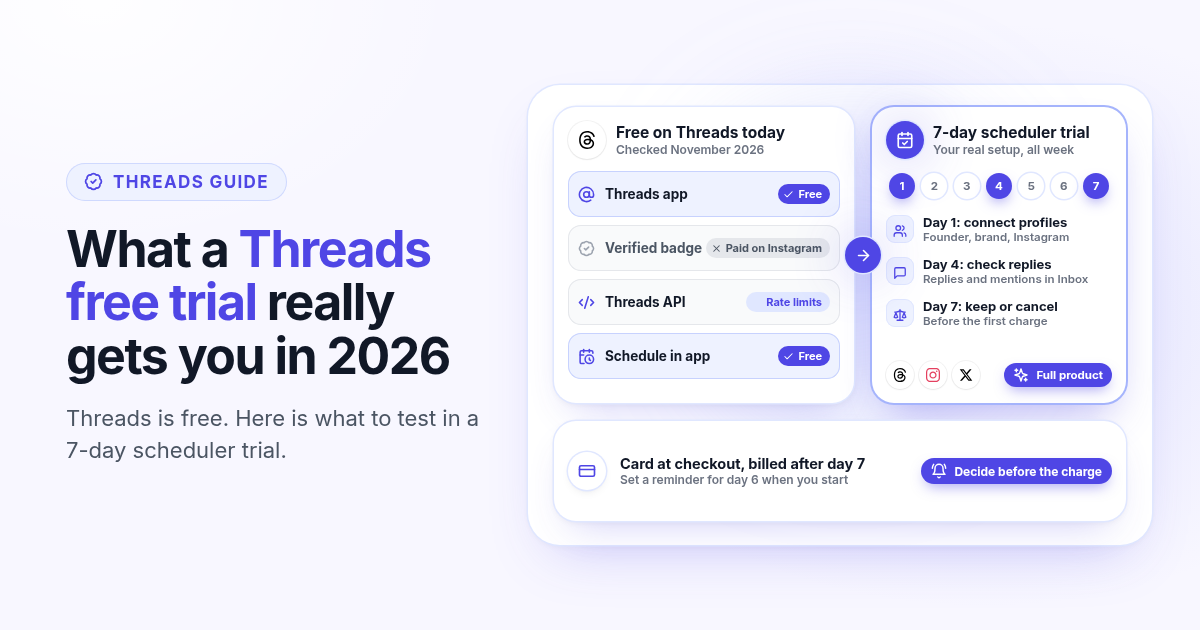
Threads free trial in 2026: what is free on Threads, and how to test a scheduler in 7 days
Threads has no paid plan, so there is no Threads free trial to start. Here is what a free Threads account already does, what the badge and the Threads API cost, and how to use a 7-day scheduler trial so you know by day 7 if a tool is worth paying for.
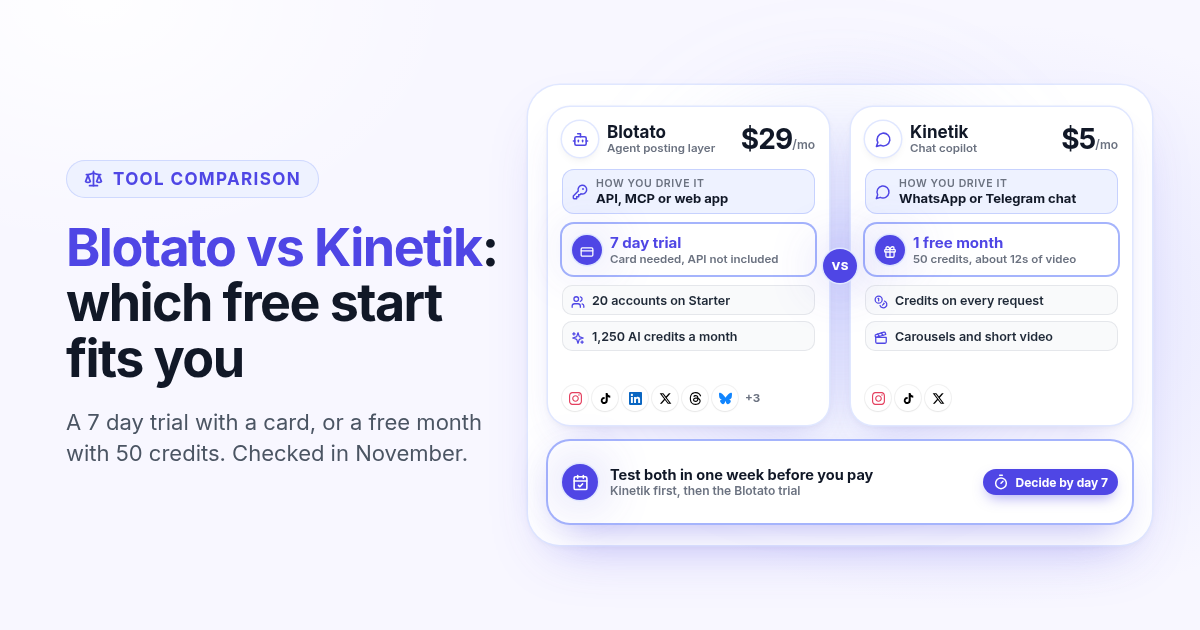
Blotato vs Kinetik in 2026: free trial, credits, and which AI social tool to test first
Blotato gives a 7-day trial with a card but no API, Kinetik gives a free month with 50 credits. Prices, credits, networks and how you drive each tool, checked November 2026, plus a one week test plan before you pay.
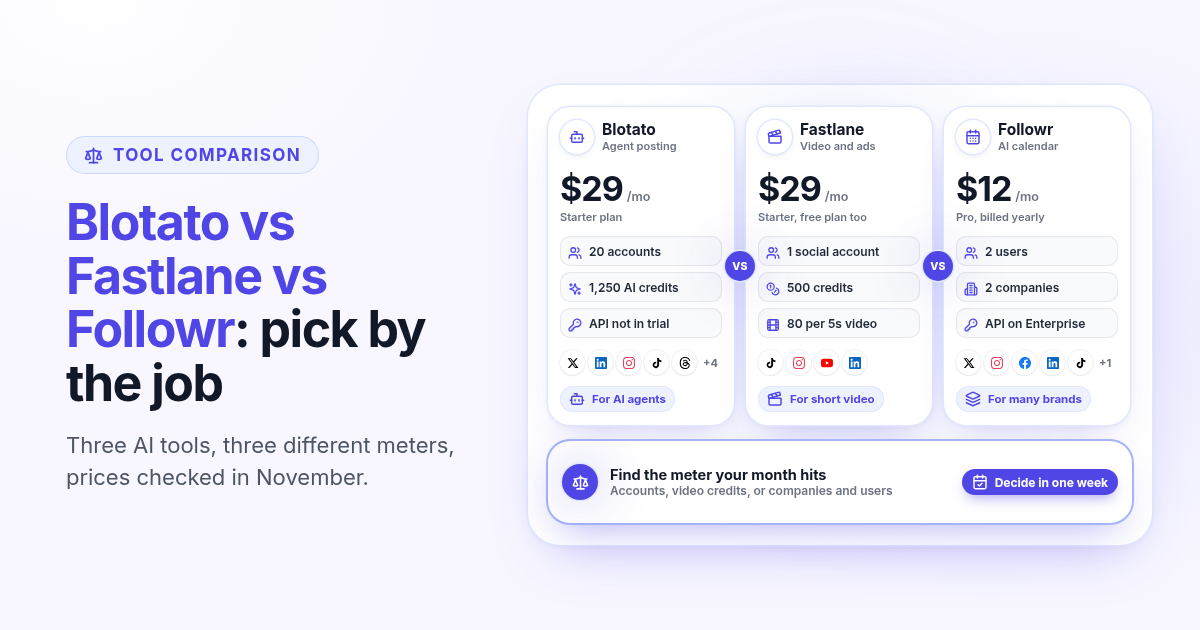
Blotato vs Fastlane vs Followr in 2026: which AI social media tool fits your job
Blotato, Fastlane and Followr all start cheap but meter different things: accounts and AI credits, video credits, or companies and users. Prices, networks and trials side by side, checked November 2026, and how to pick the right one in a week.
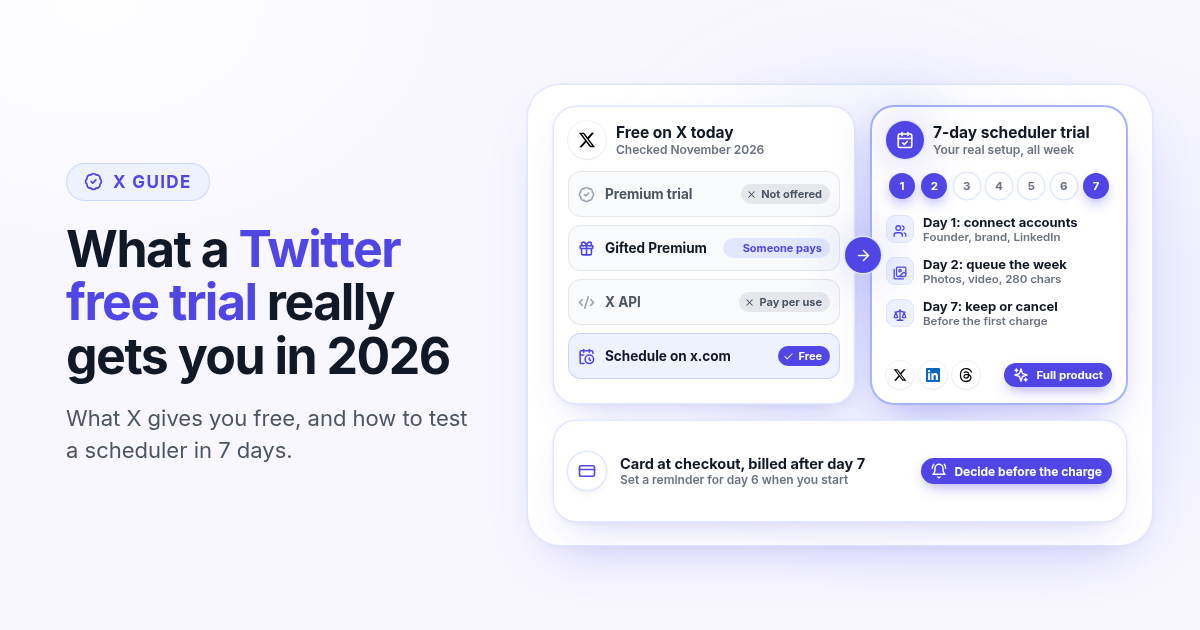
Twitter free trial in 2026: what X gives you for free, and how to test a scheduler in 7 days
X lists no free trial for Premium or The X Subscription, and the X API has no free plan for new developers. Here is what a free X account already does, what the API costs, and how to use a 7-day scheduler trial so you know by day 7 if it is worth paying for.
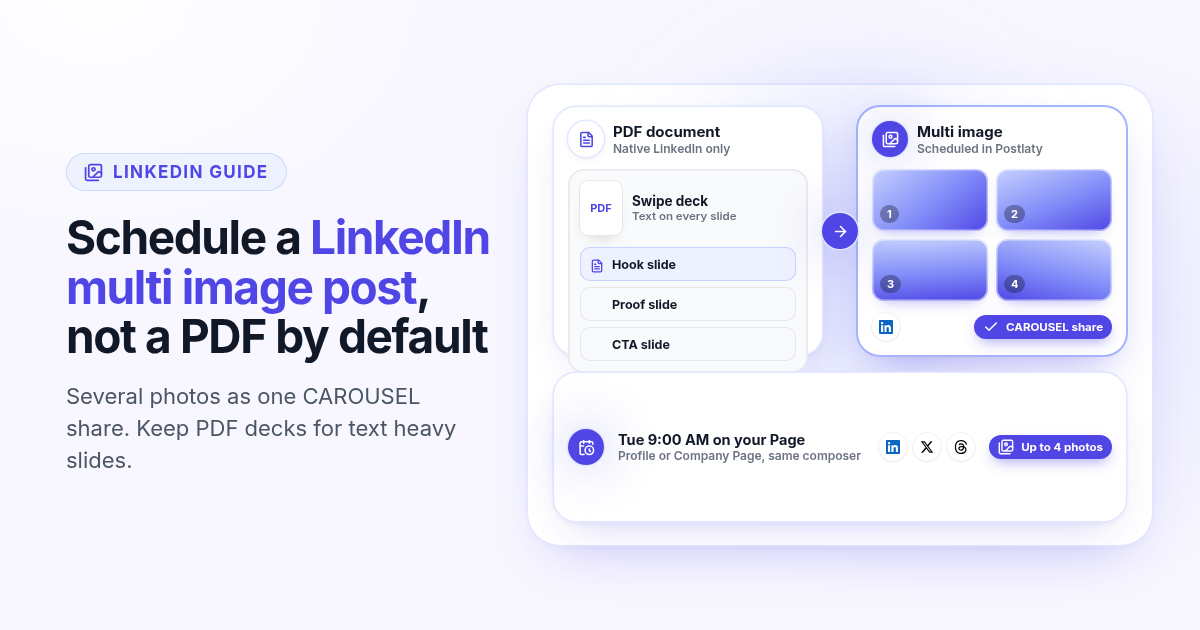
How to schedule a LinkedIn multi image post (and when a PDF carousel is better)
LinkedIn carousels usually mean a PDF. A multi image post is different: several photos as one share, including on a Company Page that cannot schedule multi photo posts natively. Here is how to queue the photo set in Postlaty, and when to stay with a document carousel.
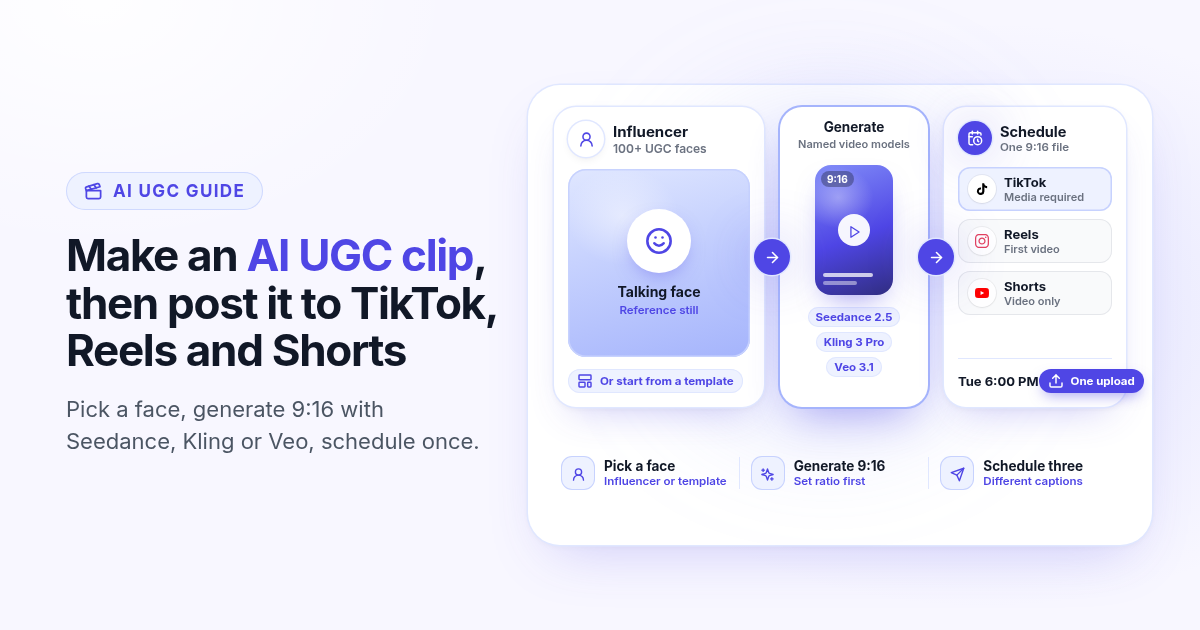
How to make an AI UGC clip and post it to TikTok, Reels, and Shorts
Pick a UGC influencer or template, generate a 9:16 talking clip with Seedance, Kling, Veo, or Grok Imagine, then schedule the same file to TikTok, Instagram Reels, and YouTube Shorts from one Postlaty post.
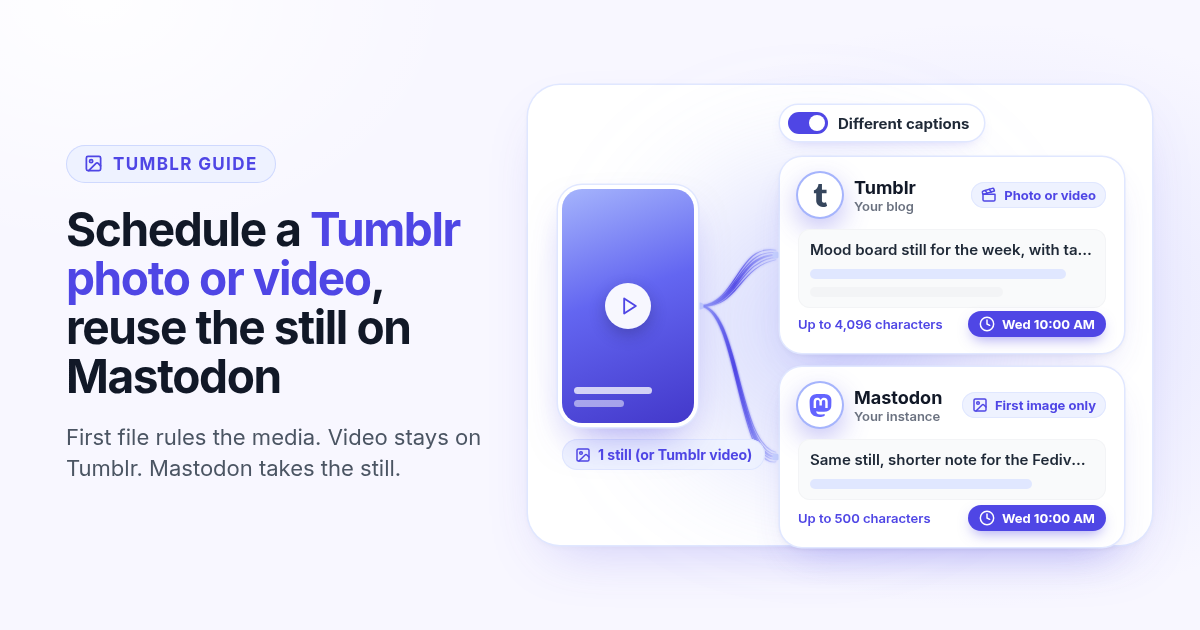
How to schedule a Tumblr photo or video (and reuse it on Mastodon)
Tumblr takes text plus the first image or video. Mastodon in Postlaty takes the first image and skips video. Connect both, attach one file, write two captions, and schedule the pair so the video stays on Tumblr only.
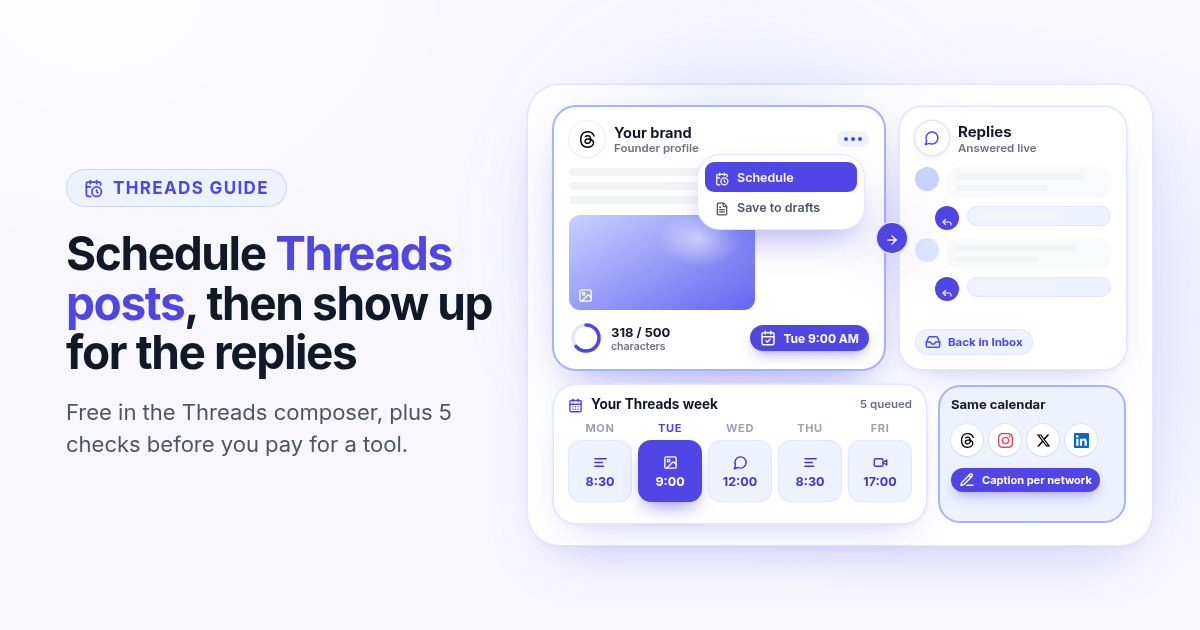
Threads scheduler in 2026: how to schedule Threads posts for free, and when a tool is worth it
Threads has a free scheduler in the composer three dot menu. How to use it step by step, where it stops (one profile, no week view, Threads only), five checks to run on any Threads scheduling tool, and a weekly routine built around replies.
Twitter scheduler in 2026: how to schedule X posts for free, and 5 checks before you pay
X still has a free scheduler: the calendar icon in the x.com composer. How to use it step by step, where it stops (one account, no week view, no long posts on the web), and five checks to run on any paid Twitter scheduler during the trial.
How to schedule LinkedIn posts for free in 2026 (and when a paid tool is worth it)
LinkedIn's own scheduler is free: profile posts from 10 minutes to 3 months ahead, Company Page posts from 1 hour. How to use it step by step, what it cannot schedule, and five signs a paid LinkedIn scheduler is worth it.
TikTok scheduler apps in 2026: 7 checks before you trust one with your videos
What TikTok Studio already schedules for free, and seven checks to run on any TikTok scheduler app during the trial: direct posting, public visibility, TikTok settings, photo posts, editing, multiple accounts and cross posting.
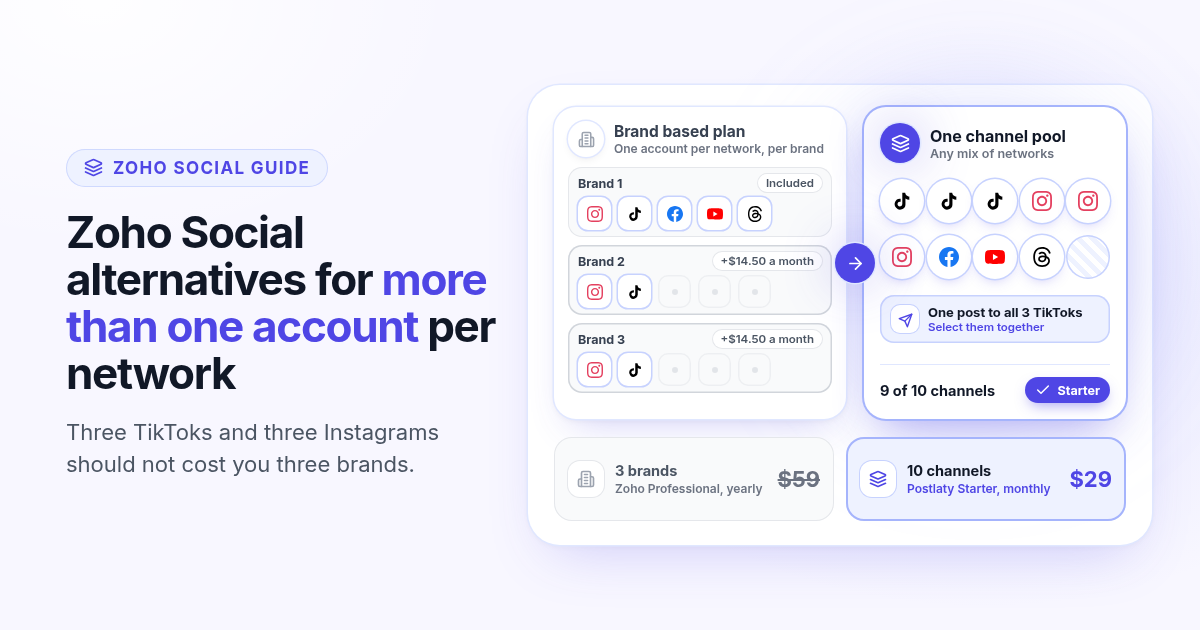
Zoho Social alternatives in 2026: when you run more than one account per network
Zoho Social prices by brand, and a brand holds one account per network. How Zoho Social pricing works in 2026, what three TikToks and three Instagrams really cost, and what to look for in an alternative priced by channels.
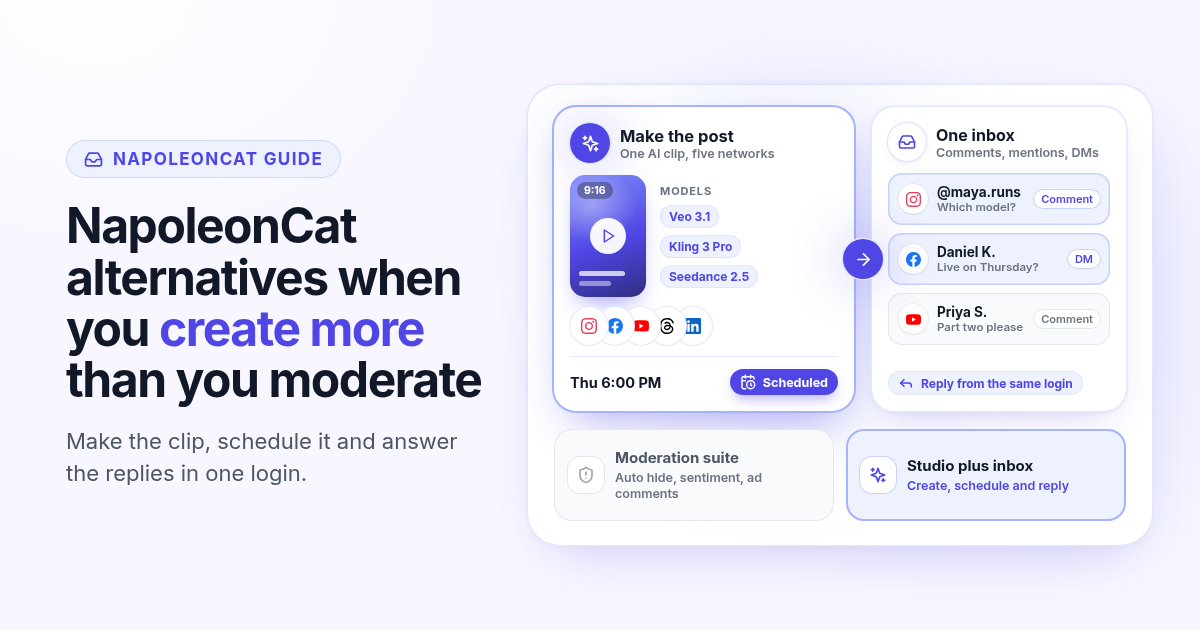
NapoleonCat alternatives in 2026: when you create more than you moderate
NapoleonCat is a strong moderation and inbox suite priced by users and profiles. If you spend more time making posts than moderating comments, here is what its 2026 pricing covers and what to look for in an alternative.
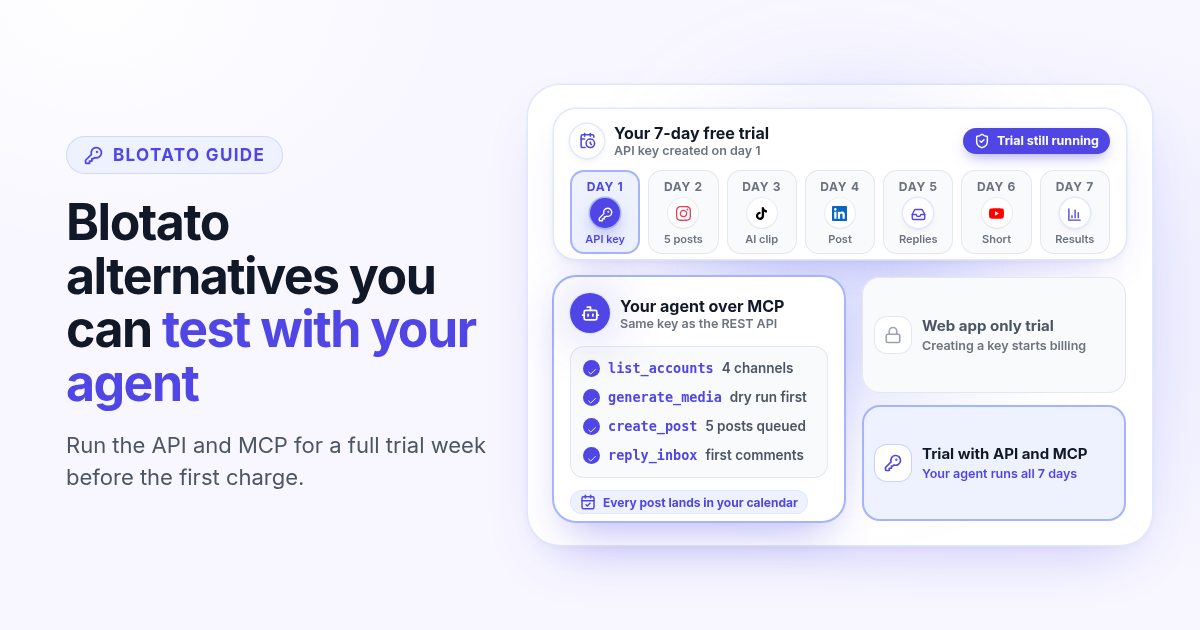
Blotato alternatives in 2026: when you want to test the API before you pay
Blotato starts at $29 a month for 20 accounts, but its free trial leaves out the API and MCP. How Blotato pricing works in 2026, why creating an API key ends the trial, and what to test in an alternative when an agent posts for you.
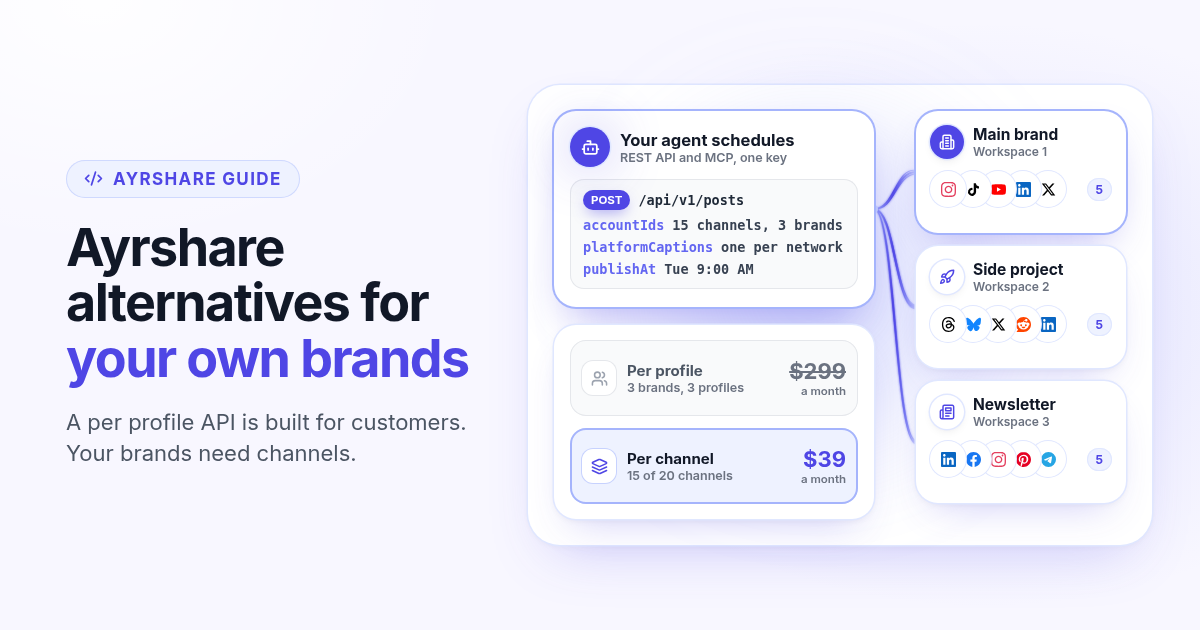
Ayrshare alternatives in 2026: when you post for your own brands, not customers
Ayrshare is a social media API billed per profile, from $149 a month for one. How Ayrshare pricing works in 2026, why profiles and channels lead to very different bills when the brands are yours, and what to test in an alternative with API and MCP on every plan.
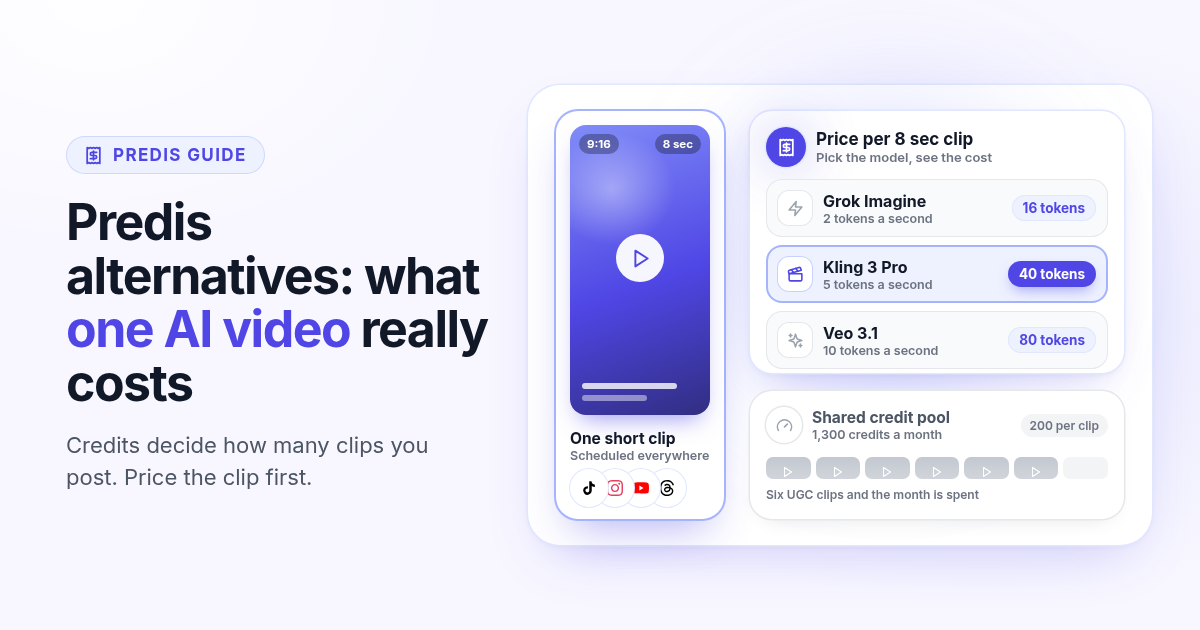
Predis alternatives in 2026: what one AI video really costs you
Predis.ai starts at $19 a month billed yearly, but credits decide how many AI videos you get. How Predis pricing works in 2026, what one clip costs on each plan, and how to price a real week of video in an alternative before you switch.
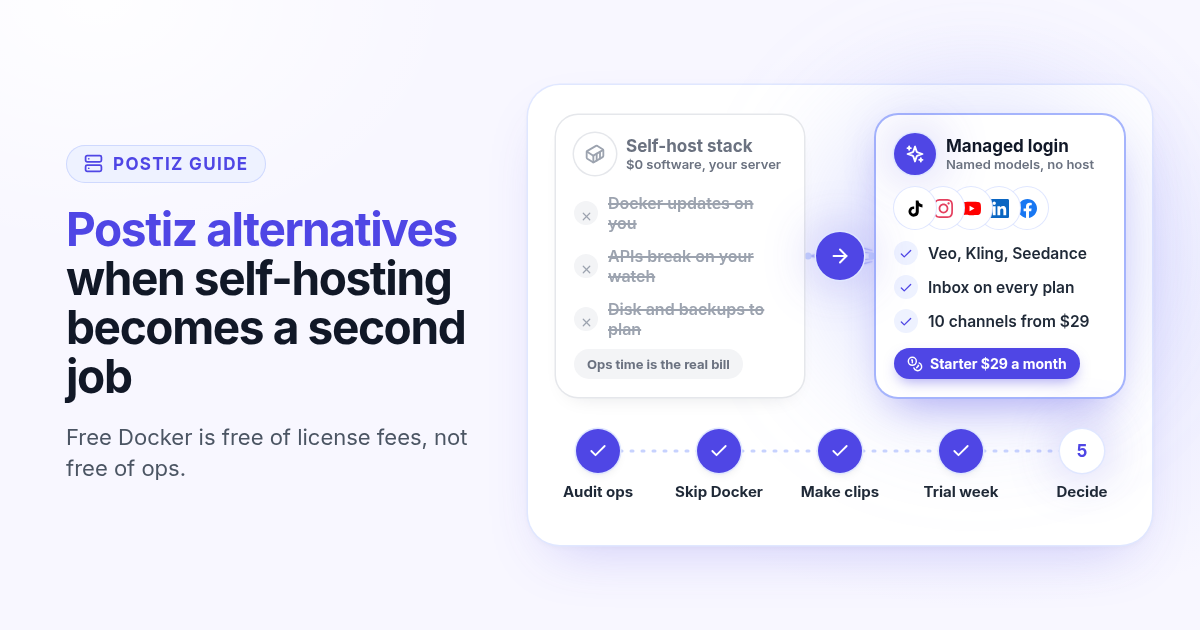
Postiz alternatives in 2026: when self-hosting becomes a second job
Postiz is a strong open-source scheduler with a free Docker install and hosted plans from $29. How Postiz pricing works in 2026, when self-hosting costs more than the bill, and what to test in a managed alternative with named AI video and inbox on the first plan.
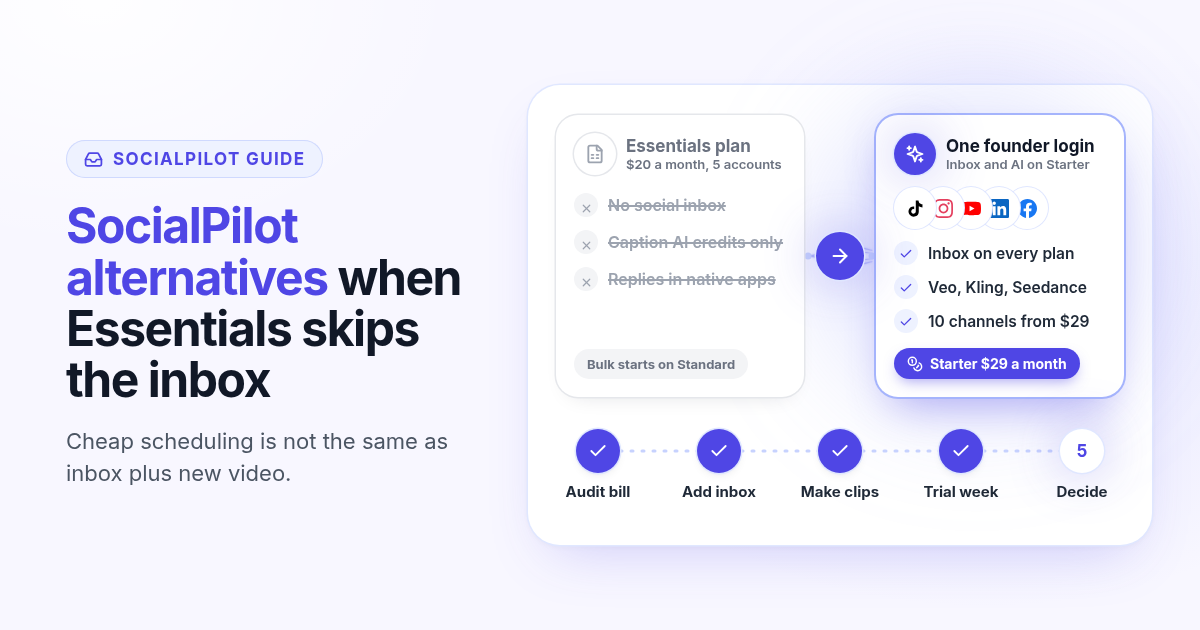
SocialPilot alternatives in 2026: when the cheap plan skips the inbox
SocialPilot Essentials is $20 a month for 5 accounts, but the inbox starts on Standard at $40. How SocialPilot pricing works in 2026, when bulk scheduling is enough, and what to test in an alternative that includes inbox and AI video on the first plan.
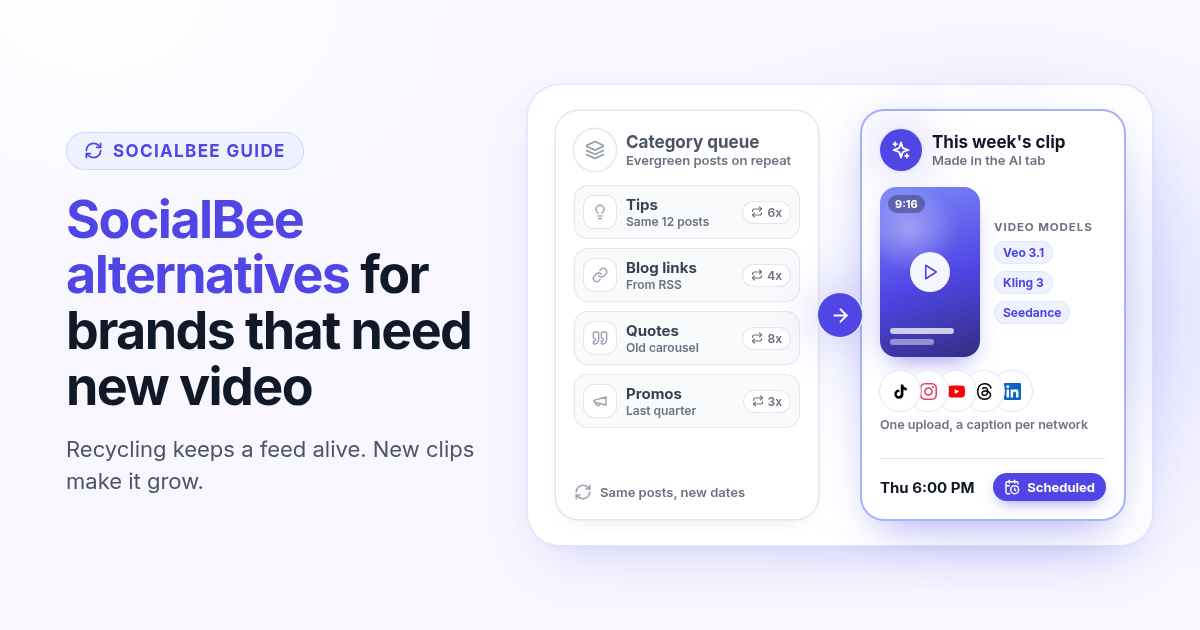
SocialBee alternatives in 2026: when recycled posts stop growing your accounts
SocialBee recycles evergreen posts by category, which keeps a feed active but rarely grows it on TikTok, Reels and Shorts. How SocialBee pricing works in 2026, how to audit your queue, and what to test in an alternative that makes new video.
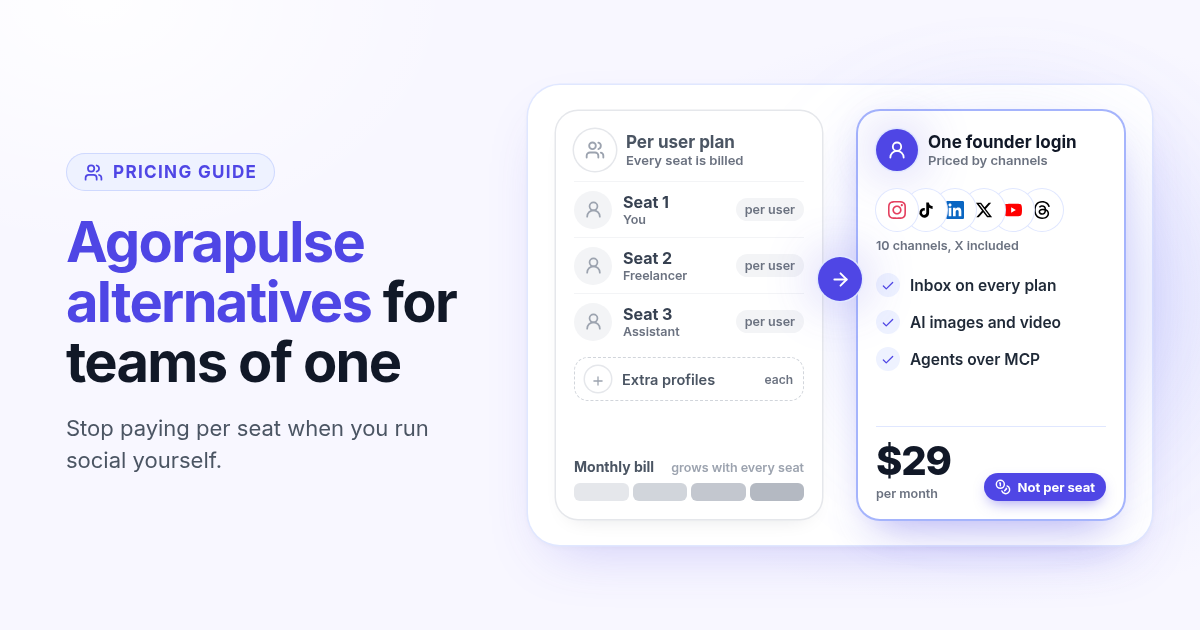
Agorapulse alternatives in 2026: when you pay per seat but post alone
Agorapulse prices every plan per user, which suits social teams more than founders. See how its pricing works in 2026, check which features you really use, and know what to test in any Agorapulse alternative before you switch.
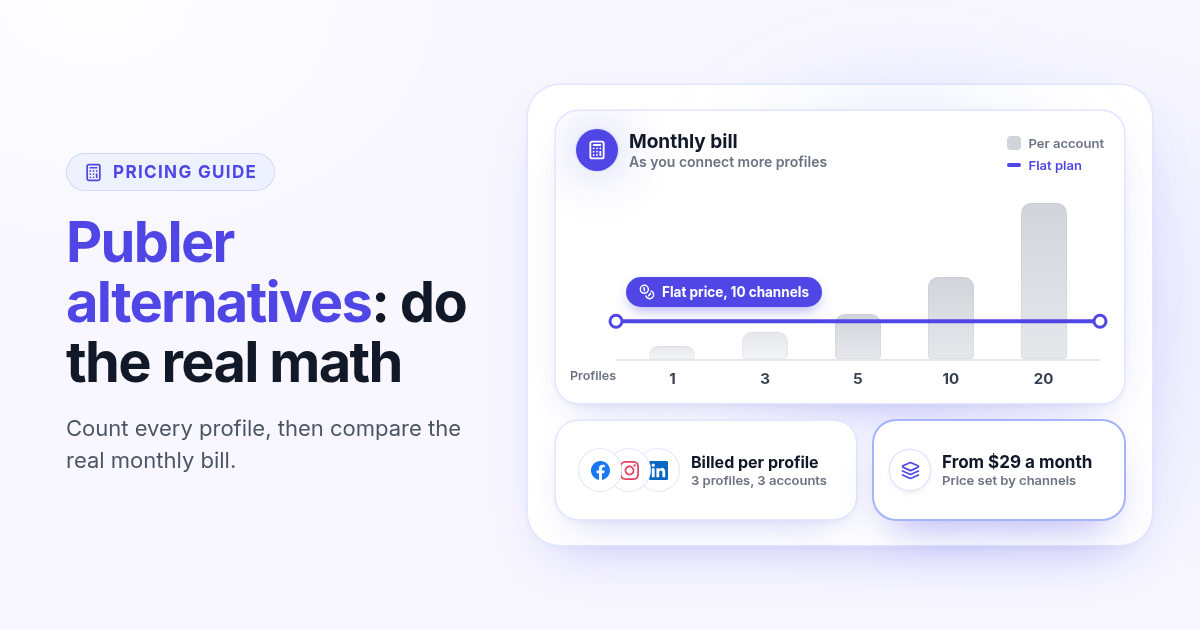
Publer alternatives in 2026: when per account pricing stops paying off
Publer bills per social account, so the price climbs with every Page and profile. Count what you really pay, spot the five signs you have outgrown it, and know what to test in any Publer alternative before you switch.
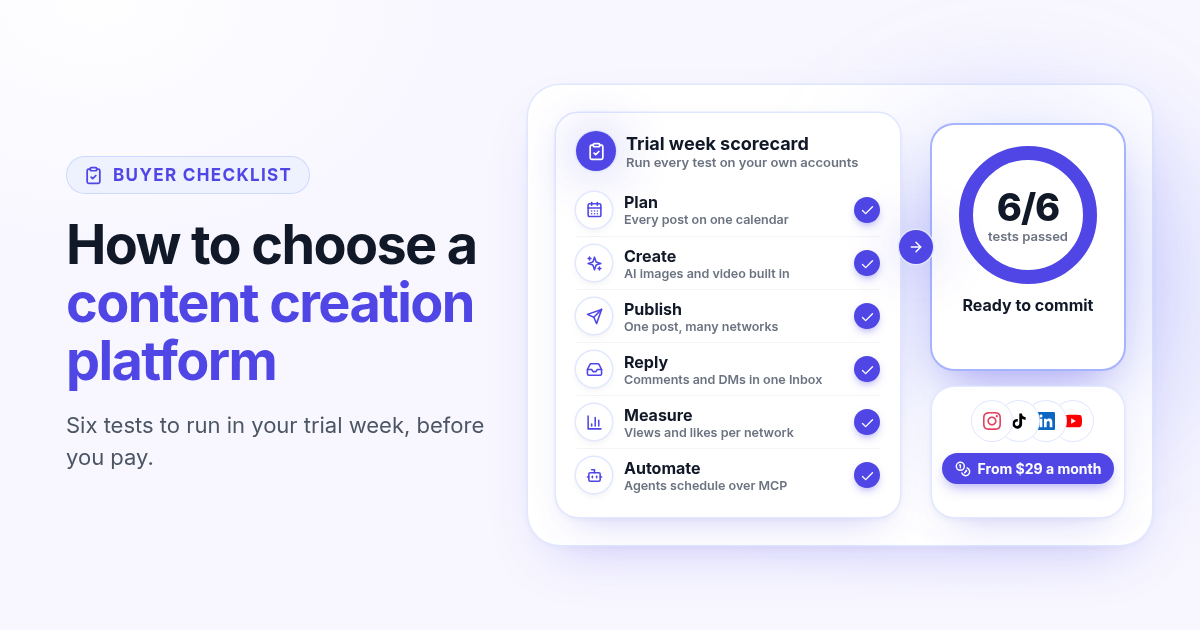
How to choose a content creation platform: 6 tests to run before you pay
A founder checklist for picking a content creation platform: add up the stack you pay for, then use a 7-day trial to test planning, AI images and video, publishing to every network, one Inbox for replies, per network numbers and AI agents.
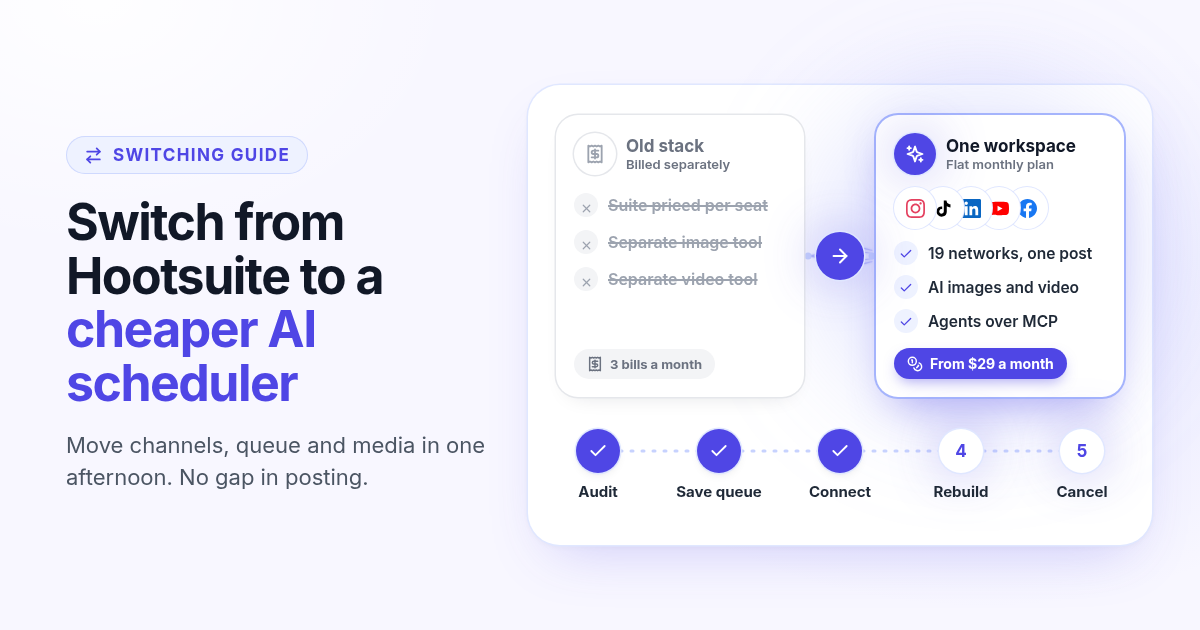
How to switch from Hootsuite to a cheaper AI scheduler in one afternoon
A step by step plan to leave Hootsuite without a gap in posting: audit what you use, save your queue and media, connect your channels, rebuild two weeks of posts, add AI images, video and agents, then cancel before renewal.
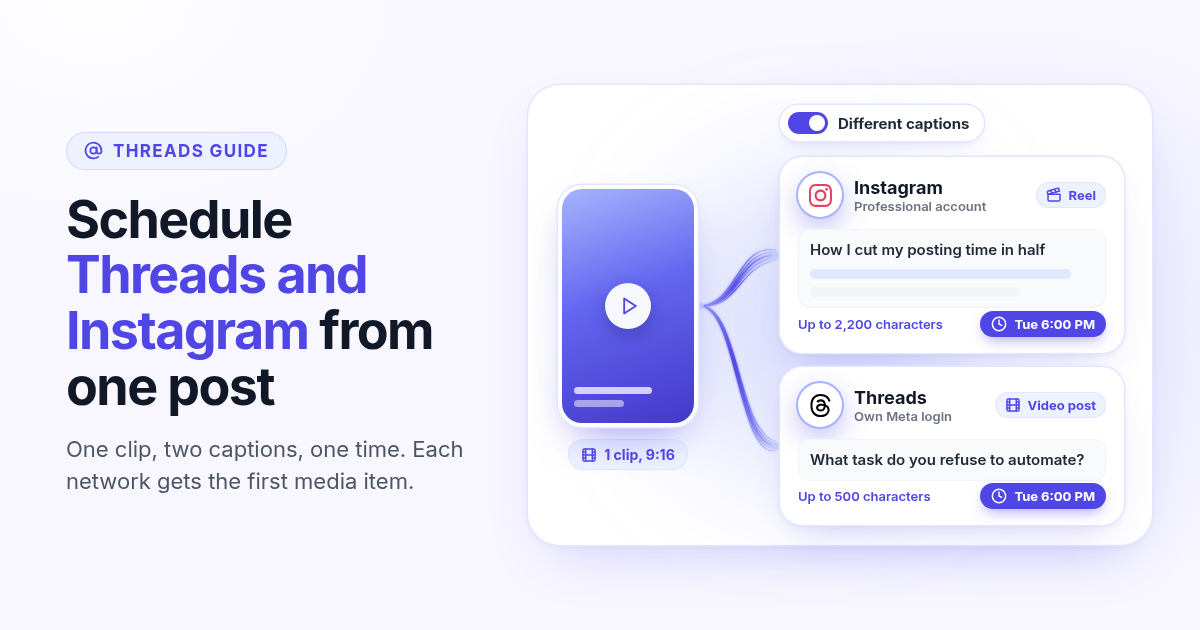
How to schedule Threads and Instagram together from one post
Schedule a Reel or photo to Instagram and Threads at the same time from one post. Connect both Meta accounts, attach one file, write a long Instagram caption and a short Threads caption, and pick one time.
How to make a Pinterest pin with AI and schedule it to a board
Generate a Pinterest pin image with Recraft, Flux, or Nanobanana, pick a Business board at connect, and schedule the pin from Create. Image required. Optionally reuse the still on Instagram.
How to schedule a Dev.to article and the posts that point to it
Schedule a Dev.to article and the short X, LinkedIn, or Bluesky posts that point to it from one queue. Connect with an API key, write the title and body, then ship pointers instead of pasting the markdown.
How to schedule a Discord announcement and the public post together
Schedule a Discord announcement and the matching Instagram and X post from one queue. Add the bot to your server, pick the channel, send text to Discord and the visual to the public networks.
How to cross-post to Bluesky and Mastodon (and where video fails)
Cross-post Bluesky and Mastodon from one composer. Connect with an app password and a server token, share one still, and know why a Bluesky video will not publish as Mastodon video.
How to schedule Telegram channel posts as yourself (not as a bot)
Native Telegram schedule works for one message. Most tools post as a BotFather bot. Here is how to connect with your phone, pick a chat, and schedule posts as yourself with Postlaty.
How to schedule Pixelfed posts (a photo is required)
Pixelfed is photo-first and has no real content calendar. Here is how to connect any server with an access token, attach a photo, and schedule posts ahead with Postlaty.
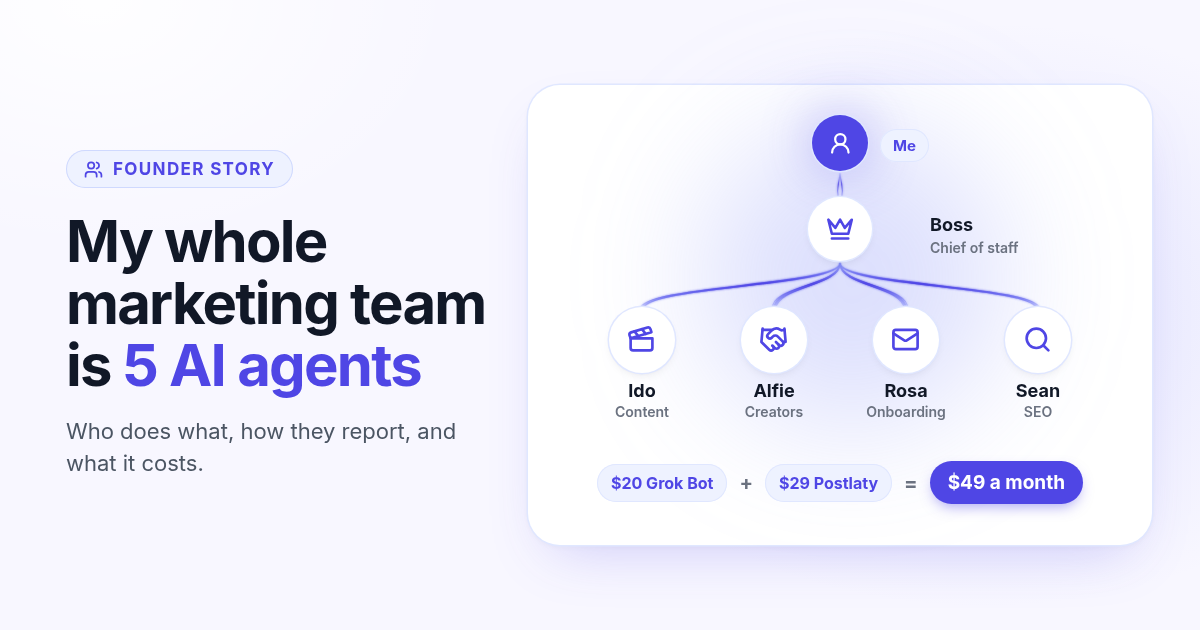
How I run my whole marketing team with AI agents for $49 a month
I am a solo founder. My marketing team is five AI agents that post, reach out, email, and write, then report to me daily. Here is who does what and what it costs.
How to schedule Whop posts to your community forum
Whop forums publish when you press Post. Here is how to schedule Whop posts ahead with a company API key, what to write, and how replies reach your inbox.
How to post the same short video to TikTok, Instagram Reels, and YouTube Shorts
One 9:16 file can feed TikTok, Reels, and Shorts. This guide covers aspect ratio, captions, covers, and a publish path that does not recrop three times.